
Best Health Screening Tools for Rural Clinics Without Equipment
A procurement-focused comparison of contactless vitals rural healthcare options for clinics without cuffs, oximeters, or reliable power across Sub-Saharan Africa.
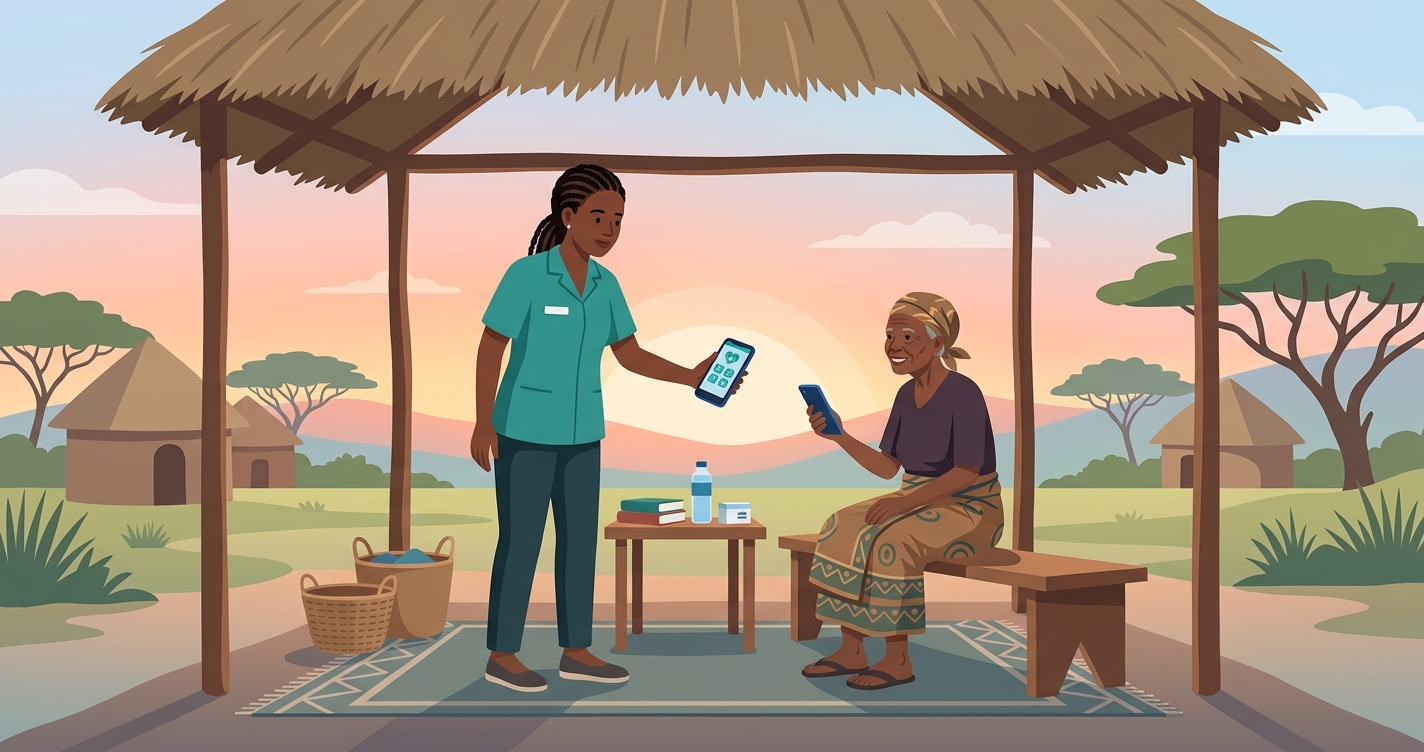
Procurement teams evaluating screening capacity for remote clinics keep running into the same wall: the standard shopping list assumes a building with power, a supply chain for consumables, and a technician who can repair a broken cuff. In much of rural Sub-Saharan Africa, none of those assumptions hold. This is why the conversation around contactless vitals rural healthcare has shifted from a novelty discussion to a serious line item in health ministry budgets. The question is no longer whether equipment-free screening can work, but which approach delivers reliable triage data at the lowest total cost of ownership when there is no socket on the wall.
"Only 28 to 34 percent of health facilities across Sub-Saharan Africa have access to reliable electricity, and the WHO projects a health workforce shortage of 5.85 million in the African Region by 2030." - World Health Organization, 2025
That combination of no power and no staff is the operating reality for thousands of facilities. It reframes the entire procurement exercise. A device that needs charging, calibration, replacement cuffs, and a trained operator is not a solution in a clinic that has none of those things. The most useful screening tool is the one that survives the conditions, not the one with the best lab specification.
Why contactless vitals rural healthcare changes the procurement math
Traditional screening hardware fails in remote settings for predictable reasons. Blood pressure cuffs drift out of calibration and tear. Pulse oximeters need charging and probe replacement. Both depend on a working consumables pipeline that rarely reaches the last mile. Research on medical equipment in the global south has documented that as much as 70 percent of donated medical equipment in Sub-Saharan Africa is never used effectively, largely because of missing technical support and inadequate operator training (PMC, medical equipment sustainability review). A procurement decision that ignores this failure rate is buying a warehouse of dead inventory.
Contactless and equipment-free approaches attack the problem from a different angle. Instead of distributing dedicated hardware to every site, they convert a device a community health worker already carries, a smartphone, into the screening instrument. Remote photoplethysmography (rPPG) uses the phone camera to detect the small color changes in skin caused by blood flow, producing estimates of heart rate, respiratory rate, and in some implementations oxygen saturation and blood pressure indicators. No cuff, no probe, no consumable.
For a ministry buyer, the relevant comparison is not feature by feature. It is which model keeps producing usable triage data after eighteen months in the field.
| Screening approach | Power required | Consumables | Operator training | Failure mode in the field | Cost per additional site |
|---|---|---|---|---|---|
| Manual (palpation, counting, observation) | None | None | Moderate to high | Inconsistent between workers, no record | Very low |
| Imported electronic cuff + oximeter | Charging needed | Cuffs, probes, batteries | Moderate | Calibration drift, broken parts, dead stock | High |
| Solar-powered device kit | Solar panel upkeep | Some | High | Panel theft, battery degradation | High |
| Smartphone rPPG (contactless) | Phone charging only | None | Low | Depends on lighting and motion control | Very low |
The bottom row is where the procurement logic tends to land. Once a workforce has phones, the marginal cost of adding another screening site approaches the cost of the software license, not a new hardware shipment.
Key factors buyers weigh during evaluation:
- Total cost of ownership across three to five years, not the sticker price of a single unit.
- Dependence on consumables that must cross a fragile supply chain.
- Training burden on community health workers who may rotate frequently.
- Data capture, since a reading that is not recorded cannot inform referral decisions or policy.
- Resilience to power gaps, theft, dust, heat, and humidity.
Industry applications for equipment-free clinics
Community outreach and door-to-door campaigns
Door-to-door screening cannot carry a cart of electronics. A community health worker walking between homesteads needs a tool that fits in a pocket and works without a clinic. Smartphone-based screening fits this workflow because the same device handles registration, the vital signs measurement, and the referral note. This is the model behind smartphone-based deployments in Uganda, where vital signs without devices is the only practical option for households hours from a facility.
High-volume events and mass campaigns
Immunization drives, refugee intake, and outbreak response generate queues of hundreds or thousands per day. A no-cuff blood pressure check and a contactless heart rate reading take seconds and require no cleaning between patients, which removes a major throughput bottleneck. The screening becomes a triage filter that flags who needs a clinician, rather than a diagnostic endpoint.
Fixed clinics without reliable power
Even permanent facilities often run on intermittent power. A screening method that needs only a charged phone, which can be topped up from a small solar bank or a market charging stall, keeps a clinic functional through outages that would idle electronic cuffs and oximeters.
Current research and evidence
The evidence base for camera-based vital signs has grown quickly. Validation work on the OptiBP smartphone application, assessed against the AAMI/ESH/ISO universal validation protocol (published in PMC), examined whether a phone camera could estimate blood pressure across diverse populations, including rural cohorts in low- and middle-income countries. A separate multi-country study coordinated with WHO-linked researchers tested the same class of application across varied settings and reported accurate readings in most cases, while flagging that performance depends on testing across different skin tones and field conditions.
In 2024, a University of Pittsburgh research team introduced a smartphone application that estimates pulse pressure without a cuff, explicitly targeting underserved communities where hypertension screening is otherwise unavailable. Reviews of rPPG for health assessment consistently report that heart rate and oxygen saturation estimates reach high agreement with reference devices, while blood pressure estimation remains more variable and is best framed as screening rather than diagnosis.
The practical reading of this literature for a procurement team is straightforward:
- Contactless heart rate and respiratory rate are well supported for triage.
- Oxygen saturation estimates are promising and improving.
- Blood pressure from a camera is useful as a screening flag, not a clinical diagnosis, and should route flagged patients to confirmation.
This matches how triage is supposed to work in a tiered health system. The goal at the community level is to identify who needs to move up the referral chain, not to replace the work of a district hospital.
The future of contactless vitals rural healthcare
Three trends will shape the next procurement cycles. First, model accuracy across skin tones and lighting is improving as training datasets become more representative of African populations, which directly addresses the main weakness reviewers have raised. Second, offline functionality is becoming standard, so a reading taken in a village with no signal syncs later when the phone reaches connectivity, which matters where 28 to 34 percent electricity access tells you what connectivity looks like too. Third, screening data is being designed to flow upward into national health information systems, turning millions of individual checks into population surveillance that can guide where ministries deploy scarce clinicians.
The McKinsey analysis of the regional health workforce paradox, alongside the 2025 WHO finding that an estimated 943,000 trained health workers in Africa were unemployed in 2024 even as systems remain understaffed, points to the same conclusion. The constraint is rarely raw willingness. It is the cost and logistics of putting capable people and usable tools in the right places. Equipment-free screening lowers both, which is why it keeps moving up procurement priority lists.
Frequently asked questions
Can contactless screening replace blood pressure cuffs entirely? Not for diagnosis. Camera-based blood pressure estimation is validated as a screening flag that identifies people who likely need a confirmatory measurement and clinical review. For heart rate and respiratory rate, the agreement with reference devices is strong enough for triage in most field conditions.
What does a clinic actually need to run equipment-free screening? A smartphone of reasonable specification, a way to keep it charged, and a trained community health worker who can follow the measurement protocol on lighting and stillness. There are no cuffs, probes, or consumables to resupply, which is the main procurement advantage.
How reliable is screening across different skin tones? This was an early limitation in the research, and reviewers continue to stress testing across diverse populations. Newer models trained on more representative datasets have narrowed the gap, and buyers should request field validation data from the specific population they serve.
Is this approach suitable for clinics with no electricity? Yes, which is much of its appeal. The only power requirement is keeping a phone charged, achievable with small solar banks or shared charging points, unlike electronic cuffs and oximeters that need regular mains or generator charging.
Circadify is working in this space, with smartphone-based vital signs screening already deployed in Uganda and field data gathered alongside community health programs. Procurement and program teams evaluating equipment-free options can review the partnership materials and field evidence in the global health section at circadify.com/blog.