How to Screen for High Blood Pressure in Rural Africa
How communities far from clinics can detect high blood pressure early using a smartphone instead of a cuff, addressing Africa's silent hypertension burden.
Hypertension is the leading preventable cause of stroke, heart failure, and premature death across Sub-Saharan Africa, yet most people who carry it have no idea. The condition produces no symptoms until an organ fails, which is why clinicians call it the silent killer. The practical problem for any program trying to act on this is geographic: roughly 400 million people in the region live more than two hours from a hospital, and the standard tool for detection, an inflatable arm cuff, assumes a trained operator, working equipment, and a patient who shows up at a facility. Building a workable model for blood pressure screening rural Africa requires rethinking where the measurement happens and what hardware it depends on. Increasingly, that conversation centers on the device already in a community health worker's pocket.
"Fewer than a third of people with hypertension in the African region are on treatment, and only about 12% have their blood pressure under control." - World Health Organization Regional Office for Africa, 2023 analysis
Why blood pressure screening in rural africa demands a different model
The numbers describe a detection failure more than a treatment failure. A 2023 meta-analysis pooling data from across the continent put crude hypertension prevalence at 28.5%, with an age-standardized rate of 27.2%. A separate review of 37 African countries found hypertension in 28.9% of women and 26.1% of men. Awareness, the share of hypertensive people who know their status, sat at 62.4% for women and just 50.5% for men, meaning roughly half of hypertensive men have never been told. Older data from a decade earlier put awareness as low as 27%. Progress is real but slow, and it stalls at the same chokepoint every time: the measurement only happens where a cuff and a clinician happen to be.
Conventional screening assumes the patient travels to the device. In rural settings that assumption breaks down. A subsistence farmer does not spend a day's wages and a half-day walk to check a number that feels like nothing is wrong. The result is that hypertension is typically caught after a stroke or kidney failure has already arrived, when the cost of care is highest and the outcome is worst.
A no-cuff blood pressure check changes the economics of detection. Remote photoplethysmography, or rPPG, uses an ordinary smartphone camera to read tiny color changes in the skin caused by each heartbeat's blood volume pulse. From that signal, machine learning models estimate a blood pressure value without any contact at all. The hardware requirement collapses from a calibrated medical instrument to a phone that a health worker is already carrying for mobile money and messaging.
| Screening approach | Equipment needed | Operator skill | Cost per added site | Best role |
|---|---|---|---|---|
| Manual cuff plus stethoscope | Aneroid cuff, stethoscope, calibration | Trained nurse | Moderate, recurring | Clinic confirmation |
| Automated oscillometric cuff | Electronic monitor, batteries, cuffs | Brief training | Moderate to high | Facility and outreach |
| Smartphone rPPG screening | Existing smartphone | Short orientation | Near zero marginal | Community first-pass triage |
The point of the table is not to declare a winner. It is to show that the three methods do different jobs. The cuff remains the reference for diagnosis. The smartphone earns its place upstream of the cuff, as a way to find the people who would otherwise never be measured at all.
How a phone replaces the cuff for first-pass triage
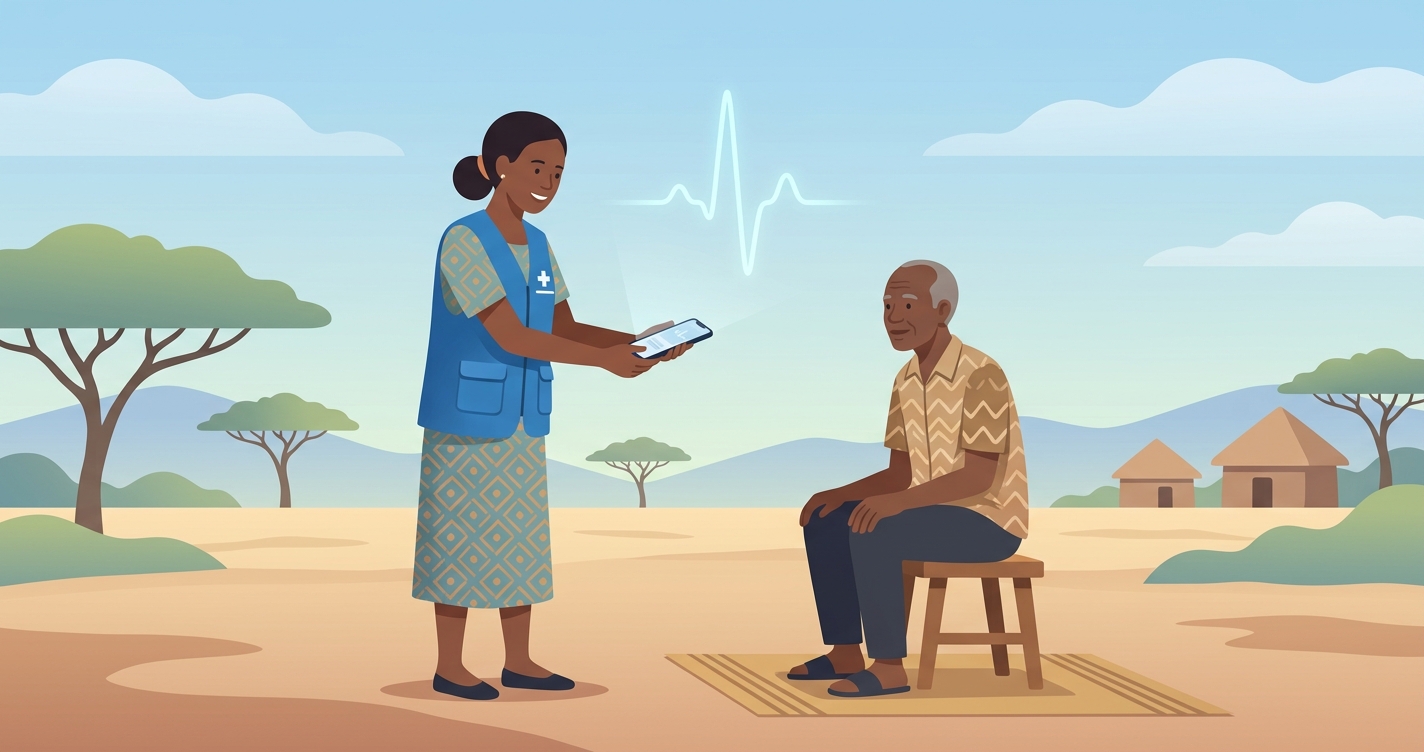
A contactless workflow reorders the screening pathway. Instead of waiting for symptomatic patients to arrive, the measurement travels to the village.
- A community health worker opens a screening app and holds the phone toward a person's face for roughly 30 to 60 seconds.
- The camera captures the pulse signal, and the model returns an estimated blood pressure reading on the spot.
- Readings above a threshold flag the person for a confirmatory cuff measurement, not an immediate diagnosis.
- Flagged cases enter a referral list with location and contact details for follow-up.
- Aggregate data syncs when connectivity allows, giving program managers a population-level view of where hypertension is concentrated.
The design principle is triage, not diagnosis. The phone's job is to separate the large group who can be reassured from the smaller group who need a cuff and a clinician. That division of labor is what makes screening at population scale financially possible.
- No consumables means no supply chain for cuffs, batteries, or replacement parts.
- A short orientation replaces weeks of clinical training.
- The same device can carry other contactless vitals for rural healthcare, including heart rate and respiratory rate, so a single visit screens for multiple conditions.
Industry Applications
National NCD campaigns
Health ministries running non-communicable disease programs face a counting problem before a treatment problem. Contactless screening lets an immunization or malaria campaign add a blood pressure pass for adults at almost no marginal cost, turning a single-purpose visit into a multi-condition touchpoint. The data produced also feeds district health planning, showing where hypertension clusters before it shows up as stroke admissions.
Ngo outreach and mobile clinics
For NGOs running mobile outreach, the binding constraint is how many people one team can screen per day. Removing the cuff inflation cycle and the equipment setup shortens each encounter and lets a small team cover more households. Hypertension screening in developing countries has historically been limited by throughput, and a phone-based first pass directly attacks that limit.
Pharmacy and community hub screening
Rural pharmacies and trading-post hubs see steady foot traffic from people who never visit a clinic. A smartphone screening station placed at these points reaches working-age men, the group with the lowest awareness rates, in the places they already go.
Current research and evidence
The evidence base for camera-based blood pressure estimation is maturing but uneven, and honesty about its limits is what makes it deployable. A 2023 review by researchers publishing in OAE's Connected Health journal summarized the field: rPPG can estimate blood pressure from facial video, but accuracy depends on calibration, lighting, and the diversity of the training data behind the model.
Specific validation studies show the range. The OptiBP smartphone application, tested in a 91-participant study, reported a mean difference of 0.5 mmHg for systolic and 0.4 mmHg for diastolic pressure against reference measurements, meeting validation standards in that sample. The low-cost BPClip device, validated in 29 participants, recorded mean absolute errors of 8.72 mmHg systolic and 5.49 mmHg diastolic. A study of the WellFie rPPG application reported predictive accuracy near 94% systolic and 93% diastolic in normotensive adults. The spread between these results is the headline finding: performance varies by method, population, and conditions.
Several themes recur across the literature:
- Models need diverse training data, and most have been trained on populations that do not represent rural African skin tones, diets, or comorbidity profiles. Local validation is not optional.
- Periodic recalibration improves and sustains accuracy.
- For high-precision diagnosis, current cuffless methods generally fall short of the strictest medical-device standards, which is exactly why their role is screening triage rather than definitive measurement.
The research consensus is consistent with the operational model above. These tools are strong at finding people who should be measured with a cuff and weak as a standalone diagnostic. Designed around that strength, they extend reach without overclaiming precision.
The future of blood pressure screening in rural africa
The near-term trajectory points toward larger, more representative validation datasets collected in the settings where the technology will actually run. As models are trained and recalibrated on local populations, the gap between lab performance and field performance should narrow. Three developments are likely to shape the next several years.
- Field validation cohorts in Sub-Saharan Africa will replace borrowed accuracy claims from studies done elsewhere, giving ministries evidence grounded in their own populations.
- Integration with national digital health records will turn one-off screenings into longitudinal tracking, so a flagged person is followed rather than lost.
- Multi-vital screening on a single device will fold hypertension detection into broader non-communicable disease and maternal health programs, spreading the cost across more outcomes.
The strategic question for global health funders is no longer whether a phone can read a pulse. It is whether screening can be moved out of the clinic and into the village fast enough to catch hypertension before it causes irreversible harm. Contactless triage is one of the few approaches with a cost structure that scales to that challenge.
Frequently asked questions
Can a smartphone really measure blood pressure without a cuff? A smartphone camera can estimate blood pressure using remote photoplethysmography, which reads pulse-driven color changes in the skin. Validation studies report a wide range of accuracy depending on the method and population. The appropriate use is first-pass screening that flags people for a confirmatory cuff measurement, not standalone diagnosis.
Why is hypertension so often undiagnosed in rural Africa? Hypertension produces no symptoms until an organ is damaged, and the standard cuff measurement only happens at facilities that many rural people rarely reach. A 2023 review of 37 countries found roughly half of hypertensive men were unaware of their status, largely because the measurement never reaches them.
How accurate are no-cuff blood pressure checks compared to a cuff? Results vary. The OptiBP app reported sub-1 mmHg mean differences in one study, while the BPClip device reported mean absolute errors near 8.7 mmHg systolic. Because performance is inconsistent across populations, these tools are best used to triage who needs a confirmatory cuff reading.
What do NGOs need to start a contactless screening pilot? At minimum, smartphones already in the field, a short health-worker orientation, a referral pathway to confirmatory measurement, and a plan for local validation against cuff readings. The absence of consumables and specialized equipment is what keeps the marginal cost per site low.
Circadify is working on this space directly, building smartphone-based contactless vitals screening deployed in field settings such as Uganda and gathering the local field data that the research base still needs. Global health NGOs and program managers evaluating a contactless first-pass screening pilot for non-communicable diseases can explore partnership and field data work in the global health section at https://circadify.com/blog.