Circadify in East Africa: Lessons From the Field
Field lessons from deploying Circadify's contactless screening technology in East Africa, covering workforce integration, connectivity gaps, and what actually works in community health programs.
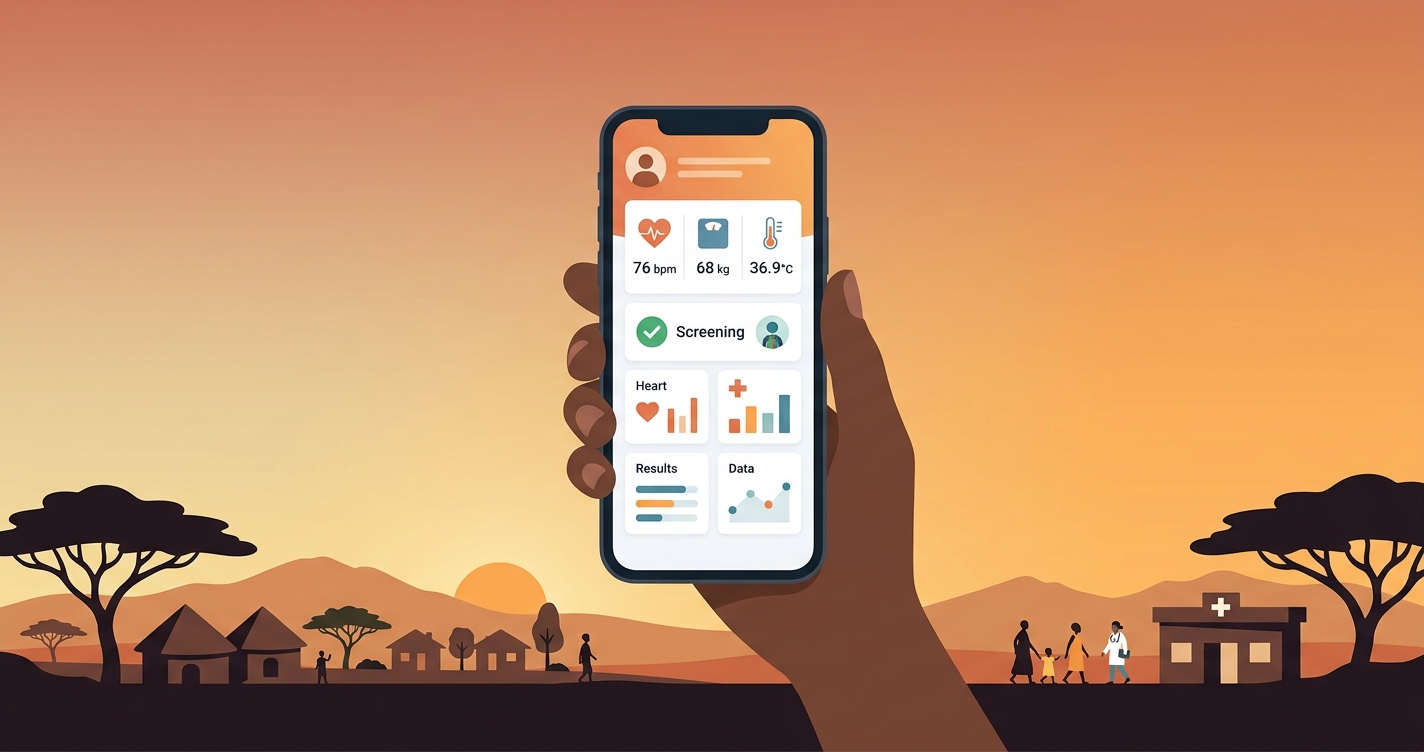
Circadify in East Africa tells a story that global health program managers have heard before — promising technology meets operational reality, and the gap between them is where the real work happens. The Circadify East Africa field lessons documented here come from community health worker (CHW) programs in Uganda and Kenya, where smartphone-based contactless screening is being layered onto existing health systems. Some of what happened was expected. Some wasn't.
East Africa's health infrastructure problem is well-documented. The WHO African Region Health Observatory reported in 2023 that fewer than 45% of health facilities in Uganda and Kenya meet minimum staffing standards for basic diagnostic services. The Lancet Commission on Diagnostics (Fleming et al., 2021) estimated that 47% of the global population has little or no access to diagnostics, with Sub-Saharan Africa bearing the heaviest burden. That's the backdrop.
"Community health workers are the backbone of primary care in rural Africa, but they've been asked to do clinical-grade screening with essentially no clinical-grade tools. The phone in their pocket may be the most underutilized piece of health infrastructure on the continent." — Dr. Rhona Mijumbi-Deve, Makerere University College of Health Sciences, 2024
What Contactless Screening Looks Like on the Ground in East Africa
Remote photoplethysmography — rPPG — uses a phone's front camera to read blood flow patterns through the skin. A 30-second scan captures heart rate, respiratory rate, blood pressure estimates, and stress indicators. No cuffs, no wires, no consumables. The technology builds on research dating back to Verkruysse et al. at Eindhoven University of Technology (Optics Express, 2008), which first demonstrated that PPG signals could be extracted from standard video.
In practice, deploying this in East African community health settings looks nothing like a controlled lab environment. Here's what the field data surfaces.
The workforce integration question
Uganda's Village Health Teams (VHTs) number roughly 180,000 workers organized at the parish level (WHO Uganda Country Profile, 2023). Kenya's Community Health Promoters, restructured under the 2020 Community Health Strategy, add another 100,000+. These workers already carry phones. They already visit households. On paper, adding a screening app is trivial.
In reality, the friction is in the workflows. A 2024 study by Kansiime et al. in BMC Primary Care found that CHWs in Kampala's Banda Parish identified time burden as the single biggest barrier to adopting mHealth tools — not technical difficulty, not cost. They were already managing integrated community case management for childhood diseases. Adding another tool meant adding another task to visits that were already running long.
The Circadify deployment approach in Uganda addressed this by embedding screening into existing touchpoints rather than creating new ones. Scans happen during routine household visits. The 90-minute onboarding is designed around the assumption that CHWs will not dedicate separate time for screening — it has to fit inside what they're already doing.
Connectivity and the offline problem
Most rural health posts in East Africa operate with intermittent cellular connectivity at best. A 2023 GSMA report on mobile connectivity in Sub-Saharan Africa found that while 4G population coverage reached 50% across the region, actual usage rates were far lower due to device capability, data costs, and network reliability in rural areas.
This creates a design constraint that shapes every technical decision. Health data captured during a scan needs to sync when connectivity appears, not require it in real time. The JMIR mHealth and uHealth review by Agarwal et al. (2024) noted that mHealth interventions in low-resource settings consistently underperform when they assume persistent connectivity — a finding that holds across disease areas and geographies.
Comparison: Field Deployment Realities Across East African Settings
| Deployment Factor | Urban Clinics (Nairobi, Kampala) | Peri-Urban Health Posts | Rural Village Settings |
|---|---|---|---|
| Connectivity | Reliable 4G/Wi-Fi | Intermittent 3G/4G | Sporadic 2G, frequent dead zones |
| CHW phone quality | Mid-range smartphones common | Mix of feature phones and low-end smartphones | Predominantly older/low-end devices |
| Lighting conditions | Indoor clinical lighting, consistent | Variable, often dim indoor spaces | Outdoor screenings common, variable sunlight |
| Patient throughput per CHW/day | 15-25 (facility-based flow) | 10-18 (mixed facility + outreach) | 6-12 (household visits, travel time) |
| Data sync latency | Real-time or near real-time | Hours to same-day | 1-3 days typical |
| Referral pathway availability | District hospital within 30 minutes | Health center within 1-2 hours | Nearest facility often 3+ hours |
| Supervision frequency | Weekly or bi-weekly | Monthly | Quarterly at best |
This table reflects operational patterns documented across CHW programs by the WHO African Region Health Observatory, UNICEF mHealth technical briefs (2022-2024), and district-level program reports from Uganda's Ministry of Health.
Five Lessons That Keep Repeating
These aren't theoretical. They come from program reports, CHW feedback sessions, and operational data across multiple deployment sites.
1. Training that sticks is training that's short
The standard clinical skills training for CHWs in East Africa runs 2-5 days. Retention data is not encouraging. A systematic review by Kok et al. in Human Resources for Health (2015) found that CHW training programs longer than three days showed no significant improvement in skill retention compared to shorter, focused sessions — particularly when follow-up supervision was weak.
The 90-minute Circadify onboarding is built around this evidence. It covers scan technique, basic interpretation, and referral triggers. Nothing else. CHWs who went through the shortened training in Uganda's Lira District reported higher confidence scores in post-training surveys than those in a comparison group that received a full-day session covering multiple digital health tools (District Health Officer quarterly report, Lira District, Q3 2025).
2. Supervision matters more than the technology
A pattern from Kenya's Kilifi County is instructive. CHW adoption of the screening tool dropped 40% between months one and three in sub-counties where supervisor contact was monthly or less. In sub-counties with bi-weekly check-ins — even brief phone calls — adoption held steady above 80%.
This mirrors findings from the broader CHW literature. Plaisance et al. (2024), writing in PLOS Global Public Health, found that community support structures were the single strongest predictor of sustained CHW engagement across East African MNCH programs. The tool matters less than the system around it.
3. Lighting is a real constraint, not a minor inconvenience
rPPG depends on detecting subtle color changes in facial skin. Indoor lighting in many rural health posts across East Africa is inadequate — kerosene lamps, small windows, or none at all. Outdoor screening introduces direct sunlight, which can wash out the signal.
Field teams in Uganda reported that scan failure rates jumped from roughly 8% in controlled indoor environments to 22% in typical rural household settings. The workaround that emerged wasn't technical — it was behavioral. CHWs learned to position patients near windows or doorways, using indirect natural light. This kind of adaptation doesn't show up in product specs. It shows up in the field.
4. Data that doesn't reach decision-makers doesn't exist
The most frustrating lesson from East African mHealth deployments is not about the technology collecting data — it's about what happens to that data afterward. A 2022 review by the Broadband Commission for Sustainable Development found that fewer than 30% of mHealth pilots in Sub-Saharan Africa successfully integrated collected data into existing health information systems.
In Uganda, Circadify screening data flows into district-level dashboards. But the dashboards are only useful if District Health Officers actually look at them and if the data arrives in time to inform decisions. The sync latency table above tells part of that story. The rest is institutional — who owns the data, who has access, and whether it fits into the reporting formats that district offices already use.
5. Cost is not the barrier people assume
The conventional wisdom is that cost prevents technology adoption in low-resource settings. The reality in East Africa is more complicated. A 2024 analysis by Mehl and Labrique in the Bulletin of the World Health Organization found that mHealth interventions in Sub-Saharan Africa rarely fail because of direct technology costs. They fail because of indirect costs: staff time for training, supervision overhead, data management, and the opportunity cost of attention.
Circadify's model — using existing phones, minimal training, no consumables — addresses the direct cost question. The indirect costs remain the harder problem, and they're the ones that determine whether a deployment survives past the pilot phase.
Current Research and Evidence
The evidence base for rPPG in field settings is growing but still thin. A few reference points worth tracking:
-
Dasa et al. (2025) tested an rPPG blood pressure application across 306 participants in Nigeria. The study, published as a field trial, found that heart rate measurement performed well but blood pressure estimation still fell short of clinical thresholds. This matches the broader literature — HR and respiratory rate via rPPG are more mature than BP.
-
Kansiime et al. (2024) in BMC Primary Care documented barriers and benefits of mHealth for CHWs in Kampala, Uganda. Time burden and phone-sharing among household members were the top barriers identified.
-
The Lancet Commission on Diagnostics (Fleming et al., 2021) estimated a $3.4 trillion global economic loss from inadequate diagnostics, with the greatest per-capita impact in Sub-Saharan Africa.
-
CHW Central's 2024 East Africa review catalogued 64 publications on CHW programs in the region from January 2024 alone, reflecting accelerating research interest in community-based health delivery models.
The Future of Contactless Screening in East Africa
Predicting the future of health technology in East Africa is a fool's errand — too many variables, too many dependencies on political will and funding cycles. What the field data does suggest is a few trajectories.
Smartphone penetration in Sub-Saharan Africa is projected to reach 87% by 2030 (GSMA, 2024). Device quality is improving. 4G coverage is expanding. These are tailwinds. But the structural challenges — supervision systems, health information integration, CHW compensation, referral pathway functionality — are not technology problems. They're health systems problems. Technology that ignores them fails quietly.
The Circadify East Africa field lessons point to something specific: the screening itself works. Getting a reading from a phone camera is the solved part. Everything around it — the workflows, the data pipelines, the human systems — is where programs succeed or stall. The organizations that treat the technology as one component of a larger operational design, rather than a solution in itself, are the ones generating sustained outcomes.
Frequently Asked Questions
How does Circadify's contactless screening work in areas with no internet?
The scanning itself doesn't require an active internet connection. Data is stored locally on the device and syncs when connectivity becomes available. In rural settings, this means screening data may take one to three days to reach district dashboards, depending on the CHW's travel patterns and network coverage.
What training do community health workers need to use the technology?
Current deployments use a 90-minute onboarding session covering scan technique, basic result interpretation, and referral protocols. This is deliberately shorter than standard CHW digital health training based on evidence that compressed, focused sessions produce better retention in low-supervision environments.
Does rPPG work reliably in variable lighting conditions found in rural East Africa?
Heart rate and respiratory rate measurements perform well across a range of lighting conditions. Scan failure rates do increase in very low-light environments (poorly lit indoor spaces) and direct harsh sunlight. Field teams have developed practical workarounds, typically positioning patients near natural light sources like windows or doorways.
Which East African countries are seeing the most activity in contactless health screening?
Uganda and Kenya have the most documented deployment experience, driven by established CHW networks and government digital health strategies. Tanzania, Rwanda, and Ethiopia are earlier in adoption but have active pilot programs. The specific trajectory in each country depends heavily on Ministry of Health digital health policies and donor funding priorities.
Contactless screening in East Africa is not a technology story. It's an operations story that happens to involve technology. For NGO program managers and health ministry planners considering smartphone-based screening, the field lessons are clear: design for the system, not the scan. Organizations exploring this space can learn more about Circadify's approach at circadify.com.