How Community Health Data Informs National Health Policy
An analysis of how community-level health data collected by frontline workers shapes national health policy decisions across Sub-Saharan Africa and low-income countries.
How Community Health Data Informs National Health Policy
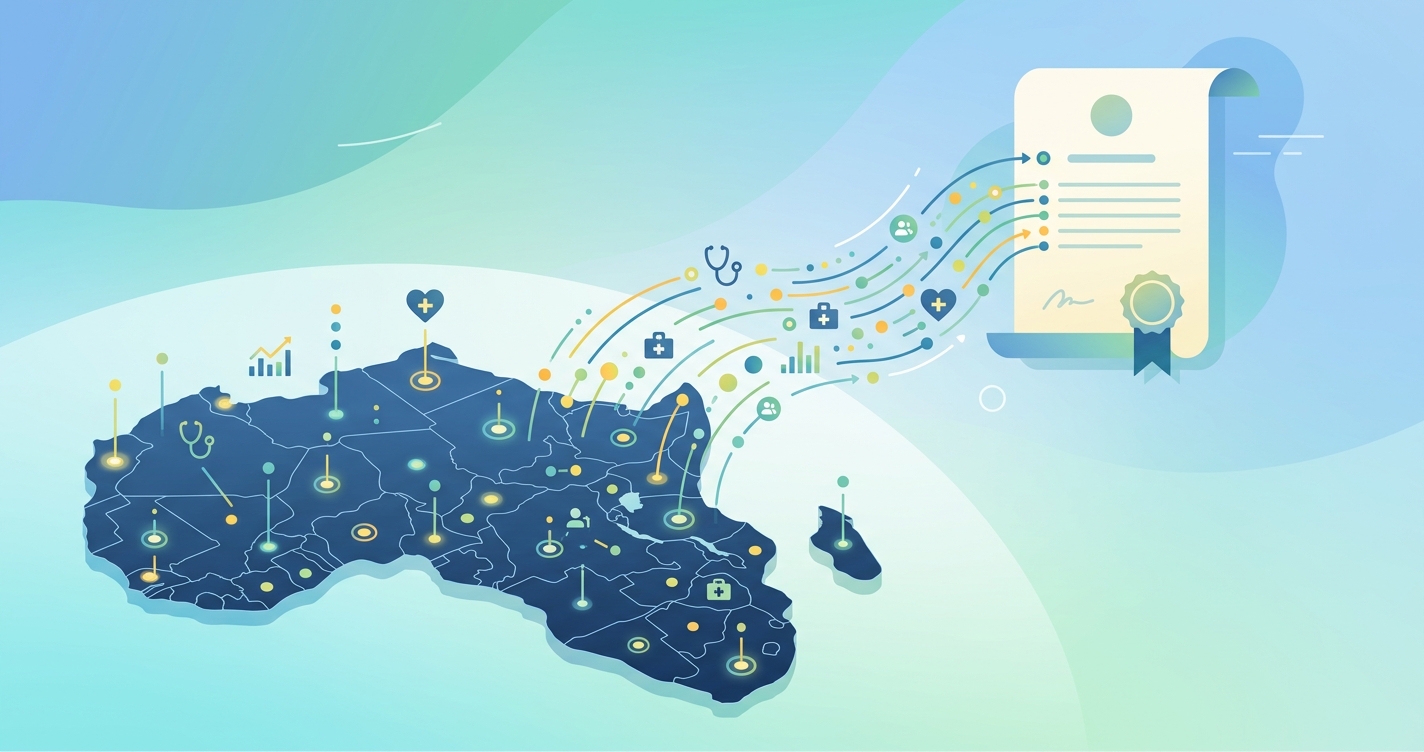
Health policy has a data problem. National governments and international organizations routinely make decisions about disease burden, resource allocation, and intervention strategy based on facility-level records, hospital discharge data, and periodic demographic surveys. But in Sub-Saharan Africa, where over 60% of the population lives in rural areas and facility-based care covers a fraction of actual health needs, this approach misses most of what is actually happening. Community health data — the information collected by frontline health workers during household visits, mobile screenings, and community outreach — fills that gap. And increasingly, it is shaping the policies that determine how billions in health spending get directed.
"Sixty-nine percent of African Union Member States have community-based data integrated into their national health information systems, but utilization of that data for policy remains inconsistent." — Africa CDC and UNICEF joint assessment, 2024
What community health data actually captures
Community health data is not a single dataset. It is a patchwork of information generated by community health workers (CHWs), village health teams, and community-based surveillance systems operating outside formal clinical settings. The data types vary by country and program, but the common categories include household-level vital signs readings, disease symptom reports, referral records, pregnancy and birth registrations, nutrition assessments, and medication adherence tracking.
What makes this data different from facility records is where it comes from. A hospital admission record tells you about people who made it to a hospital. Community data tells you about the people who did not — the pregnant woman who delivered at home, the child with a fever whose parents could not afford transport, the elderly patient managing hypertension without any clinical supervision.
A 2024 scoping review published in BMC Health Services Research examined community-based health information systems (CBHIS) across 18 African countries. The researchers, led by Yakubu and colleagues at the University of KwaZulu-Natal, found that community data was being used for five primary purposes: policymaking, resource allocation, staffing decisions, program evaluation, and community health dialogue. Community dialogue — where local health data gets presented back to village councils and district health teams — was the most commonly reported use (Yakubu et al., BMC Health Services Research, 2024).
Comparison: facility data vs. community health data for policy decisions
| Dimension | Facility-based health data | Community health data |
|---|---|---|
| Population covered | People who visit health facilities | Entire community including non-attendees |
| Geographic granularity | District or facility level | Village, household, or individual level |
| Timeliness | Monthly or quarterly aggregation | Often real-time or weekly |
| Disease detection scope | Diagnosed conditions only | Pre-symptomatic screening and symptom surveillance |
| Maternal health coverage | Facility-based deliveries (~55% in SSA) | All pregnancies including home deliveries |
| Data collectors | Nurses, clinical officers | Community health workers, village health teams |
| Cost per data point | Higher (facility overhead) | Lower (integrated into existing CHW visits) |
| Policy blind spots | Misses rural, poor, and hard-to-reach populations | May lack clinical precision and standardization |
Sources: WHO Global Health Workforce Statistics (2023); UNICEF State of the World's Children (2024); Yakubu et al. (2024).
The data-to-policy pipeline in practice
The path from a community health worker's notebook to a national policy document is neither automatic nor straightforward. In most African countries, community data flows through a layered reporting chain: CHW to health facility, facility to district health office, district to regional or provincial level, and regional to national ministry of health. At each step, data gets aggregated, and detail gets lost.
DHIS2 (District Health Information Software 2), developed by the University of Oslo's HISP Centre, is the backbone of health data management in over 80 countries. According to UNICEF's 2024 Digital Health and Information Systems report, UNICEF supported DHIS2 implementations in 45 countries during 2024 alone, with a particular focus on integrating community-level data streams into national dashboards.
The integration matters because policy decisions follow the data that is visible. When community health data is absent from national dashboards, community health needs are absent from national budgets. Rwanda is frequently cited as a counterexample. The country's national community health program feeds CHW data directly into the national HMIS through a structured digital reporting system. This data integration contributed to Rwanda reducing under-five mortality from 152 per 1,000 live births in 2005 to 45 per 1,000 by 2020, according to the Rwanda Ministry of Health and WHO country office statistics.
Benin took a different but parallel approach. Its national community health policy, reviewed by WHO AFRO in 2024, was built on data from 15,547 community health workers operating across the country. The policy allocated 86 billion CFA francs (approximately $140 million USD), with 66.6 billion already mobilized, specifically because community-level data demonstrated both the reach and the cost-efficiency of CHW-led interventions.
Where the data breaks down
The picture is not uniformly positive. Data quality from community health programs varies enormously. A 2023 study by Maina and colleagues at the Kenya Medical Research Institute found that only 38% of community health data submissions in three Kenyan counties met minimum quality thresholds for completeness and accuracy. The problems were predictable: paper-based recording, inconsistent training, high CHW turnover, and limited supervision.
Digital tools help, but they do not solve everything. When CHWs use smartphones or tablets for data entry, completeness rates improve — the UNICEF 2024 report found that digital reporting increased data completeness by 25-40% compared to paper-based systems in pilot programs across five countries. But digital adoption introduces its own complications: device maintenance, connectivity gaps, and the risk that CHWs spend more time entering data than actually interacting with patients.
South Africa's experience illustrates the governance complexity. The country has some of the continent's strongest health data legislation, including the National Health Act and Protection of Personal Information Act (POPIA). A 2025 Health Data Governance country report noted that while South Africa's legal framework for health data is comprehensive, the actual integration of community-level data into policy processes remains fragmented across provincial health departments.
Smartphone screening and the data volume question
One development that is changing the equation is smartphone-based health screening. Traditional CHW data collection captures symptoms, observations, and referral outcomes. Smartphone screening tools — including contactless vital sign measurement using phone cameras — add objective physiological data to the mix: heart rate, respiratory rate, blood pressure estimates, and other metrics captured during routine household visits.
This matters for policy because it shifts community health data from subjective reporting to measurable, quantifiable health indicators. A CHW reporting "patient appears short of breath" generates different policy signals than a CHW uploading timestamped respiratory rate measurements from 200 households in a district over three months. The second dataset can identify geographic clusters, seasonal patterns, and population-level trends that the first cannot.
The data volume implications are significant. The Africa CDC and UNICEF assessment found that countries with higher CHW density generate proportionally more community health data, but processing and analyzing that data remains a bottleneck. Moving from narrative symptom reports to structured vital sign data makes automated analysis more feasible, but it also multiplies the storage, processing, and governance requirements.
How different data types influence policy decisions
| Data type | Policy question it answers | Example policy outcome |
|---|---|---|
| Household vital signs screening | Where are undiagnosed hypertension clusters? | Targeted NCD screening programs in high-burden districts |
| Pregnancy registration and tracking | What is the true antenatal care coverage? | Adjusted maternal health budget allocation |
| Child nutrition assessment | Which regions have rising malnutrition? | Emergency nutrition intervention deployment |
| Disease symptom surveillance | Is there an outbreak forming? | Early warning system activation |
| Referral completion tracking | Are referrals resulting in facility visits? | Transport subsidy programs, facility placement planning |
| Medication adherence records | Are HIV/TB patients staying on treatment? | Community-based treatment support program expansion |
Lessons from countries that got this right
A few countries have built functional pipelines from community data to national policy, and their experiences share common features.
Ethiopia's Health Extension Program deployed over 38,000 health extension workers across the country starting in 2003. The program collected community health data through a standardized system that fed into national health planning. Between 2000 and 2019, Ethiopia reduced under-five mortality by 67%, and the Health Extension Program's data on community disease burden directly informed the country's Health Sector Transformation Plan (Federal Ministry of Health, Ethiopia, 2015).
Malawi's integrated community case management (iCCM) program trained CHWs to diagnose and treat childhood pneumonia, malaria, and diarrhea using standardized protocols. Data from the program showed that CHW-led treatment reduced childhood mortality by 63% in intervention areas compared to control zones, according to a study by Nsona and colleagues published in The American Journal of Tropical Medicine and Hygiene (2012). That data drove national policy to expand iCCM to all districts.
Bangladesh's BRAC community health model, while outside Africa, is often referenced in African policy discussions. BRAC's Shasthya Shebikas (community health workers) generate household-level health data that feeds into program monitoring systems covering over 110 million people. The model demonstrated that community data could drive health policy at scale, and several African countries including Uganda and Sierra Leone have adapted elements of BRAC's data systems.
What needs to change
Three specific gaps remain between community health data collection and effective national health policy use.
First, data interoperability. Community health data systems frequently operate on different platforms than national HMIS. The result is parallel data streams that do not communicate. WHO's 2020-2025 Global Strategy on Digital Health identified interoperability as a priority, but implementation is slow. Countries need middleware that translates between community data formats and national reporting standards.
Second, feedback loops. Data flows upward from communities to national ministries, but policy decisions rarely flow back down with explanation. CHWs who collect data but never see how it gets used lose motivation for accurate reporting. The countries with the strongest data quality — Rwanda, Ethiopia — are also the ones with the strongest feedback mechanisms, where district health teams share aggregate results with CHW supervisors monthly.
Third, analytical capacity. Raw community data needs epidemiologists and data scientists to translate it into policy-relevant insights. Most district health offices in Sub-Saharan Africa lack this capacity. Africa CDC's partnership with UNICEF is working to build regional analytical hubs, but the current coverage is thin relative to the data volume being generated.
Frequently asked questions
What is community health data?
Community health data is health information collected outside of formal clinical settings, typically by community health workers during household visits, outreach campaigns, and mobile screening events. It includes vital signs measurements, symptom reports, pregnancy registrations, nutrition assessments, and disease surveillance data from populations that may not regularly access health facilities.
How does community health data differ from hospital data?
Hospital and clinic data captures information about people who seek care at health facilities. Community health data captures information about entire populations, including those who do not visit facilities due to distance, cost, or cultural factors. In Sub-Saharan Africa, where facility-based care reaches roughly 55% of the population for maternal health services and less for other conditions, community data fills a gap that facility records cannot.
Which countries use community health data for policy most effectively?
Rwanda, Ethiopia, and Malawi are frequently cited examples. Each has built structured data pipelines from community health workers through district health systems to national policy processes. Common features include standardized digital reporting tools, regular feedback to frontline workers, and dedicated analytical capacity at the national level.
Can smartphone screening improve community health data quality?
Smartphone-based screening tools, including contactless vital sign measurement, add objective physiological measurements to community health data that previously relied on subjective symptom reporting. This generates more structured, analyzable data. Companies like Circadify are developing contactless screening technology that converts smartphones into multi-parameter vital sign measurement tools, making it practical for CHWs to collect clinical-grade data during routine household visits without carrying additional equipment.