How do communities in Africa get health scans quickly before a crisis?
How community health scans in Africa use smartphone vital sign screening to reach people before a crisis, with research on mHealth and rPPG in rural settings.
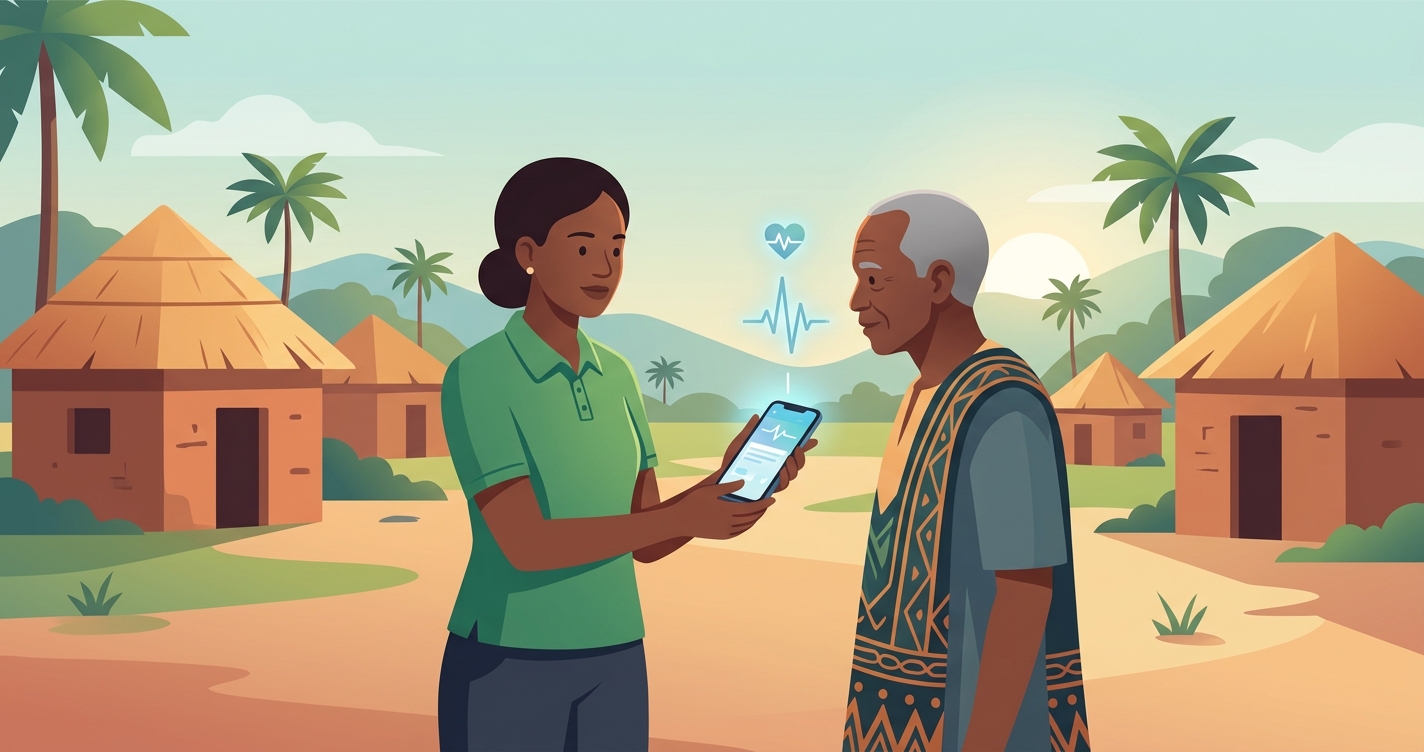
In most of rural Sub-Saharan Africa, the first warning sign of a health crisis is not a clinical measurement. It is a symptom that has already become severe enough to force a long journey to a facility that may be hours away. By the time a fever, a dangerously high blood pressure reading, or a respiratory infection is formally measured, the window for cheap, early intervention has often closed. The central question for health ministries and donor programs is no longer whether early detection matters, but how to deliver community health scans Africa-wide at a speed and scale that matches the geography. The answer increasingly points toward technology that already sits in the pockets of community health workers: the smartphone.
The World Health Organization projects a global shortfall of roughly 10 million health workers by 2030, with the gap concentrated in low- and lower-middle-income countries. Africa carries about 25 percent of the world's disease burden but employs only around 3 percent of its health workforce.
This imbalance explains why proactive screening has been so hard to operationalize. Equipment-based screening assumes a clinic, a trained technician, a power supply, and a supply chain for cuffs, probes, and consumables. Remove any one of those, and the screening model breaks. The shift now underway reframes screening as something that can travel to the patient rather than the other way around.
Why community health scans Africa programs are moving to mobile tools
The logic behind mobile-first community health scans Africa programs is operational before it is clinical. A community health worker walking between households cannot carry a cabinet of medical devices, calibrate them in the field, and keep them charged. What that worker can carry is a phone. When the phone itself becomes the screening instrument, the cost and logistics of population-level screening change fundamentally.
Two technical approaches dominate field deployments today. The first is software that uses the phone's camera to estimate vital signs through remote photoplethysmography, or rPPG, which detects tiny color changes in the skin caused by blood flow. The second relies on small, ruggedized peripheral sensors paired with a phone over Bluetooth. Each has trade-offs that matter at scale.
| Screening approach | Equipment needed | Speed per person | Maintenance burden | Best fit |
|---|---|---|---|---|
| Camera-based rPPG screening | Smartphone only | 30 to 60 seconds | Very low, software updates only | Mass campaigns, household visits, triage queues |
| Bluetooth peripheral sensors | Phone plus cuffs and probes | 2 to 5 minutes | Moderate, charging and replacement | Follow-up and confirmatory checks |
| Traditional clinic equipment | Dedicated devices and power | 5 to 10 minutes | High, calibration and consumables | Diagnosis and treatment at facilities |
| Manual community worker checks | Basic tools, manual counting | 3 to 8 minutes | Low but skill dependent | Symptom-based referral where no tech exists |
The appeal of the camera-only approach for early, pre-crisis screening is that it removes nearly every recurring cost after the phone is in hand. There are no cuffs to lose, no probes to replace, and no calibration drift to manage across hundreds of devices. For a ministry trying to screen tens of thousands of people during an immunization drive or a seasonal outbreak response, that difference compounds quickly.
Key reasons programs adopt smartphone-based screening include:
- Devices are already widely distributed, with smartphone penetration across Sub-Saharan Africa rising steadily year over year.
- A single trained community health worker can screen far more people per day when no setup or teardown is required.
- Results can be logged digitally and aggregated for surveillance rather than recorded on paper.
- The marginal cost of one additional scan approaches zero once the software is licensed.
- Workers need only basic training to capture a usable reading.
Industry Applications
Mass screening campaigns
National immunization days and outbreak responses already gather large numbers of people in one place. Adding a 30 to 60 second contactless vital sign check to that flow lets programs catch hypertension, abnormal heart rate, or respiratory distress in people who came for an entirely different reason. This piggybacking strategy is among the most cost-efficient ways to reach adults who rarely visit a clinic.
Household and door-to-door visits
Community health workers conducting routine home visits can fold screening into conversations they are already having. For maternal and child health in particular, a quick scan of a mother or infant during a scheduled visit can flag a problem days before it would otherwise surface. The portability of a phone-only workflow is what makes this realistic across dispersed rural populations.
Triage in resource-limited facilities
Even where a clinic exists, queues are long and staff are few. Rapid contactless screening at the point of entry helps sort patients by urgency, directing scarce clinical attention to those who need it first. This is triage augmentation rather than diagnosis, and it fits the realities of understaffed facilities.
Current research and evidence
The evidence base for mobile screening in low-resource settings has two strands. The first concerns whether mHealth tools improve the performance of community health workers. A systematic review published in BMC Public Health (2021) examining mHealth and community health worker performance in Sub-Saharan Africa found consistent improvements in data quality, adherence to protocols, and timeliness of referrals when workers were equipped with mobile tools, while flagging digital literacy and connectivity as recurring constraints. A separate systematic review of mobile health interventions for non-communicable diseases in Sub-Saharan Africa (published in PMC, 2021) reached similar conclusions for chronic disease management, noting that mobile platforms extended reach but that sustainability beyond pilot funding remained the weak point.
The second strand concerns the accuracy of the camera-based measurement itself. Validation studies of rPPG published across 2023 and 2024 report strong agreement with reference devices for heart rate, with reported accuracy above 97 percent and mean absolute error near 3 beats per minute in controlled settings. Results for respiratory rate are also promising, while blood pressure and oxygen saturation estimates remain less consistent and are an active area of research. Independent reviewers, including a current review of rPPG, have been clear about the limits: performance degrades under poor lighting, subject movement, and video compression artifacts. Researchers have also documented historically weaker accuracy for darker skin tones, a fairness issue that recent work is explicitly trying to correct and one that is non-negotiable for any technology intended for African populations.
The honest reading of the evidence is that contactless screening is well suited to triage and early flagging, where the goal is to identify who needs further attention, and is not a replacement for confirmatory clinical measurement. That distinction is exactly the role pre-crisis community screening is meant to play.
The Future of community health scans in Africa
The trajectory of community health scans Africa-wide will be shaped less by raw algorithm accuracy and more by integration. The programs most likely to last will be the ones that connect screening data to referral pathways, to district health information systems, and to surveillance dashboards that ministries actually use for planning. A reading that is captured but never acted on changes nothing.
Three developments are worth watching:
- Multi-vital screening from a single camera capture, expanding what one scan can flag without adding devices.
- Offline-first software that stores readings locally and syncs when connectivity returns, since rural networks are unreliable.
- Skin-tone-inclusive model training that closes the documented accuracy gap and makes results trustworthy across all populations.
As these mature, the cost of identifying a community member at risk before they reach crisis should keep falling, which is the metric that matters most to budget-constrained health systems.
Frequently asked questions
How accurate are smartphone health scans compared to clinic equipment? For heart rate, recent rPPG validation studies report accuracy above 97 percent in controlled conditions. Respiratory rate is also strong, while blood pressure and oxygen saturation are less consistent. These tools are best understood as triage and early-flagging instruments, not diagnostic replacements for clinical devices.
Do these scans work without internet or electricity? The screening itself runs on a charged phone and does not require a constant connection. Offline-first designs store readings locally and upload them when a network is available, which suits rural areas with intermittent coverage and limited power.
Who performs the scans in the community? Community health workers and campaign staff typically perform them. A camera-only workflow needs only basic training, since there is no equipment to calibrate or assemble, which is what allows one worker to screen many more people per day.
Can contactless screening detect a crisis before symptoms are obvious? It can flag abnormal vital signs, such as elevated heart rate or irregular readings, that often precede a visible emergency. The value is in sorting who needs urgent follow-up, prompting earlier referral than symptom-based judgment alone would.
Circadify is working in this space directly, with smartphone-based vital sign screening already deployed in field settings in Uganda and a focus on the integration and fairness challenges that determine whether programs survive past their pilots. For partnership inquiries and field data from these deployments, visit circadify.com/blog.