Community Health Screening in Africa: A 2026 Field Guide
A 2026 field guide to community health screening Africa: models, staffing, outcomes, and best practices for NGO and ministry program leads across Sub-Saharan Africa.
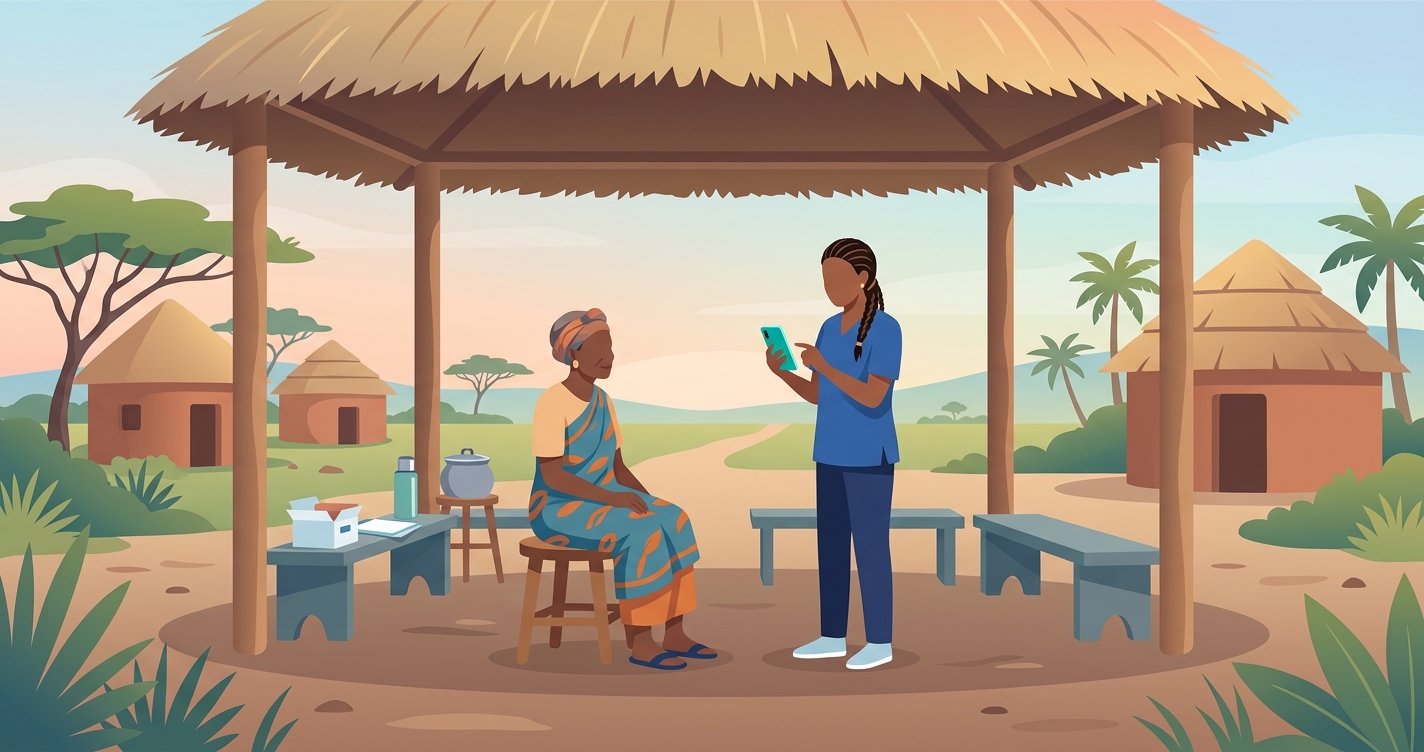
Across Sub-Saharan Africa, the gap between where people live and where clinical measurement happens remains the single largest obstacle to early detection of disease. An estimated 400 million people in the region live more than two hours from the nearest hospital, and the WHO African Region records the lowest health worker density in the world, with roughly 2.3 medical doctors and 12.6 nursing and midwifery personnel per 10,000 population (WHO, 2014-2021 data). Community health screening Africa programs exist to close that gap by moving basic measurement out of facilities and into villages, markets, places of worship, and households. For NGO program leads and ministry planners designing deployments for 2026, the question is no longer whether mass screening works but which model, staffing structure, and technology stack produces durable coverage at an affordable cost.
"Hypertension prevalence in the African region is the highest worldwide, affecting an estimated 46% of adults aged 25 years and older, and a large share remain unaware of their condition." - World Health Organization, Regional Office for Africa
What community health screening Africa actually involves
Community health screening Africa is best understood as a set of repeatable field operations rather than a single intervention. A program typically combines a target condition (hypertension, anemia, malnutrition, cervical cancer, or maternal risk), a screening site strategy, a trained workforce, a measurement method, and a referral pathway that connects flagged individuals to a facility able to confirm and treat. The weakest link is almost always the referral step. A screening event that identifies thousands of elevated blood pressure readings but cannot route those people to confirmatory testing and medication produces data without health outcomes.
Three operational models dominate the region:
- Campaign-based screening, where large teams screen tens of thousands of people over days or weeks, often attached to immunization drives or health weeks.
- Village health team (VHT) screening, where resident community health workers conduct ongoing, door-to-door screening as part of routine duties.
- Facility-adjacent screening, where measurement happens in waiting areas or outreach posts to catch patients who came for an unrelated reason.
Each model trades reach against continuity. Campaigns maximize one-time coverage but rarely sustain follow-up. VHT models sacrifice peak throughput for the relationships and repeat contact that make chronic disease management possible.
Comparing the dominant screening models
The table below summarizes how the main approaches differ on the variables that matter most to program budgets and outcomes.
| Model | Typical reach | Staffing | Follow-up strength | Cost per person screened | Best suited to |
|---|---|---|---|---|---|
| Campaign / mass event | 10,000-100,000+ per campaign | Large temporary teams, surge supervision | Low without a linked registry | Low at scale, high fixed setup | NCD baseline mapping, integration with immunization |
| Village health team (VHT) | Hundreds per worker per quarter | Resident CHWs, ongoing stipend | High, relationship-based | Moderate, recurring | Hypertension, maternal, chronic conditions |
| Facility-adjacent outreach | Hundreds to thousands monthly | Existing clinic staff plus assistants | Moderate, tied to facility records | Low marginal cost | Opportunistic NCD and anemia detection |
| Digital / smartphone-assisted | Scales with device count | CHWs with minimal training | High when paired with shared records | Low marginal, no consumables | Equipment-scarce, remote settings |
The fourth row matters most for 2026 planning. Smartphone-assisted screening, including camera-based vital sign methods that require no cuffs, electrodes, or consumables, changes the cost structure by removing per-test supply chains. That shift is why several ministries are now evaluating phone-based tools against imported devices that depend on calibration, batteries, and replacement parts.
Staffing and training: the real constraint
Technology gets the headlines, but staffing decides whether a program survives past its pilot. The evidence for task-shifting to community health workers is now substantial. A scoping review of task-sharing for hypertension treatment found that CHWs reliably perform health education and blood pressure measurement when given structured protocols, and a randomized trial in Kiambu County, Kenya, demonstrated preliminary efficacy of a CHW home-based intervention for hypertension control. In Lesotho, trained CHWs supported by a tablet-based application achieved better blood pressure control than traditional clinic-based care, a result that points directly at the combination program leads should be designing toward: human relationships plus a simple digital guide.
Effective staffing models share a few features:
- Short, competency-based training measured by demonstrated skill rather than hours attended.
- Supervision ratios that keep one supervisor responsible for a manageable cluster of workers.
- Stipends or salaries that recognize CHW time, since unpaid volunteer models show high attrition.
- Digital job aids that standardize measurement and reduce the cognitive load of paper protocols.
A WHO-aligned analysis of community health worker requirements stresses that the choice between full-time and part-time arrangements materially changes both coverage and cost, and that ministries consistently underestimate the workforce needed to reach universal coverage targets.
Industry applications across the region
National NCD and hypertension programs
The Pan-African Society of Cardiology set a target of 25% hypertension control across Africa through its roadmap, and community screening is the entry point for that cascade. In eastern Uganda, a quasi-experimental study found that village health teams could feasibly screen for hypertension and refer affected residents, confirming that lay workers can run the detection step at population scale. The WHO Package of Essential Noncommunicable Disease Interventions (WHO PEN) gives ministries a standardized protocol set to plug screening into primary care.
Maternal, child, and nutrition screening
Anemia and acute malnutrition screening fit naturally into campaign and VHT models because the at-risk populations, pregnant women and children under five, are already targets of existing outreach. Camera-based and rapid visual methods allow non-specialist workers to flag cases for confirmation, extending reach into households that never present at a clinic.
Cancer and chronic disease detection
Detection gaps here are severe. Cervical cancer screening coverage among women aged 30-49 in Sub-Saharan Africa stayed roughly flat at about 14% between 2000 and 2020, according to a systematic analysis of population-based surveys published in PLOS Medicine. Community screening, paired with mass media outreach that the same body of research links to higher uptake, is one of the few levers capable of moving that figure.
Current research and evidence
The research base for community screening in the region has matured from feasibility questions to implementation science. The strongest signals from recent studies:
- Task-shifting works for measurement and education, but treatment initiation and adherence require facility linkage and medication supply.
- Digital tools add value mainly when they reduce error and connect to a shared record, not when they simply replace a paper form on a screen.
- Social determinants drive uptake. Research on preventive healthcare in Sub-Saharan Africa shows wealth, education, and occupation strongly predict whether people accept screening, meaning equity-blind programs reproduce existing gaps.
- Donor dependence is a structural risk. Analyses of the 2024-2025 funding contraction documented a 22% decline in HIV testing and a 38% drop in PrEP recipients in high-burden countries, a warning that screening volumes tied to single funding streams collapse quickly when budgets shift.
The methodological weakness across much of the literature remains follow-up. Many published programs report people screened and cases identified but stop short of measuring how many flagged individuals were confirmed, treated, and controlled. Program leads should treat that cascade, not the screening count, as the real metric.
The future of community health screening in Africa
Three trends will define deployments through 2026 and beyond. First, equipment-light screening will expand because it removes consumable supply chains and calibration dependencies that strand imported devices. Smartphone-based vital sign capture, already in field use in Uganda, lets a single device serve an entire VHT cluster. Second, screening will increasingly feed national digital health records, turning one-time measurement into longitudinal data that informs both individual care and policy. Third, financing will diversify away from single-donor dependence toward blended ministry and partner funding, a direct response to the volatility exposed in the recent funding shocks.
The programs most likely to last share a common design: low marginal cost per screen, a resident workforce with continuity, a working referral pathway, and a data system that proves outcomes rather than activity. Program leads who build for that combination from the start will avoid the pilot-stage collapse that has ended so many promising deployments.
Frequently asked questions
What is the most cost-effective model for community health screening in Africa?
There is no single answer, but equipment-light, CHW-delivered screening tends to offer the best cost per outcome because it avoids consumable supply chains and uses a resident workforce that also handles follow-up. Campaign models reach more people faster but cost more per confirmed and treated case unless they are linked to an ongoing referral system.
How many people can a village health screening program realistically reach?
A single trained community health worker can screen hundreds of residents per quarter on an ongoing basis, while campaign events can process tens of thousands over days. Reach scales with workforce size, supervision quality, and, for digital approaches, the number of available devices rather than the number of consumable kits.
What conditions are most commonly included in large-scale health checks in Africa?
Hypertension is the most common target given its 46% adult prevalence and low awareness, followed by anemia, acute malnutrition in children, maternal risk indicators, and cervical cancer. Most programs bundle several conditions into one contact to maximize the value of each visit.
Why do so many population screening programs in rural Africa fail to sustain?
The most common failure points are weak referral linkage, dependence on a single donor, unpaid or under-supervised workers, and reporting that counts people screened rather than people treated and controlled. Programs designed around the full detection-to-control cascade are far more durable.
Circadify is working on this problem from the equipment-light end of the spectrum, with smartphone-based vital signs screening deployed in Uganda that needs no cuffs, consumables, or imported hardware. NGO and ministry program leads planning 2026 deployments can review partnership models and field data, and request a deployment consultation, through the global health section at circadify.com/blog.