How to Integrate Contactless Vitals Into National Immunization Campaigns
Analysis of how contactless vital signs screening can be integrated into national immunization campaigns across Africa, improving health data capture during routine vaccination touchpoints.
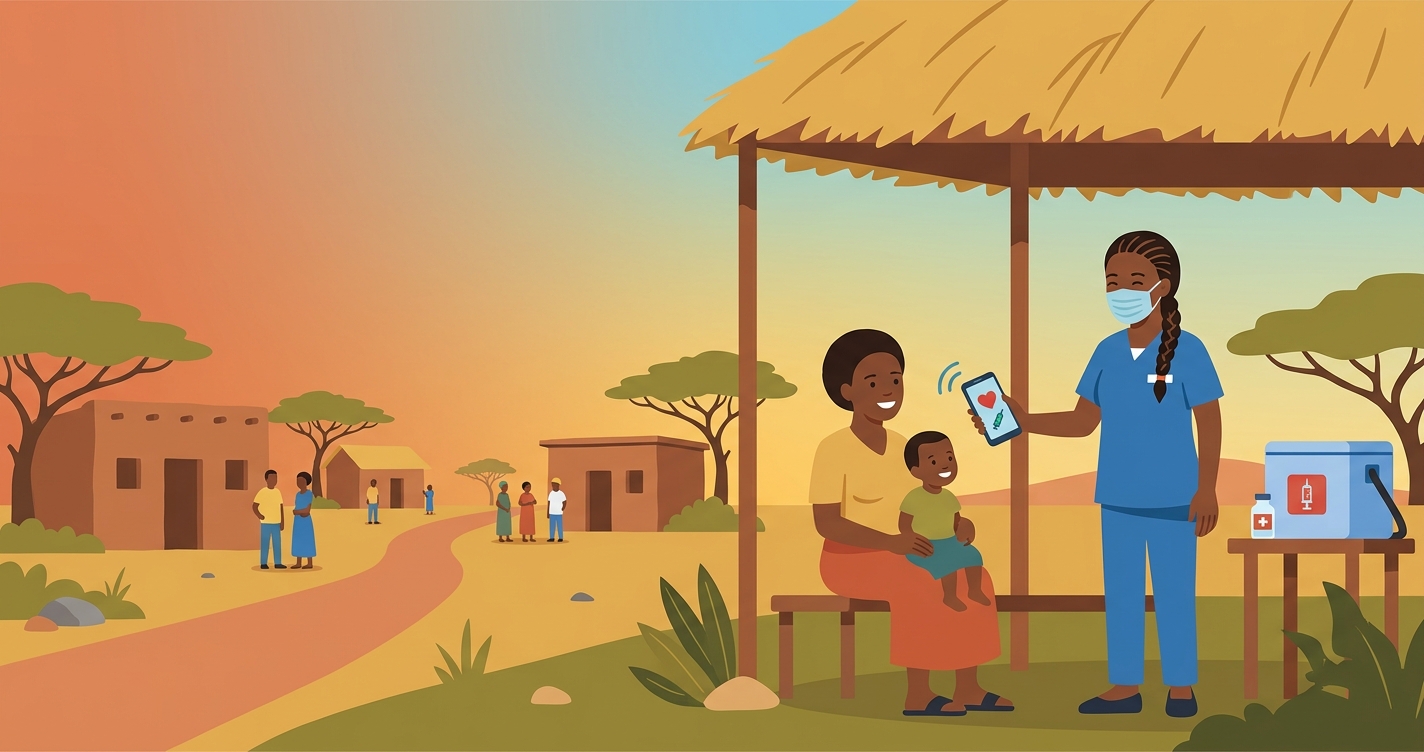
National immunization campaigns in Sub-Saharan Africa already reach millions of children and caregivers every year. Polio supplementary immunization activities alone contact an estimated 450 million children annually across the African region, according to the WHO Regional Office for Africa. These campaigns deploy thousands of community health workers who go door-to-door, set up fixed posts at markets and churches, and spend weeks moving through areas that the formal health system barely touches the rest of the year. The infrastructure is there. The contact points exist. What almost never happens during these campaigns is any health assessment beyond the vaccine itself.
That missed opportunity sits at the center of a growing conversation among global health program designers. Contactless vitals and national immunization campaigns represent two systems that, if layered together, could turn vaccination touchpoints into population health screening events without adding significant cost or complexity.
"Immunization contacts remain the single most reliable touchpoint between health systems and hard-to-reach populations. Any strategy to extend primary healthcare services should start by asking what else can happen during that contact." — Dr. Seth Berkley, former CEO of Gavi, the Vaccine Alliance, in a 2023 address to the World Health Assembly
Why immunization campaigns are the right integration point
The logic is straightforward but worth stating clearly. Immunization campaigns solve the hardest problem in community health: getting a trained worker in front of a person. Everything else about screening, including identifying hypertension, flagging respiratory concerns, detecting fever, and triaging referrals, depends on that initial contact happening. And in much of rural Sub-Saharan Africa, it happens reliably only during vaccination drives.
Consider the numbers. UNICEF's 2024 State of the World's Children report estimated that 67% of zero-dose children (those who have never received a single vaccine) live in remote or conflict-affected communities. These same communities have the least access to routine health services. When a supplementary immunization activity reaches them, it may be the only interaction with a health worker that household has all year.
The African Region certified wild poliovirus eradication in August 2020 after decades of campaign infrastructure investment. That infrastructure didn't disappear. Countries like Nigeria, Democratic Republic of Congo, Ethiopia, and Uganda maintain campaign logistics networks capable of reaching tens of millions of people in a matter of weeks. The question health planners are now asking is whether those networks can do more than deliver vaccines.
Dr. Tedros Adhanom Ghebreyesus, WHO Director-General, has repeatedly emphasized the concept of "immunization as a platform" for delivering integrated primary health care services. The 2021 Immunization Agenda 2030 framework explicitly calls for using immunization contacts to deliver other health interventions, including health screening and referral.
What contactless vitals add to the equation
Traditional vital signs measurement requires equipment. A blood pressure cuff, a pulse oximeter, a thermometer. Each device needs batteries, calibration, maintenance, and training. For a door-to-door immunization campaign running across hundreds of thousands of households, adding physical screening equipment is a logistics problem that most program managers won't accept.
Smartphone-based contactless vital signs change the calculation. A community health worker who already carries a phone for campaign data collection (using tools like ODK, KoboToolbox, or DHIS2 Tracker) can potentially capture heart rate, respiratory rate, and oxygen saturation estimates through the same device. No additional equipment. No additional supply chain. The marginal cost of adding a screening step approaches zero once the software is deployed.
| Factor | Traditional Screening Equipment | Contactless Smartphone Screening |
|---|---|---|
| Additional hardware needed | BP cuffs, pulse oximeters, thermometers | None (uses existing CHW phone) |
| Per-unit equipment cost | $30-150 per kit | $0 marginal (software-based) |
| Supply chain burden | Batteries, calibration, replacements | Software updates via OTA |
| Training time required | 2-4 days for multi-device proficiency | 30-60 minutes for app orientation |
| Data entry | Manual recording or separate forms | Automatic digital capture |
| Screening time per person | 5-10 minutes | 30-60 seconds |
| Integration with DHIS2 | Requires manual data bridge | API-based or built-in |
| Maintenance in field conditions | Frequent (humidity, dust, damage) | Phone maintenance only |
This table isn't theoretical. Several mHealth programs have demonstrated that smartphone-based tools can be layered onto existing campaign workflows without breaking them. The challenge is doing it at a scale that matters.
How eLQAS and digital campaign tools paved the way
The technical groundwork for integrating additional digital tools into immunization campaigns was laid years ago. Electronic Lot Quality Assurance Sampling (eLQAS) replaced paper-based post-campaign surveys in multiple African countries starting around 2013. In South Sudan, eLQAS deployed on smartphones during supplementary vaccination activities produced faster, more accurate coverage assessments than the paper method it replaced, according to WHO documentation of the African region's polio eradication effort.
Nigeria's Emergency Operations Center, established during the polio eradication push, built a digital infrastructure that tracked vaccination teams in real-time using GPS-enabled smartphones. By 2019, the system covered over 800 local government areas. That same infrastructure, the phones, the data pipelines, the supervision structures, is exactly what a contactless vitals integration would plug into.
DHIS2, now used in 46 of the 47 countries in the WHO African Region according to the University of Oslo's Health Information Systems Programme, provides the backend that connects campaign-level data to national health information systems. Mozambique's 2024 campaign to reach zero-dose children used a custom DHIS2 Tracker program to register and follow individual children, a level of data granularity that could easily accommodate vital signs data captured during the same contact.
Dr. Jean Kaseya, Director General of the Africa Centres for Disease Control and Prevention, has described DHIS2 as "a key tool for digitizing Africa's public health systems." The platform's existing presence across the continent means that any contactless vitals tool built with DHIS2 integration has a ready-made path into national health data architectures.
The operational model: what integration actually looks like
Integrating contactless vitals into an immunization campaign is not a technology problem at this point. It's a workflow design problem. Here's what a realistic integration model involves.
Pre-campaign preparation
Campaign microplans already assign teams to geographic areas, estimate target populations, and allocate vaccine stocks. Adding a screening component means including it in the microplan from the start: defining which vital signs will be captured, setting referral thresholds, identifying the nearest health facility for each campaign zone, and ensuring the screening app is installed and tested on CHW phones before deployment begins.
Training happens during the standard pre-campaign orientation. CHWs spend 30-60 minutes learning the screening app alongside their existing training on vaccine administration and adverse event monitoring. The key is that screening happens after vaccination, not before. Vaccination remains the priority contact. The vital signs capture is an add-on that happens while the caregiver is already present.
During the campaign
A CHW arrives at a household. They administer the vaccine. While the caregiver waits the standard 15-minute observation period (recommended post-vaccination to monitor for adverse events), the CHW opens the screening app. A 30-60 second scan captures heart rate, respiratory rate, and oxygen saturation estimates. The data is tagged with the campaign identifier, geographic coordinates, and a timestamp. If any readings fall outside normal ranges, the app generates a referral notification to the nearest facility.
Post-campaign data flow
Campaign data flows through existing reporting channels. DHIS2 aggregate reports already capture doses administered by district and by antigen. Adding vital signs summary data (percentage of screened individuals with elevated readings, referral rates by zone, screening coverage relative to vaccination coverage) gives district health officers a health status snapshot that didn't exist before.
This is where the value compounds. Individual campaigns produce useful data. Multiple campaigns over time produce trend data. And trend data at scale is what health ministries need to allocate resources, justify budget requests, and target chronic disease prevention programs.
What the evidence says about multi-service delivery during campaigns
The idea of using immunization contacts to deliver other services isn't new. Vitamin A supplementation has been routinely integrated into polio campaigns across Sub-Saharan Africa for decades. Deworming tablets are distributed during measles campaigns. Insecticide-treated bed nets have been given out at vaccination posts.
A 2022 systematic review by Partapuri, Steinglass, and Burnett published in Vaccine examined 38 studies on integrated service delivery during immunization campaigns. They found that adding services like vitamin A, deworming, and growth monitoring did not significantly reduce vaccination coverage when properly planned. The additional services benefited from the campaign's reach, and the campaign itself sometimes saw improved attendance because caregivers perceived more value in the visit.
The same review noted limitations: adding too many services can overwhelm health workers and slow down campaign flow. The authors recommended that any integrated service should take less than two minutes per contact and require minimal additional training. Contactless vitals screening, at 30-60 seconds with automated data capture, fits squarely within those parameters.
Dr. Robert Steinglass, a senior immunization specialist formerly with the John Snow Inc. MOMENTUM program, has argued that "the immunization platform is underleveraged" and that health systems should view every campaign contact as "an opportunity for a brief health encounter, not just a needle."
Challenges that program designers need to solve
None of this is without friction. Several real obstacles stand between the concept and widespread implementation.
Phone availability and quality
Not every CHW has a smartphone. A 2023 survey by the GSMA found that while mobile phone ownership in Sub-Saharan Africa exceeded 50%, smartphone penetration was closer to 29% in rural areas. Campaign programs that rely on CHW-owned devices face inconsistency in hardware quality. Programs that issue devices face procurement and asset management costs.
Camera quality matters for contactless vitals. Older or low-end smartphones may lack the camera resolution or frame rate needed for reliable readings. This is a solvable problem (newer budget phones like the Tecno Spark series popular across East Africa have increasingly capable cameras), but it needs to be addressed in procurement specifications.
Connectivity in remote areas
Immunization campaigns reach areas with little or no cellular coverage. The screening app needs to work offline and sync data when connectivity returns. This is standard practice for tools like ODK and DHIS2 Android Capture, but it requires deliberate architectural choices. Data queuing, conflict resolution, and batch upload logic all need to be built in before the first campaign launches.
Regulatory and ethical considerations
Capturing vital signs data during a campaign raises questions about informed consent, data ownership, and the boundary between screening and diagnosis. Health ministries need clear guidance on what the screening data can and cannot be used for. A referral based on an elevated heart rate reading from a smartphone app is not a diagnosis, and the communication around it matters.
WHO's 2019 recommendations on digital health interventions provide a framework, but country-level regulatory environments vary significantly. Any integration program needs to work with national health authorities to establish data governance protocols before deployment.
Sustainability beyond donor funding
Immunization campaigns in many African countries depend heavily on Gavi and UNICEF funding. Adding a screening component funded by a separate donor creates a dependency that may not survive funding transitions. The most sustainable model builds the screening capability into the campaign's core budget, framing it as an enhancement to campaign effectiveness rather than a separate vertical program.
Where this is heading
The convergence of three trends makes this integration increasingly inevitable rather than aspirational.
First, smartphone penetration across Sub-Saharan Africa continues to climb. The GSMA projects 615 million smartphone connections in the region by 2030, up from roughly 290 million in 2023. The hardware barrier is eroding on its own.
Second, the global health community is moving aggressively toward integrated primary health care delivery. The Immunization Agenda 2030 framework, the WHO's operational guidance on integrating health services, and Gavi's 5.0 strategy all emphasize using immunization platforms as entry points for broader health service delivery. The policy environment is aligned.
Third, contactless vitals technology is maturing. Companies like Circadify are developing smartphone-based vital signs measurement specifically designed for field conditions, including low-bandwidth environments, variable lighting, and diverse skin tones. As these tools prove themselves in community health settings, their integration into campaign workflows becomes a natural next step. More information on field deployment approaches is available at circadify.com/blog.
The organizations that move first on this will be the ones that already have both immunization campaign experience and digital health implementation capacity. And the countries that adopt it earliest will likely be those where DHIS2 infrastructure is mature, CHW smartphone programs are established, and health ministries are actively seeking ways to extend the value of their campaign investments.
Frequently Asked Questions
Does adding vital signs screening slow down immunization campaigns?
Evidence from integrated service delivery studies suggests that services taking under two minutes per contact do not significantly impact campaign throughput. Contactless vitals screening takes 30-60 seconds and happens during the standard post-vaccination observation period, so it should not create bottlenecks in well-planned campaigns.
What vital signs can smartphone cameras actually measure?
Smartphone-based rPPG technology can estimate heart rate, respiratory rate, and blood oxygen saturation by analyzing subtle color changes in facial skin captured by the phone's camera. Blood pressure estimation is an active area of research but is not yet reliable enough for clinical screening in field conditions.
How does screening data get into national health systems?
Through DHIS2 integration. Most African countries already use DHIS2 for health data management, including immunization campaign reporting. A screening app built with DHIS2 APIs can push vital signs data directly into existing national health information infrastructure, avoiding the creation of parallel data systems.
Who pays for the screening component?
The most sustainable approach builds screening into the campaign budget rather than funding it separately. Since the primary cost is software (the phones already exist for campaign data collection), the incremental expense is modest. Gavi's integrated service delivery framework and WHO's primary health care integration guidance both support this kind of cost-sharing model.
For related analysis on community health worker deployment and contactless screening in Sub-Saharan Africa, see our coverage of how community health workers use contactless screening tools and smartphone vital signs in Sub-Saharan Africa.