Can contactless vitals save lives in places without electricity?
Analyzing the role of smartphone-based contactless vital signs monitoring in healthcare settings with unreliable power, focusing on Sub-Saharan Africa.
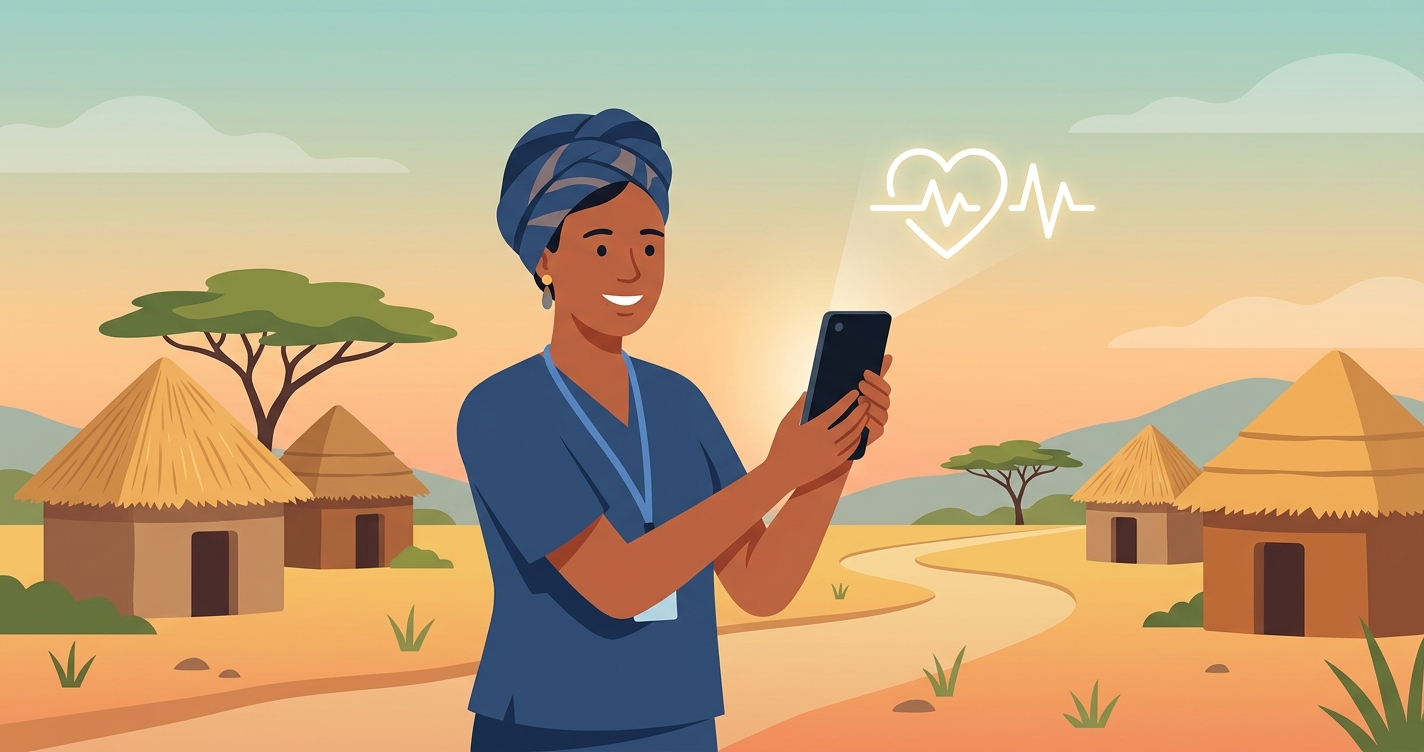
The delivery of healthcare in regions with intermittent or non-existent electricity is one of the most persistent challenges in global health. For hundreds of millions of people, access to even basic diagnostic procedures is constrained by the electrical grid. This reality forces a critical question: how can technology bridge this gap? The emergence of smartphone-based health screening, particularly contactless vitals no electricity solutions, offers a potential shift, moving essential health assessments from powered clinics to any community with a mobile phone.
"In Sub-Saharan Africa, only about half of hospitals have reliable access to electricity. For lower-level facilities, the situation is even more dire. This single infrastructure gap compromises everything from vaccine storage to the use of basic diagnostic equipment."
- World Health Organization (WHO), 2023
The challenge of healthcare delivery with contactless vitals no electricity
In much of Sub-Saharan Africa, the electrical grid is not a given. A 2023 report from the World Health Organization and the World Bank noted that about 15% of healthcare facilities in the region have no electricity at all. For those that do, service is often unreliable, forcing reliance on expensive and inconsistently available diesel generators. This has profound implications for the type of medical equipment that can be deployed.
Traditional vital signs monitors - blood pressure cuffs, pulse oximeters, and electrocardiogram machines - all require a stable power source for operation and recharging. While some are battery-powered, their utility is limited by the need for eventual recharging, a significant logistical hurdle in off-grid areas. This "power bottleneck" effectively excludes many communities from consistent health monitoring, a critical component of managing chronic conditions like hypertension and tracking maternal and child health. This is the specific gap where solutions for contactless vitals no electricity become most relevant. By using the processing power of a standard smartphone, these technologies bypass the need for dedicated, power-hungry medical hardware.
| Feature | Traditional Vital Signs Monitors | Smartphone-Based Contactless Vitals |
|---|---|---|
| Power Requirement | Requires consistent electricity for operation or recharging of dedicated batteries. | Uses the smartphone's internal battery; can be recharged with common power banks. |
| Hardware Dependency | Relies on specialized medical devices (cuffs, probes, sensors). | No external hardware needed; uses the phone's built-in camera. |
| Portability | Often bulky and requires careful transport; multiple devices needed. | Highly portable; a single smartphone can run multiple assessments. |
| Supply Chain | Requires procurement and maintenance of devices, cuffs, and parts. | Primarily software-based; distributed through app updates. |
| Training | Requires clinical training on proper use of each device. | Simplified user interface designed for community health workers. |
This shift has several immediate benefits for health programs operating in energy-poor environments.
- It eliminates the need to procure, maintain, and power a suite of separate medical devices.
- It dramatically increases the portability and reach of health screening initiatives.
- It lowers the barrier to entry for community health workers (CHWs), who are already familiar with smartphone technology.
Industry Applications
The ability to measure vital signs using a device that does not depend on a clinical power source unlocks several key applications for global health programs.
Community health worker programs
CHWs are the foundation of primary care in many rural parts of Africa. Equipping them with smartphones capable of contactless vital sign assessment allows them to screen for conditions like hypertension or pre-eclampsia during household visits, far from any clinic. This model decentralizes screening, turning every CHW with a charged phone into a mobile health checkpoint.
Humanitarian and refugee settings
In crisis situations, deploying traditional medical infrastructure is slow and complex. Refugee camps and internally displaced person (IDP) settlements are often in locations with no reliable power. Smartphone-based screening allows aid organizations to rapidly assess large numbers of people for baseline health indicators, triage critical cases, and monitor for disease outbreaks without setting up a field hospital.
National health campaigns
Ministries of Health can integrate contactless screening into large-scale public health initiatives like immunization drives or maternal health weeks. As health workers administer vaccines, they can simultaneously capture baseline vitals using their phones, gathering valuable population-level data that would otherwise be impossible to collect at scale.
Current research and evidence
The core technology enabling contactless vitals is remote photoplethysmography (rPPG), which uses a smartphone's camera to detect minute changes in light reflected from the skin, corresponding to blood flow. While promising, its effectiveness in real-world field conditions is a subject of ongoing research.
A key area of investigation concerns performance across diverse skin tones and in variable lighting conditions, which are common challenges in rural Africa. Researchers like those at Google and other institutions have published extensively on algorithmic methods to improve accuracy and mitigate bias. A 2023 study published in Nature by a team at the University of Washington demonstrated a new approach using polarized light to improve signal quality from deeper blood vessels, showing consistent performance across different skin tones. Another research team explored physics-driven algorithms to better separate the desired rPPG signal from environmental noise (Chen et al., 2022).
Furthermore, studies are validating the use of this technology specifically in low-resource settings. A project in Ethiopia focused on developing a low-cost system for transmitting vital signs data from rural areas to a central monitoring station, demonstrating the feasibility of such systems even with limited connectivity (as detailed in a 2021 research paper available on ResearchGate). These studies confirm that while challenges exist, the scientific community is actively working to refine and validate contactless vitals no electricity applications for the unique demands of global health.
The future of contactless vitals in off-grid healthcare
Looking ahead, the evolution of contactless vitals will likely focus on three areas. First is the expansion of measurable biomarkers. While heart rate and respiration rate are well-established, work is accelerating on camera-based blood pressure and blood oxygen (SpO2) estimation, which would dramatically increase the clinical utility.
Second is the improvement of on-device AI models. As these models become more efficient, they will require less processing power, extending the battery life of the smartphones running them, a critical factor in off-grid settings. This also allows for more sophisticated analysis to happen "at the edge," without needing to send data to the cloud.
Third is the integration with national health information systems. For data collected by a CHW in a remote village to be truly valuable, it must flow into the national health data architecture. This will require new standards and interoperability protocols to ensure that a vital sign taken on a smartphone in the field can inform policy at the Ministry of Health.
Frequently asked questions
Q: How accurate is contactless vital sign monitoring? A: Accuracy is a key area of research. For measurements like heart rate and respiratory rate, studies have shown high concordance with traditional medical devices under good conditions. Accuracy can be affected by factors like movement, low light, and certain skin tones, but researchers are developing advanced algorithms to improve performance and reduce bias.
Q: What vital signs can be measured with just a smartphone camera? A: Currently, heart rate, heart rate variability, and respiratory rate are the most common and well-validated measurements. Active research and development are underway for blood pressure, blood oxygen saturation (SpO2), and even hemoglobin levels.
Q: Does this technology require a special, expensive smartphone? A: No. Most modern contactless vitals solutions are designed to work on common, off-the-shelf Android and iOS smartphones. The goal is to use the devices that people already have, making the technology highly scalable.
As a leader in camera-based health screening, Circadify is deeply engaged with solving the challenges of deploying these technologies in low-resource settings. By focusing on offline-first, hardware-agnostic solutions, we support global health partners in reaching communities regardless of their connection to the grid. To learn more about our work and explore potential field partnerships, visit Circadify's global health program at circadify.com/blog.