Diabetes Screening in Sub-Saharan Africa Without Lab Tests
How phone-based community programs flag diabetes risk early in Sub-Saharan Africa where lab access is scarce, and what it means for the rising NCD burden.
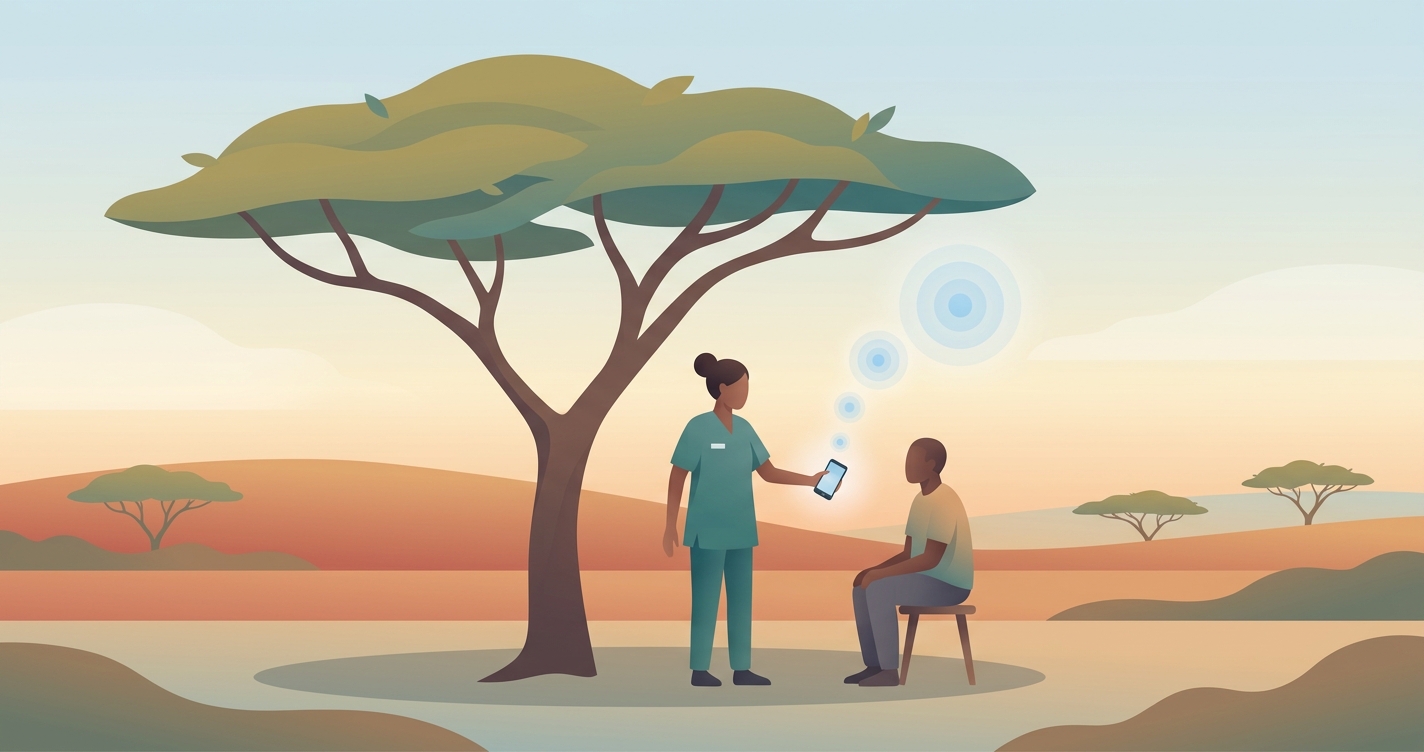
Program managers building non-communicable disease strategies across the region keep colliding with the same structural fact: most people who develop type 2 diabetes will never see a fasting glucose test until the disease has already damaged their kidneys, nerves, or eyes. The diagnostic pathway everyone learned in training assumes a laboratory, a phlebotomist, a centrifuge, and a cold chain for reagents. In rural districts those assets are concentrated in a handful of referral hospitals, often a full day's travel away. This mismatch between where people live and where blood is analyzed is the central problem any realistic approach to diabetes screening Sub-Saharan Africa must solve, and it is why attention is shifting toward checks that need no needle and no lab at all.
"More than one in two adults living with diabetes in the IDF Africa Region are undiagnosed - the highest proportion of any region in the world." - International Diabetes Federation, Diabetes Atlas, 10th Edition (2021)
Why diabetes screening Sub-Saharan Africa needs a non-lab pathway
The numbers behind the urgency are not subtle. The International Diabetes Federation's 2021 Diabetes Atlas counted roughly 24 million adults living with diabetes in Sub-Saharan Africa, a figure projected to reach 33 million by 2030 and 55 million by 2045. Diabetes was linked to about 416,000 deaths in the region in 2021, and regional health expenditure tied to the condition reached an estimated 12.9 billion US dollars. The defining feature, though, is detection failure: over half of cases go undiagnosed, the worst ratio of any IDF region.
The reason is mechanical, not behavioral. Confirmatory diagnosis depends on fasting plasma glucose, oral glucose tolerance testing, or HbA1c, all of which require laboratory infrastructure. In settings where a single district lab serves hundreds of thousands of people, screening the asymptomatic majority with blood draws is neither affordable nor logistically feasible. A non-lab pathway changes the question from "who can we test" to "who do we need to test," letting scarce confirmatory capacity focus on people already flagged as high risk.
That two-step logic - cheap, scalable risk stratification first, then targeted confirmation - is the backbone of modern community-level non-communicable disease screening Africa programs. The first step does not have to be perfect. It has to be cheap, fast, and good enough to sort a crowd at a market or an immunization day into "reassure and educate" versus "refer for a glucose test."
The table below compares the main approaches health ministries weigh when designing that first step.
| Screening approach | Equipment needed | Lab dependency | Cost per person | Field scalability | Best role |
|---|---|---|---|---|---|
| Fasting plasma glucose / OGTT | Lab, phlebotomy, cold chain | High | High | Low | Confirmation, not mass screening |
| Point-of-care HbA1c device | Dedicated analyzer + cartridges | Medium | Medium-high | Medium | Clinic-based confirmation |
| FINDRISC-style risk questionnaire | Paper or phone, tape measure | None | Very low | High | Population risk stratification |
| Phone-based vitals and risk capture | Smartphone only | None | Low | Very high | First-pass mass screening |
How phone-based checks flag risk without a needle
The validated starting point is the questionnaire. The Finnish Diabetes Risk Score (FINDRISC) estimates ten-year type 2 diabetes risk from age, body mass index, waist circumference, physical activity, diet, blood pressure history, and family history - no blood required. African validation studies have tested how well it travels. Work led by researchers publishing in PLOS One (2021) on Kenyans aged 18 to 69 found a simplified FINDRISC useful for detecting undiagnosed diabetes, and a 2022 Nigerian primary-care study reported it to be a practical non-invasive screen. A Tanzanian study in young urban adults (MDPI, 2021) was more cautious, finding modest sensitivity in that narrow age group - a reminder that a questionnaire must be calibrated to the population it screens.
A smartphone extends this in three ways. First, it digitizes the questionnaire so a community health worker captures structured, geotagged data instead of paper that may never be entered. Second, the camera can add objective signals. Remote photoplethysmography (rPPG) reads subtle color changes in facial skin to estimate pulse rate and other cardiovascular vitals, contactless vitals rural healthcare workers can collect without a cuff or a finger clip. Because hypertension and elevated resting heart rate cluster with metabolic risk, these readings sharpen a risk profile that a questionnaire alone would miss. Third, the device handles referral logic, telling the worker on the spot whether a person should continue to a confirmatory glucose test.
What this combination produces is not a diagnosis. It is a triage decision, and that distinction matters for any ministry evaluating it:
- A high-risk flag means "send this person for a confirmatory glucose test," not "this person has diabetes."
- A low-risk result is an opportunity for lifestyle counseling, not a discharge.
- The objective vitals reduce reliance on self-reported history, which is often incomplete.
- Digital capture builds a district-level risk map that paper screening cannot.
Industry Applications
Community campaigns and outreach days
mHealth Sub-Saharan Africa deployments work best when they ride existing foot traffic. Immunization days, antenatal visits, and market-based outreach already gather adults in one place. Adding a five-minute phone-based risk check converts those moments into NCD screening events without standing up new clinics. Because the only hardware is a device a worker already carries, a program can screen hundreds in a day and still route only the flagged minority toward limited lab capacity.
Integration with community health worker networks
Community health workers are the existing distribution channel for primary care across much of the region. A smartphone tool fits their workflow if it is fast, works offline, and produces a clear next step. The systematic review of mHealth for diabetes and hypertension in Africa (published via PMC, 2024) found growing evidence that mobile interventions improve management, while flagging recurring barriers: device cost, intermittent connectivity, and the need for training. A screening tool designed around those constraints - offline-first, single-device - sidesteps the worst of them.
Surveillance and policy data
Every screening encounter is also a data point. Aggregated, phone-captured risk scores give health ministries something they rarely have: near-real-time district maps of where metabolic risk is concentrating. That feeds resource allocation, justifies budget requests, and lets planners measure whether outreach is reaching the populations most likely to be undiagnosed.
Current research and evidence
The evidence base splits cleanly into two validated layers. On the questionnaire side, FINDRISC and its simplified variants have multiple African evaluations - Kenya and Nigeria showing useful performance for detecting undiagnosed diabetes, Tanzania urging age-specific calibration. On the mHealth side, the BMJ Open systematic review protocol and the 2024 PMC meta-analysis both document a rapid rise in mobile interventions for diabetes management, alongside consistent acceptability findings such as the Johannesburg commuter study (PMC) on diabetes risk-awareness apps.
What remains thinner is head-to-head field validation of camera-derived vitals against reference instruments in African community settings, and prospective evidence that phone-flagged individuals actually complete confirmatory testing and treatment. The African High-Level Panel on Innovation and Emerging Technologies has encouraged adoption of smartphone-based diabetes tools, but encouragement is not the same as a referral-completion dataset. Programs should treat current tools as risk-stratification aids with strong logistical advantages and a still-maturing evidence record for their newest components.
The Future of diabetes screening Sub-Saharan Africa
The trajectory is toward a layered model rather than a single replacement technology. Phone-based risk capture handles volume at the community level. Point-of-care confirmation handles the flagged minority at the clinic. Laboratories handle complex or ambiguous cases. As rPPG and related camera methods accumulate field validation, the first layer will carry more objective signal and refer with greater precision, lowering the burden on confirmatory capacity. The decisive variable will not be the algorithm but the referral pathway: a flag that leads nowhere helps no one. Ministries that pair screening with a guaranteed route to confirmation and treatment will see the early-detection gains; those that deploy the phone alone will generate data without changing outcomes.
Frequently asked questions
Can a phone diagnose diabetes? No. Phone-based tools estimate risk and capture vitals to decide who should be referred for a confirmatory glucose or HbA1c test. Diagnosis still requires a laboratory or point-of-care blood measurement.
Why not just expand lab testing instead? Lab expansion is necessary for confirmation but cannot scale to screen the asymptomatic majority across rural districts. Non-lab screening narrows the population that needs blood testing, so limited lab capacity reaches the people most likely to be affected.
Is the FINDRISC questionnaire valid in African populations? Studies in Kenya and Nigeria found simplified FINDRISC useful for detecting undiagnosed diabetes, while a Tanzanian study urged age-specific calibration. It is a reasonable risk-stratification base when tuned to the local population.
What infrastructure does phone-based screening require? A smartphone, trained community health workers, and a working referral pathway. Offline-capable tools remove the dependence on continuous connectivity, which is the most common field constraint.
Circadify is working on this exact gap, building smartphone-based vital signs screening designed for community deployment where labs and equipment are scarce. Health ministries and global health partners exploring partnership or field data can follow the work and case studies in the global health section at circadify.com/blog.