
Will my elderly relative’s cough get worse before we can find help?
Why an elderly cough can turn serious fast in Africa, and how contactless screening helps NGOs and health ministries catch warning signs earlier.
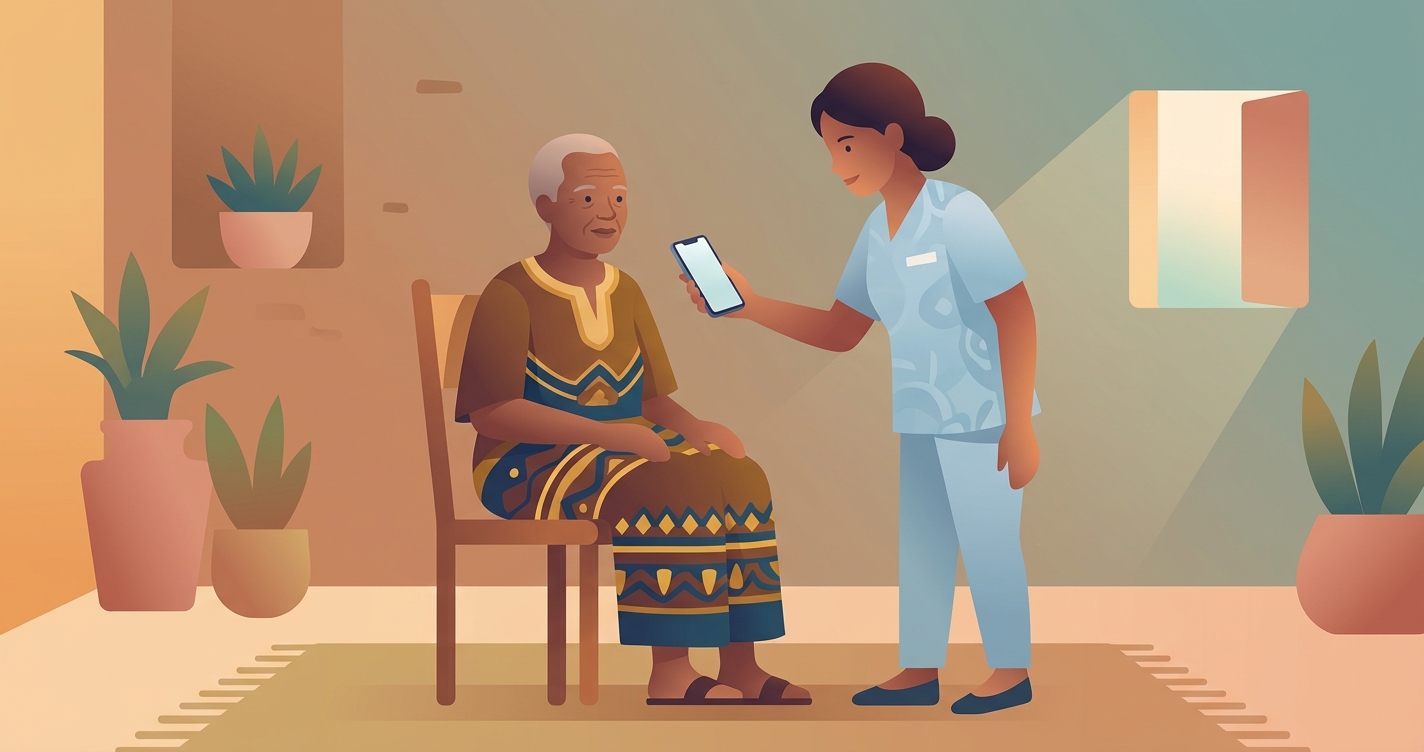
A persistent cough in an older relative rarely announces itself as an emergency. It starts as a nuisance, gets blamed on dust or the cold season, and is watched at home for days. By the time the breathing changes and the family decides to travel, the window for a simple intervention may already have closed. For health ministries and NGOs working across rural Sub-Saharan Africa, this slow drift from minor symptom to crisis is one of the most preventable patterns in elder care. Understanding when an elderly cough is serious in Africa, and building systems that flag it early, is now a measurable opportunity to reduce avoidable deaths in older populations.
A 2023 systematic review of pneumonia in older adults across Sub-Saharan Africa found consistently high case fatality rates, driven less by the infection itself than by delayed presentation and limited access to diagnostics and oxygen.
Why an elderly cough turns serious in Africa faster than families expect
The clinical reason older adults deteriorate quickly is well documented. Pneumonia and other lower respiratory infections often present atypically in the elderly. Instead of a dramatic high fever, the early signs may be confusion, reduced appetite, fatigue, and a quiet rise in breathing rate. Co-morbidities common in the region, including HIV, tuberculosis, undernutrition, and uncontrolled hypertension, lower the body's reserve. A 2023 systematic review by researchers publishing in PMC on pneumonia in older adults in Sub-Saharan Africa described both the substantial burden and the diagnostic delays that make outcomes worse.
The logistical reason is geography. An estimated 400 million people in Sub-Saharan Africa live more than two hours from the nearest hospital. When the warning signs are subtle and the journey is long, families face a genuine dilemma: travel now on a hunch, or wait and risk that the cough was the first stage of something that needed treatment 48 hours ago.
Respiratory rate is the single most useful early signal here, and it is also the one most often missed. A breathing rate that has crept above 22 to 24 breaths per minute in an older adult with a cough is a recognized red flag long before oxygen saturation collapses. Counting it accurately by eye, in a noisy home, is difficult even for trained staff. That is precisely where contactless screening changes the calculation.
Comparing the options for catching a worsening cough early
Families and program managers are effectively choosing between several screening pathways. The table below compares them on the factors that matter in low-resource elder care.
| Screening approach | Equipment needed | Time per person | Works far from clinic | Early-warning value for cough |
|---|---|---|---|---|
| Wait and watch at home | None | Days | Yes, but passive | Low - signs noticed late |
| Travel to nearest clinic | Transport, cost | Hours to days | No | High, but often too late |
| Community health worker visit with manual vitals | Thermometer, watch, cuff | 5-10 min | Partial | Moderate - depends on skill |
| Smartphone contactless screening | Existing phone | Under 2 min | Yes | High - objective respiratory and pulse signals |
The pattern is clear. The approaches with the strongest early-warning value have historically required either a journey the family cannot easily make or equipment the community health worker does not have. Contactless smartphone screening is the option that combines speed, reach, and an objective measurement.
Key advantages families and field teams report:
- No needles, cuffs, or consumables that run out mid-campaign
- A measurement that does not depend on the older adult tolerating contact, which matters for frail or distressed patients
- Results that travel as data, so a flagged case can be referred before the family commits to a long trip
- A low training burden for community health workers already stretched across many tasks
Industry applications for elder respiratory screening
National elder care and NCD programs
Many African health ministries are extending non-communicable disease and aging programs into rural districts. Adding a fast respiratory and pulse check to routine community visits lets these programs catch worsening coughs in the same encounter used for blood pressure or diabetes follow-up, without new hardware budgets.
NGO home-visit and outreach models
For NGOs running home-based elder care, the bottleneck is the number of households a worker can meaningfully assess in a day. A sub-two-minute contactless check raises throughput while keeping an objective record, which strengthens both triage and later reporting to donors.
Refugee and displacement settings
Older adults in displacement camps face crowding, cold nights, and limited oxygen access. Rapid, equipment-light screening helps overstretched teams sort the many coughs that will resolve from the few that signal pneumonia needing urgent referral.
Current research and evidence
The evidence base for contactless vital sign measurement has matured quickly. Remote photoplethysmography, or rPPG, estimates pulse and respiratory rate from subtle color changes in facial video captured by an ordinary smartphone camera. A 2023 prospective validation study published in PMC reported a mean absolute error of roughly 0.78 breaths per minute for smartphone camera-based respiratory rate, well within the pre-specified clinical goal of 3 breaths per minute, with similar accuracy in participants who had chronic respiratory conditions. A separate 2023 evaluation of an rPPG-enabled application reported respiratory rate measurement in normotensive adults, and a 2024 study using photoplethysmographic imaging with discrete wavelet transform reported maximum absolute errors below 1 breath per minute in a small sample.
On the clinical urgency side, the 2023 systematic review of pneumonia in older adults in Sub-Saharan Africa and a related 2023 meta-analysis of older-adult mortality in the region both point to the same conclusion: outcomes hinge on how early a deteriorating patient is identified and referred. The World Health Organization continues to list lower respiratory infections among the leading causes of death in older populations globally, with the heaviest burden in low- and middle-income settings.
The research has limits worth stating plainly. Most validation has occurred in controlled or higher-income settings, sample sizes are often modest, lighting and motion degrade accuracy, and few studies focus specifically on frail elderly patients in field conditions. The direction of evidence is encouraging, but field data from African deployments is the gap the sector still needs to close.
The Future of elderly cough screening in underserved regions
The trajectory points toward screening that is embedded in the visits that already happen. Three shifts are likely over the next several years. First, respiratory rate and pulse checks will become a standard, expected part of community health worker elder visits rather than an optional extra. Second, screening data will feed district dashboards, letting ministries see clusters of respiratory deterioration during cold seasons or outbreaks and pre-position oxygen and referral capacity. Third, the same phone-based workflow used for children and pregnant women will extend to older adults, so a single tool covers the whole household.
The harder work is not technical. It is referral pathways, transport for flagged cases, and sustaining programs past the pilot stage. A screening tool that identifies a worsening cough is only as valuable as the system standing ready to act on the flag.
Frequently asked questions
How can I tell if my elderly relative's cough has become serious? Watch for faster breathing, new confusion or drowsiness, reduced eating and drinking, bluish lips, chest pain, or a cough that worsens over two to three days rather than improving. In older adults these signs can appear without a dramatic fever, so a rising breathing rate is one of the most reliable early warnings.
Why is respiratory rate so important for older adults? A breathing rate creeping above the normal range often signals a lower respiratory infection before oxygen levels fall. Because it changes early, an accurate respiratory rate gives families and health workers more time to seek care, which research links directly to better outcomes.
Can a smartphone really screen for a serious cough without any equipment? Smartphone-based contactless screening uses the camera to estimate pulse and respiratory rate. Validation studies from 2023 and 2024 report respiratory rate errors of roughly one breath per minute against clinical references. It is a screening and triage aid that flags who needs follow-up, not a replacement for clinical diagnosis.
What should NGOs and health ministries do with screening results? The value comes from acting on flags. Programs need clear referral thresholds, a way to transport or escalate urgent cases, and data systems that aggregate results so districts can spot respiratory deterioration trends and allocate resources accordingly.
Circadify is working on exactly this space, deploying smartphone-based vital signs screening in Uganda so that a worsening cough in an older relative can be identified before the family runs out of time. For partnership opportunities and field data from these deployments, visit the global health section at circadify.com/blog.