How can I check for health problems in my family without travel?
A family health check at home is becoming possible in rural Africa through community-led, smartphone-based screening that removes the need for long-distance travel.
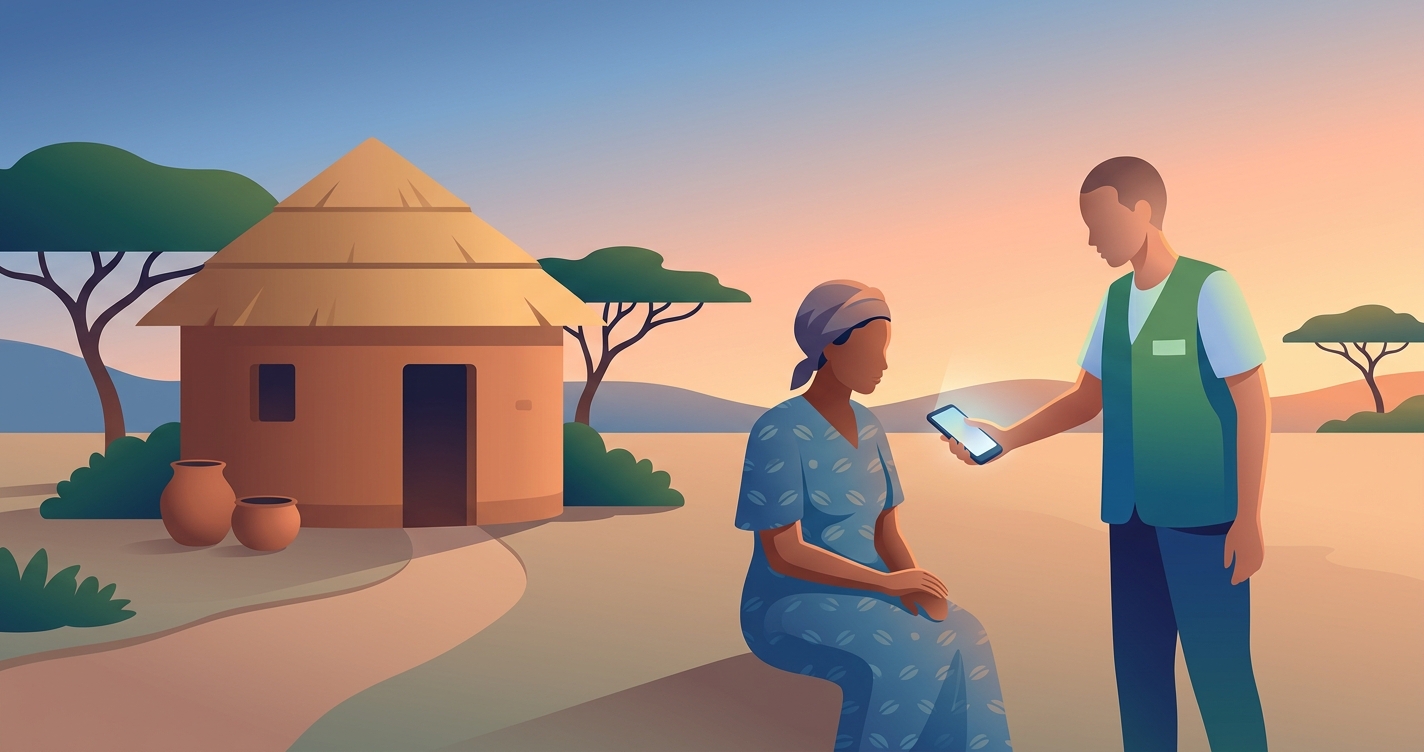
For millions of households across rural Sub-Saharan Africa, the question of how to check on a sick relative rarely begins with a clinical measurement. It begins with a calculation about distance. A grandmother with a persistent headache, a child whose breathing has changed, a pregnant sister who feels unwell: each of these situations forces a family to weigh the cost, time, and risk of a journey against the uncertainty of staying home. A reliable family health check at home in Africa, without that journey, has long been treated as a luxury rather than a baseline. That assumption is now being tested by a new generation of community-led screening models that move basic health assessment to where people already live.
"Around 65 percent of people in villages and dispersed rural areas were within 30 minutes of a health facility circa 2020, while roughly 10 to 15 percent had to travel more than three hours to reach any health post," reports research summarized from the European Commission Joint Research Centre's work on geographic access to healthcare in Sub-Saharan Africa (2022).
That travel gap is not a minor inconvenience. It changes who gets screened, when, and whether early warning signs are caught at all. For health ministries and global health programs, the operational problem is clear: the people most likely to develop preventable complications are also the least likely to reach a facility in time to do anything about them.
Why a family health check at home in Africa is now feasible
The idea of decentralized screening is not new, but the tools that make it practical at the household level have changed sharply. The decisive shift is the move away from dedicated medical equipment toward devices families and community workers already own. Smartphone-based screening using remote photoplethysmography (rPPG) is central to this. The technique reads tiny color changes in the skin captured by an ordinary phone camera and converts them into vital signs such as heart rate and respiratory rate, with no cuff, probe, or consumable required.
This matters because the binding constraint in rural settings is rarely clinical knowledge. It is logistics. A blood pressure cuff needs calibration. A pulse oximeter needs batteries and replacement probes. A thermometer breaks or goes missing. Each piece of equipment introduces a supply chain that must reach the last mile and stay funded. Software-based screening collapses much of that chain into a device that is already widespread, already charged, and already maintained by its owner.
The workforce shortage reinforces the case. According to the World Health Organization's 2024 review of the African health workforce, the region has only about 46 percent of the health workers it needs, with a projected deficit of 5.85 million by 2030. At the same time, the number of community health workers in the WHO African Region grew from 486,186 in 2018 to nearly 853,500 in 2021. Decentralized screening is, in practice, a way to extend the reach of that growing community workforce rather than wait for facility-based staff who may never arrive.
Comparing approaches to checking family health without travel
Families and programs effectively choose among a few models for assessing health close to home. Each carries different costs, accuracy expectations, and coverage limits.
| Approach | Travel required | Equipment burden | Who operates it | Best suited for |
|---|---|---|---|---|
| Travel to a facility | High (often 1 to 3+ hours) | None at home | Clinical staff | Diagnosis and treatment |
| Household visit by a community health worker | Low to none | Portable kit, consumables | Trained CHW | Routine checks, follow-up |
| Smartphone-based contactless screening | None | A phone already owned | CHW or family member | Early triage and referral |
| Waiting and observing symptoms | None | None | Family | Nothing reliable; high risk |
The comparison makes the trade-off visible. The lowest-burden options that require no travel have historically also been the least reliable, because "waiting and observing" is not a measurement. Contactless screening is significant precisely because it sits in the corner that was previously empty: no travel, minimal equipment, and an actual quantitative reading that can trigger a referral.
Key advantages that make home and community screening workable at scale include:
- No consumables to resupply, which removes a recurring cost and a frequent point of program failure
- Compatibility with phones that families and community workers already maintain and charge
- Fast screening times that suit high-volume campaigns and door-to-door visits
- Data that can be captured digitally and aggregated for program monitoring
- A lower training threshold than operating and interpreting multiple separate instruments
Persistent limitations that program designers should plan around include:
- Screening is triage, not diagnosis, and still depends on a referral pathway that works
- Accuracy across very dark skin tones requires datasets that represent those populations
- Connectivity and electricity gaps affect data sync even when the screening itself is offline-capable
- Community trust and consent practices must be built deliberately, not assumed
Industry applications for decentralized screening
NGOs running community outreach
For non-governmental organizations, the appeal is reach per dollar. A door-to-door team equipped with phones can screen far more households per day than a team carrying and recalibrating instruments. The model fits maternal and child health programs, where a quick check during a routine visit can flag a pregnant woman or infant who needs to reach a facility before a complication becomes an emergency.
Health ministries pursuing decentralized care
Ministries increasingly frame primary health care around bringing services closer to communities. Task shifting, where lower-level cadres take on tasks once reserved for clinicians, is already widely implemented across the region. Smartphone screening extends that logic to vital signs measurement, letting community workers generate structured data that feeds district-level planning rather than disappearing into paper registers.
Campaign and emergency contexts
During immunization drives, disease outbreaks, or displacement, the ability to screen large numbers quickly and without physical contact has obvious value. Contactless methods reduce shared-surface transmission risk and remove the bottleneck of limited devices being passed between hundreds of people.
Current research and evidence
The evidence base for contactless screening is maturing, with two threads worth tracking. The first is technical validation. A 2023 study published on medRxiv evaluating a remote photoplethysmography-enabled smartphone application reported that it could estimate heart rate, respiratory rate, and blood pressure in normotensive adults with accuracy comparable to reference standards. Separately, clinical validation work on rPPG-enabled contactless pulse rate monitoring in cardiovascular disease patients, published in MDPI's Sensors, has examined performance in patient populations rather than only healthy volunteers.
The second thread addresses a known weakness: representation. Most early rPPG datasets skewed toward lighter skin tones, which raised legitimate concerns about performance for the populations these African programs serve. The Vital Videos Africa dataset, collected in Ghana, was assembled specifically to improve model generalization across skin types 5 and 6. This kind of geographically representative data collection is what separates a method that works in a lab from one that works in a village. Field deployments in East Africa, including documented work in Uganda, are now generating the operational evidence on usability, training, and referral linkage that determines whether a tool survives past its pilot.
The future of decentralized family health screening
The trajectory points toward screening becoming a routine layer of community health rather than a special event. Three developments are likely to shape the next phase. First, integration: screening data will increasingly flow into national digital health information systems, so a household check contributes to district and national planning rather than ending at the doorstep. Second, multi-parameter expansion, where a single phone-based session estimates several indicators relevant to local disease burden. Third, a sharper focus on the referral side of the equation, because a screening result only saves a life if it reliably connects a family to care.
The realistic framing is not that phones replace clinics. It is that screening at home becomes the front door that decides who needs to travel and who does not. For families, that means fewer wasted journeys and fewer dangerous delays. For programs, it means scarce facility capacity is reserved for the people who genuinely need it.
Frequently asked questions
Can I really check a family member's health at home without any equipment? You can perform a meaningful screening, not a full diagnosis. Smartphone-based contactless methods can estimate vital signs such as heart rate and respiratory rate using only a phone camera. This is enough to flag warning signs and decide whether someone needs to reach a clinic, which is often the most important and time-sensitive decision a family faces.
Is smartphone screening accurate for people with dark skin? Early rPPG models underperformed for darker skin tones because training data lacked diversity. Recent efforts, including the Vital Videos Africa dataset collected in Ghana, were designed to improve performance for skin types 5 and 6. Accuracy depends heavily on the specific software and the quality of the data behind it, so programs should ask for evidence relevant to their population.
Who actually performs these checks in a community? In most models, trained community health workers conduct screening during household visits or campaigns, since they already hold community trust and understand referral pathways. Family members can also use these tools for basic checks, but linking results to a functioning referral system is what makes screening useful rather than just informative.
Does this replace going to a clinic? No. Screening is triage. It identifies who needs further care and how urgently, which reduces unnecessary travel for those who are fine and speeds up referral for those who are not. The clinic remains essential for diagnosis and treatment.
Circadify is working in this space directly, with smartphone-based vital signs screening deployed in community settings in Uganda and a focus on the field realities that decide whether decentralized care actually reaches families. Partnership inquiries and field data are available through the Circadify global health blog at https://circadify.com/blog, where program managers can review how contactless screening performs outside the lab and how it might fit a decentralized care strategy.