When should I worry about a fast heartbeat if there's no clinic?
A field guide to triaging a fast heartbeat with no clinic in Africa, using accessible smartphone tools to turn anxiety into actionable screening data.
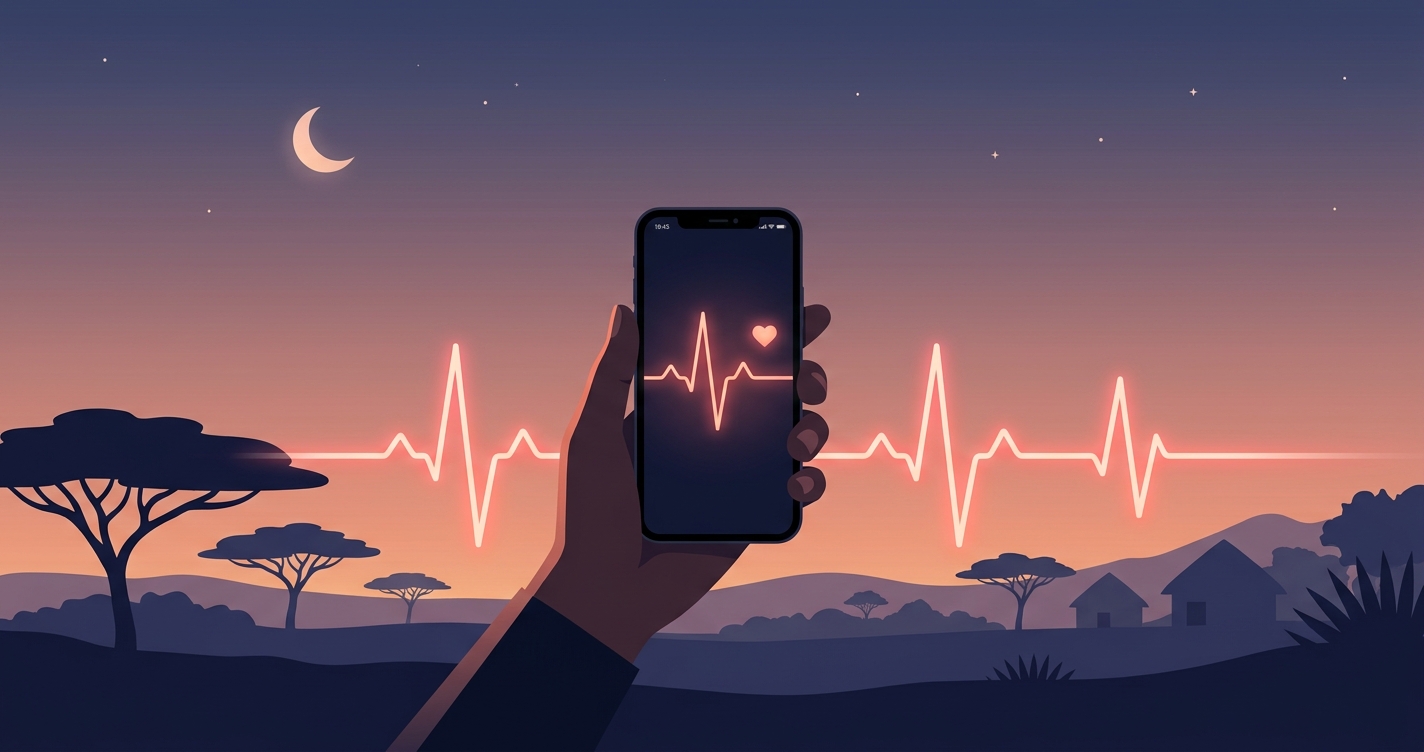
A racing heart in the middle of the night, far from any health facility, is one of the most common reasons families across rural Sub-Saharan Africa feel powerless. The symptom is frightening precisely because it is invisible to everyone except the person feeling it, and the usual advice to "see a doctor" assumes a doctor is reachable. For the millions facing a fast heartbeat with no clinic in Africa within a reasonable distance, the real question is not whether a racing pulse is theoretically dangerous, but how to separate the episodes that can wait until morning from the ones that cannot. That triage decision, normally made by a clinician with a stethoscope and a pulse oximeter, is increasingly being shifted toward accessible tools that a community health worker or family member can operate.
A normal resting heart rate for adults sits between 60 and 100 beats per minute, and a sustained rate above 100 at rest, known as tachycardia, becomes a concern when paired with chest pain, breathlessness, dizziness, or fainting, according to clinical guidance summarized by the Cleveland Clinic and the British Heart Foundation.
The gap this opens in low-resource settings is enormous. An estimated 400 million people in Sub-Saharan Africa live more than two hours from the nearest hospital. When a symptom like palpitations appears, the cost of an unnecessary journey, lost wages, transport, an overnight stay near a facility, competes directly with the risk of ignoring something serious. Getting even one objective number, the heart rate, can change that calculation.
Reading a fast heartbeat with no clinic in Africa
Tachycardia is a symptom, not a diagnosis. In high-income settings, palpitations are most often benign, triggered by caffeine, stress, dehydration, or anxiety. In much of Sub-Saharan Africa the differential looks different because the underlying disease burden is different. A persistently fast heartbeat can signal anemia, which affects a large share of women and children across the region, fever from malaria or other infections, dehydration from diarrheal illness, thyroid disorders, or the chronic damage of rheumatic heart disease, which remains far more prevalent in Africa than in wealthier regions. For pregnant women, a sustained high pulse can be one of the few early external signs that something is going wrong.
This is why a single number matters. A measured heart rate does not name the cause, but it answers the first triage question: is this within the normal range, mildly elevated, or dangerously high? Combined with simple observed signs, it gives a family or a community health worker a defensible basis for the next decision.
The table below outlines how the available options for assessing a fast heartbeat compare in settings where a clinic is hours away.
| Approach | Equipment needed | Skill required | Availability in remote areas | What it tells you |
|---|---|---|---|---|
| Manual pulse count | Watch or phone clock | Moderate, error-prone | High | Approximate heart rate only |
| Dedicated pulse oximeter | Device plus batteries | Low | Limited, supply-dependent | Heart rate and oxygen saturation |
| Smartphone PPG (finger on camera) | Existing smartphone | Low | High where phones exist | Heart rate, trend over time |
| Contactless rPPG (camera on face) | Existing smartphone | Low | High where phones exist | Heart rate without contact |
| Travel to nearest clinic | Transport, time, money | None for patient | Often hours away | Full clinical assessment |
The point of the comparison is not that a phone replaces a clinic. It is that for the first, urgent question, do we travel tonight or wait, the accessible options sit much closer to the patient than the clinic does.
Key signs that should push a family toward urgent travel regardless of the exact number include:
- A fast heartbeat that does not slow down after rest
- Chest pain or pressure alongside the racing pulse
- Shortness of breath or struggling to speak full sentences
- Dizziness, confusion, or fainting
- Blue or very pale lips and fingertips
- A racing heart in a pregnant woman, a young child, or an elderly relative
By contrast, a brief episode that settles within minutes, with no other symptoms and a return to a normal resting rate, is far more likely to be benign and can usually be monitored rather than acted on immediately.
Industry applications for remote heart rate triage
For health ministries, NGOs, and program managers, the value of accessible heart rate measurement is less about any single episode and more about systems that route patients correctly across whole populations.
Community health worker triage
Community health workers are the front line in most rural districts. A tool that lets them capture a reliable heart rate during a routine home visit converts a vague complaint of "my heart races" into a recordable vital sign. That number can anchor a referral decision and, when logged, builds a picture of cardiovascular risk in a catchment area that previously had none.
Maternal and child health programs
A sustained high pulse is a recognized warning sign in pregnancy and in seriously ill children. Integrating quick heart rate checks into antenatal visits and child health campaigns gives programs an early, low-cost filter to identify who needs to reach a facility before a crisis develops.
Population screening and surveillance
When heart rate data is captured at scale through screening campaigns, it feeds into something national systems badly lack: baseline cardiovascular data. Rheumatic and hypertensive heart disease are major causes of death in the region, yet they are poorly counted. Accessible measurement turns scattered symptoms into surveillance signal.
Current research and evidence
The scientific case for smartphone heart rate measurement rests on photoplethysmography, or PPG, the same optical principle used in clinical pulse oximeters. A systematic review and meta-analysis of smartphone-based PPG for heart rate, published in JMIR and indexed by the US National Library of Medicine, found strong agreement between smartphone-derived heart rate and reference electrocardiogram or oximeter readings across multiple studies, supporting heart rate as one of the more robust measurements a phone can capture.
Contactless variants, known as remote PPG or rPPG, extend this by reading the tiny color changes in facial skin from a standard camera, removing the need for the patient to touch the device at all. Researchers including Daniel McDuff, formerly at MIT Media Lab, and Wim Verkruysse, who first demonstrated camera-based pulse extraction in 2008, established the optical foundations that current systems build on.
The evidence base also flags honest limitations. Reviews of mHealth in rural Africa, including work indexed in PubMed Central, repeatedly note that accuracy of optical heart rate methods can be affected by motion, ambient light, and skin tone, the last of which has been a documented weakness in some optical sensors and demands deliberate validation in African populations rather than assumed transfer from studies done elsewhere. The same literature stresses connectivity gaps, device sharing, and digital literacy as deployment realities, not afterthoughts. None of these caveats remove the value of a fast, accessible heart rate; they define the conditions under which it is trustworthy.
The future of remote heart rate screening
The direction of travel is toward measurement that asks less of the patient and the infrastructure. Contactless capture that needs only a phone camera, offline-first apps that store readings and sync when a signal appears, and algorithms validated specifically on diverse African skin tones are the features that will separate durable programs from failed pilots. The broader prize is integration: a heart rate reading that is not just shown to a worried family but logged, trended, and connected to a referral pathway, so that an abnormal number reliably reaches someone who can act on it.
As that ecosystem matures, the anxiety of a racing heart in the dark, hours from help, does not disappear. But it becomes answerable. A number replaces a guess, and a guess is what costs lives.
Frequently asked questions
What heart rate is too high if I cannot reach a clinic? A resting heart rate sustained above 100 beats per minute is considered tachycardia. A reading well above that, especially alongside chest pain, breathlessness, dizziness, or fainting, is a reason to seek urgent help despite the distance. A brief spike that settles quickly with rest and no other symptoms is usually less concerning.
Can a smartphone really measure heart rate accurately? Smartphone PPG, where a fingertip covers the camera, has shown strong agreement with clinical reference devices in published meta-analyses for heart rate specifically. Accuracy can be reduced by movement, poor lighting, and skin tone effects, which is why context-specific validation matters.
Is a fast heartbeat always a heart problem? No. In Sub-Saharan Africa a fast heartbeat is frequently driven by anemia, fever, infection such as malaria, dehydration, or anxiety rather than primary heart disease. The measured rate guides triage; it does not by itself diagnose the cause.
What should a community health worker do with a high reading? Record the number, check for accompanying danger signs, and use both to decide on referral. Logging the reading also contributes to population-level data that helps programs identify cardiovascular risk earlier.
Circadify is working on this exact problem, building smartphone-based vital signs screening that community programs can deploy without dedicated equipment, with field experience in Uganda. Health ministries, NGOs, and program managers exploring partnerships or field data can read more in the global health section at circadify.com/blog.