How to Screen Thousands of Patients With One Smartphone a Day
A field operations guide to high-volume mobile health screening: how one device per worker lets NGOs run mass screening campaigns without lab tests.
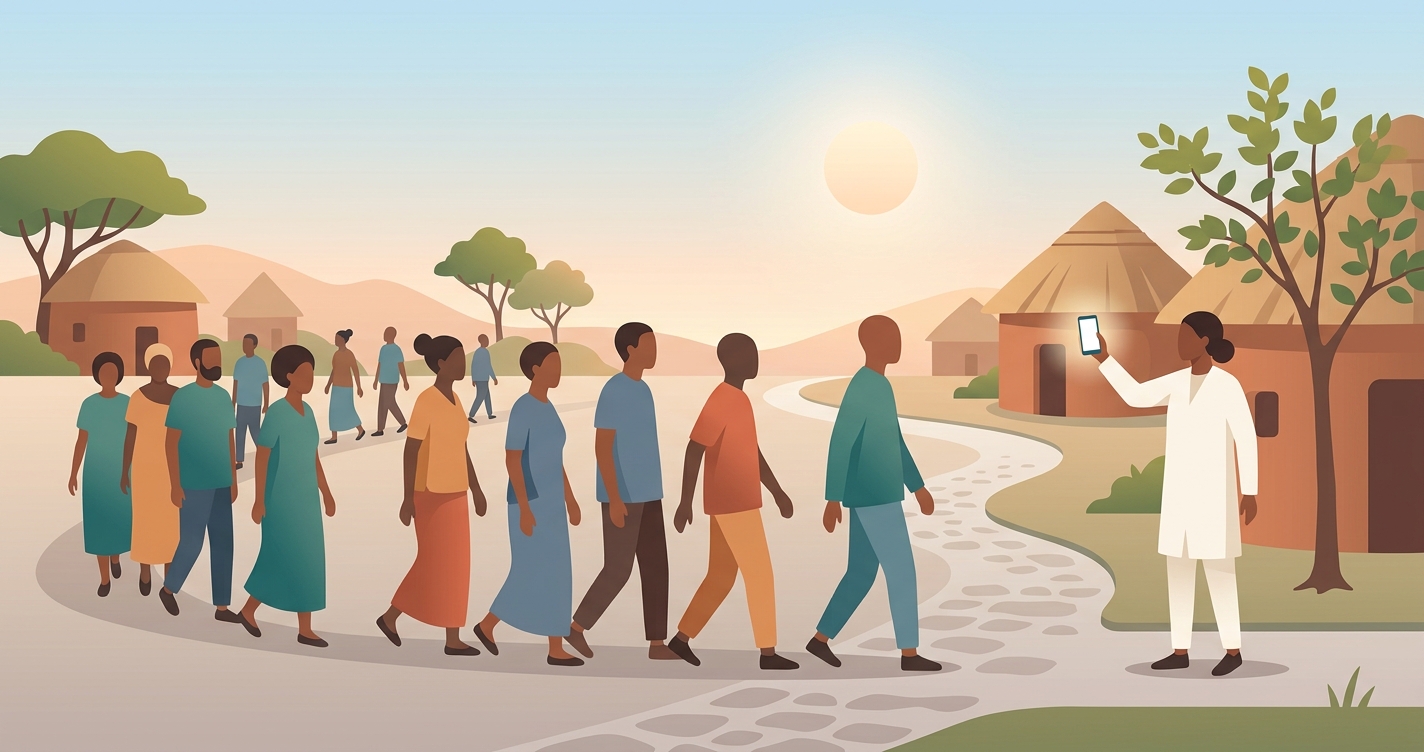
Field coordinators planning a large outreach event face the same arithmetic every time: a target population in the tens of thousands, a fixed number of working days, and a supply chain that rarely arrives intact. The traditional answer has been to ship more equipment and hire more clinical staff. The emerging answer is the opposite. High-volume mobile health screening built around a single smartphone per worker reverses the equation, treating throughput as a workflow problem rather than a hardware problem. This guide examines how mass screening campaigns can move thousands of people through a triage line each day when each worker carries nothing heavier than a phone.
A multi-country newborn screening program in Sub-Saharan Africa processed 73,903 dried blood spot samples by April 2024 and was judged feasible and scalable despite resource constraints, demonstrating that very high screening volumes are achievable when the workflow is designed for it. (American Society of Hematology, 2024)
Why high-volume mobile health screening changes the math
High-volume mobile health screening works because it removes the three things that historically slowed a screening line: equipment setup, consumable resupply, and the wait for laboratory turnaround. When the measurement device is a phone already in the worker's hand, the bottleneck shifts from the instrument to the human steps around it, namely registration, consent, measurement, and referral. Those steps can be standardized, timed, and parallelized.
The core idea is that a worker does not need a clinic to capture a meaningful health signal. Camera-based remote photoplethysmography (rPPG) reads pulse, breathing rate, and related vital signs from a short facial video, which means screening without lab tests becomes possible for a defined set of conditions. A 2025 medRxiv evaluation of the rPPG-based WellFie application reported accuracy comparable to clinical reference standards for heart rate, respiratory rate, and blood pressure in normotensive adults, indicating the signal quality is sufficient for triage-level decisions in the right population.
That qualifier matters. Screening is not diagnosis. The goal of a mass screening campaign is to sort a large crowd quickly into people who can go home reassured and people who need a clinician. Throughput, not certainty, is the metric that decides whether a campaign reaches its population before the funding window closes.
Comparing screening models for patient throughput in rural health
The table below contrasts three approaches a coordinator might budget for, using realistic field assumptions rather than vendor specifications.
| Factor | Equipment-heavy clinic model | Point-of-care kit model | One-smartphone-per-worker model |
|---|---|---|---|
| Setup time per site | Half a day or more | 1 to 2 hours | Under 15 minutes |
| Patients per worker per day | 30 to 60 | 60 to 100 | 150 to 300+ |
| Consumables per patient | High (reagents, cuffs, gloves) | Moderate (test strips) | Minimal |
| Lab dependency | Yes | Partial | No (screening without lab tests) |
| Power and cold chain | Required | Often required | Battery and power bank only |
| Cost driver | Devices and maintenance | Recurring consumables | Worker time and connectivity |
| Failure mode | Equipment breakdown | Stockout | Lighting, motion, connectivity |
The pattern is clear. As you move right, the per-patient marginal cost falls and daily throughput rises, while the failure modes shift from logistics to data quality. That tradeoff is the central design decision for efficient community outreach.
Key operational advantages of the single-device model include:
- No assembly line of instruments to calibrate, sterilize, or repair at each site.
- A flat learning curve, since most workers already know how to operate a phone.
- Linear scaling, where adding a worker adds a full screening station without adding equipment.
- Resilience in places without electricity, since a phone and a power bank outlast most clinical devices in the field.
Industry Applications
Mass screening campaigns and event days
Immunization days, market-square outreach, and school-based events concentrate large crowds into short windows. A one-device-per-worker setup lets a coordinator deploy ten or twenty parallel stations in a single venue, each running an identical script. Because there is no shared equipment, lines do not collapse when one station slows down. The Kenyan HPV program that screened more than 47,000 women since 2021 shows the scale these campaigns reach when the workflow, rather than the instrument, sets the pace.
Patient throughput in rural health districts
In dispersed rural districts, the constraint is travel, not crowd size. A worker on a motorbike carrying one phone can screen across several villages in a day and sync data when connectivity returns. This converts a fixed clinic schedule into a mobile route, which is often the only way to reach populations who live two or more hours from any facility.
Referral triage and follow-up
The output of high-volume screening is a sorted list. Workers flag the small fraction with abnormal readings for clinician review, while the majority receive reassurance and basic health education. A 2025 randomized controlled trial in rural Kenya and Uganda found that community health worker-facilitated telehealth significantly improved blood pressure control for people with severe hypertension, confirming that the screen-then-refer chain produces real clinical outcomes when follow-up is built in.
Current research and evidence
The evidence base supports the volume thesis while issuing a clear warning about equity. The same 2025 work that validated rPPG signal quality in controlled conditions is balanced by a 2025 Nigerian field study of an rPPG blood pressure application that reported mean absolute errors above 15 mmHg for systolic pressure and near-zero sensitivity for detecting hypertension in the darkest skin tone group. For a coordinator, that finding is not a reason to abandon the model. It is a reason to define scope carefully: use the technology for the vital signs and populations where it performs, and pair blood-pressure triage with confirmatory measurement for high-risk groups.
Researchers continue to work on the robustness of rPPG to motion, lighting, and skin tone, the three variables that most affect field accuracy. Reviews of contactless vital sign monitoring published through 2024 identify these as the open engineering problems, which means protocol design (consistent lighting, a stable seated posture, a quiet measurement moment) can meaningfully improve data quality today without waiting for better algorithms.
The operational literature adds a second lesson. Community health worker programs across Africa repeatedly show that digital tools succeed or fail on supervision and data flow, not on the device itself. Throughput is only valuable if the captured data reaches a system that can act on referrals.
The Future of high-volume mobile health screening
Three shifts will shape the next few years. First, model improvements for diverse skin tones will widen the set of conditions that can be screened reliably, closing the equity gap that current field data exposes. Second, offline-first software will make patient throughput in rural health independent of live connectivity, letting workers screen continuously and sync in batches. Third, integration with national health information systems will turn campaign data into a continuous population signal rather than a one-off snapshot, which is what program managers need to justify recurring funding.
The direction of travel is toward screening as a routine, low-cost layer of primary health care rather than a periodic event. When the marginal cost of one more screen approaches the cost of a worker's minute, the question stops being whether to screen a population and becomes how often.
Frequently asked questions
How many patients can one worker realistically screen in a day? Field-realistic throughput for a smartphone-only station ranges from roughly 150 to 300 people per worker per day, depending on registration overhead, crowd flow, and the length of the consent and education step. The measurement itself takes under a minute, so the surrounding workflow usually sets the limit.
Is screening without lab tests accurate enough to be useful? For triage, yes, within scope. Camera-based vital signs can reliably sort a crowd into reassure-or-refer categories for several conditions. They do not replace diagnosis, and current field evidence shows blood pressure estimation is less reliable for the darkest skin tones, so high-risk cases should be confirmed with a cuff.
What is the biggest operational risk in a mass screening campaign? The referral chain. Capturing thousands of readings is pointless if flagged patients cannot reach a clinician. Successful campaigns budget follow-up capacity before they budget screening capacity.
Does this approach work where there is no electricity or network? Yes. A phone plus a power bank runs all day, and offline-capable workflows let workers store readings and sync when a signal returns, which makes the model well suited to remote routes.
Circadify is building toward this exact problem, developing smartphone-based screening workflows tested in the field in Uganda so that NGO and ministry teams can plan campaigns around realistic throughput rather than equipment catalogs. Field coordinators who want to model a high-volume deployment, review operational data, or scope a partnership can read the global health field reports and reach the operations team through circadify.com/blog.