
How Schools in Africa Screen Children's Health by Phone
Discover how teachers and health workers use smartphone health screening in African schools to non-invasively detect anemia, malnutrition, and infections.
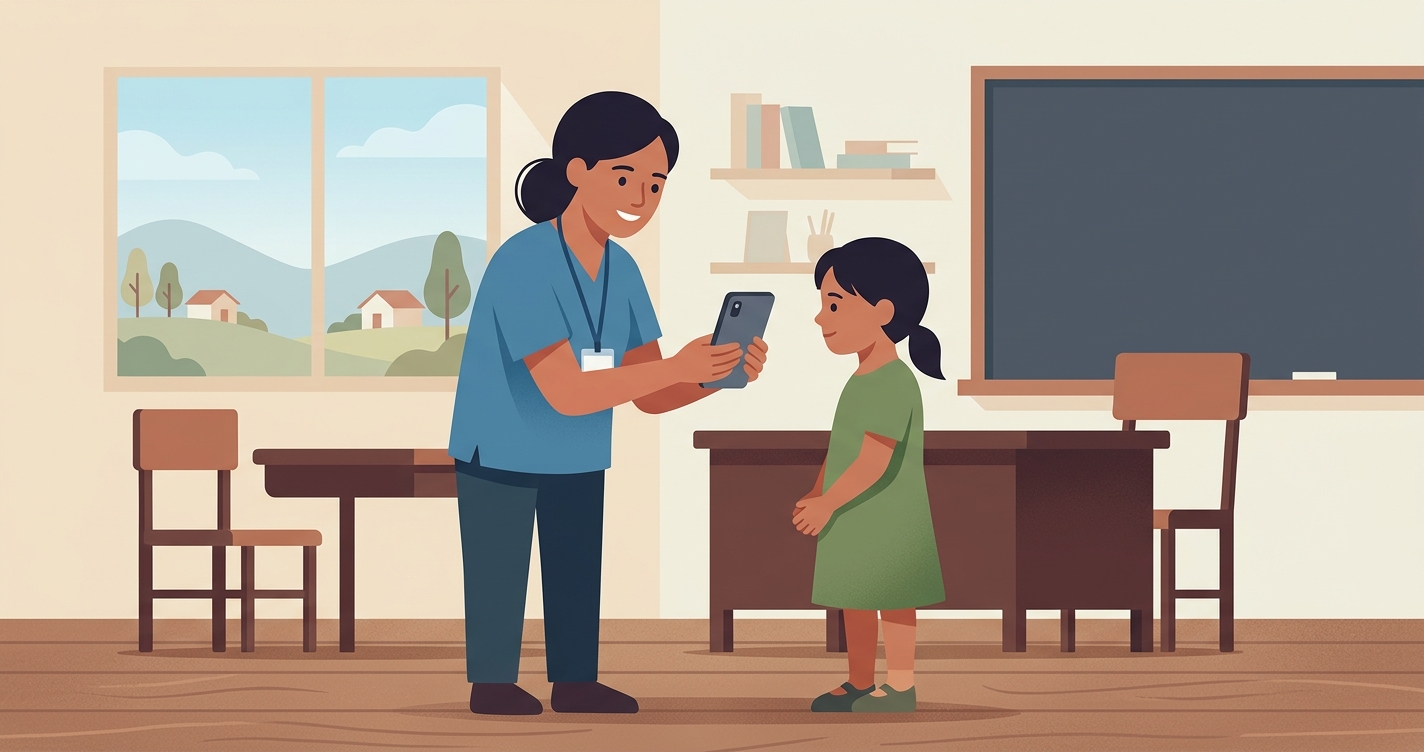
Routine health checks in schools serve as the primary safety net for millions of children across Sub-Saharan Africa. For many students, a school-based health program is their only regular interaction with the healthcare system, offering a critical window to detect conditions like anemia, malnutrition, and infectious diseases before they cause permanent developmental harm. Yet, traditional screening methods require specialized diagnostic equipment, invasive blood draws, and trained clinical staff, resources that are scarce in rural and underfunded educational districts. To close this gap, health ministries and global NGOs are fundamentally changing how school health screening Africa operates. By equipping teachers and community health workers with everyday smartphones, public health programs are deploying advanced diagnostic software directly into the classroom. This transition from hardware-heavy clinics to software-enabled community settings is proving to be one of the most effective strategies for population-level pediatric health monitoring.
"The ability to accurately predict disease risk using unmodified smartphones removes the logistical and financial barriers of physical diagnostic hardware, allowing school-based screening programs to reach children who would otherwise remain unassessed." , Terence S. Leung, Researcher in Medical Physics and Biomedical Engineering at University College London, 2023
The operational realities of school health screening africa
School-based health interventions rely heavily on task-shifting. Since rural schools rarely have full-time nurses, the responsibility of health monitoring often falls to teachers, community health promoters, or visiting NGO field workers. Historically, this meant relying on visual assessments, paper growth charts, or invasive finger-prick blood tests that require sterile supplies, biohazard disposal, and clinical training.
The logistical friction of traditional screening often restricts these programs to small pilot studies or infrequent annual campaigns. When the procurement budget is consumed entirely by imported disposable medical supplies, there is little capital left for execution and follow-up. Moving to a phone-based model changes the fundamental economics of the process.
| Feature | Traditional School Health Screening | Smartphone-Based Health Screening |
|---|---|---|
| Primary Equipment | Specialized devices (hemoglobinometers, rapid test kits) | Standard Android or iOS smartphones |
| Invasiveness | Often requires blood draws (finger pricks) | Completely contactless (camera-based imaging) |
| Supply Chain | Requires continuous procurement of consumables | No physical consumables needed |
| Data Aggregation | Manual entry onto paper forms, prone to loss | Automated cloud syncing and real-time dashboarding |
| Operator Training | Clinical training for blood handling and device use | Brief operational training on software apps |
By substituting specialized hardware with optical sensors and software algorithms, ministries of health overcome several chronic barriers to scale:
- Cold chain storage for testing reagents is entirely eliminated.
- Biohazard waste management is no longer a requirement for remote schools.
- Data collection is digitized at the point of care, providing health ministries with immediate epidemiological maps.
- Screening capacity scales instantly with software distribution rather than physical hardware procurement.
- Budget allocations can be shifted from purchasing imported plastics toward training and compensating local health workers.
Key applications in school environments
Non-invasive anemia detection
Anemia affects a significant portion of school-aged children across the continent, severely impacting cognitive development and academic performance. The standard diagnostic approach requires drawing blood to measure hemoglobin levels, a process that causes distress in children, introduces infection risks, and generates medical waste.
Recent studies have validated the use of standard phone cameras for colorimetric analysis of human tissue. In 2023, researchers Thomas Alan Wemyss and Terence S. Leung from University College London, working alongside Christabel Enweronu-Laryea from the University of Ghana, conducted a clinical study at Korle Bu Teaching Hospital in Ghana. They developed a non-invasive smartphone colorimetry technique to screen for anemia in infants and young children. The software analyzes images of three specific regions: the lower eyelid (palpebral conjunctiva), the sclera, and the mucosal membrane adjacent to the lower lip. Because these areas have minimal skin pigmentation, the camera can accurately assess blood chromaticity without requiring specialized color reference cards.
Malnutrition and growth tracking
Malnutrition is traditionally measured using a Mid-Upper Arm Circumference (MUAC) tape or height-to-weight ratios. While MUAC tapes are cheap, consistent data collection and reporting at the community level remain highly fragmented. Paper records are frequently delayed, damaged, or lost before they reach regional health offices for analysis.
To digitize this process, researchers Ravi Bhavnani and Nina Sophia Link (2023) developed and evaluated the D2A ("Data to Analysis") smartphone tool in West Pokot County, Kenya. The D2A app enables community-led malnutrition screening, allowing mothers, caregivers, and community health workers to record Family MUAC data directly into a phone. The software includes audio guides in multiple regional languages like Swahili and Pökoot, accommodating non-literate operators through visual and auditory cues. The study demonstrated that the smartphone app yielded classification accuracy comparable to traditional paper-based screening but at a substantially lower cost and with immediate data availability for organizations like the National Drought Management Authority.
Malaria and infectious disease risk
Malaria is a primary driver of school absenteeism. Asymptomatic carriers within schools can silently sustain local transmission, making early detection vital for regional eradication efforts. Rapid diagnostic tests (RDTs) exist but face the same supply chain limitations as anemia tests, often resulting in widespread stock-outs during peak transmission seasons.
In a landmark 2025 study published in NPJ Digital Medicine, a research team including Hong SG, Park SM, and Kim YL investigated a non-invasive prescreening method for malaria in asymptomatic school-age children in Rwanda. By analyzing 4,302 smartphone photographs of the palpebral conjunctiva from 405 children aged 5 to 15, the researchers applied a neural network classification model to predict malaria risk. The software relies entirely on the built-in camera of unmodified Android devices operating under ambient lighting. The resulting radiomic analysis allows health workers to quickly stratify risk and allocate scarce rapid diagnostic tests only to students flagged by the algorithm.
Current research and evidence
The shift toward digital, camera-based screening is supported by robust clinical data indicating that algorithmic analysis of visual indicators can match or approach the efficacy of point-of-care clinical tests.
The 2023 Ghana study by Wemyss, Leung, and Enweronu-Laryea reported that their smartphone colorimetry method achieved a sensitivity of 92.9% and a specificity of 89.7% for detecting anemia (defined as a hemoglobin concentration below 11.0 g/dL) using a naïve Bayes classifier. This level of accuracy is highly competitive with traditional point-of-care hemoglobinometers, which cost hundreds of dollars per unit and require expensive, proprietary disposable microcuvettes.
Similarly, the 2025 Rwandan malaria study demonstrated that the neural network could differentiate between malaria-infected and non-infected cases with an area under the receiver operating characteristic curve (AUC) of 0.76. Crucially, the researchers noted that the image patterns captured by the software were independent radiomic features, not merely indirect proxies for fever or severe anemia, marking a significant advancement in optical diagnostic capabilities.
in malnutrition, Bhavnani and Link's evaluation of the D2A tool in Kenya highlighted operational efficiency over pure diagnostic novelty. The evidence showed that task-shifting MUAC measurements to local community members via a guided smartphone application resulted in near-identical severe wasting detection rates as expert clinical interventions. However, the smartphone intervention drastically shortened the feedback loop between data collection in the village and emergency resource deployment by central health authorities.
The future of contactless pediatric screening
As digital health initiatives mature, the reliance on fragmented, single-disease applications is giving way to unified diagnostic platforms. A community health worker or teacher visiting a rural classroom will not need separate apps for anemia, malnutrition, and malaria. Instead, a single scan using the device's optical sensors will parse multiple vital signs and risk factors simultaneously.
This convergence is critical for ministries of health and organizations like UNICEF that are tasked with managing population health on constrained budgets. The ability to deploy a software update that instantly equips thousands of field workers with a new screening capability is an operational advantage that physical medical supply chains simply cannot replicate. The future of global health logistics involves moving data rather than moving boxes. Programs that integrate these smartphone technologies are already demonstrating improved epidemiological surveillance, lower per-patient screening costs, and substantially higher assessment volumes across the continent.
Frequently asked questions
What equipment is needed for smartphone health screening in schools? Most modern screening software requires only a standard, unmodified Android or iOS smartphone with a functional camera. The algorithms are designed to operate under ambient lighting conditions, eliminating the need for external hardware attachments, specialized color calibration cards, or constant internet connectivity.
How accurate are smartphone-based anemia and malaria checks? Clinical studies show strong reliability. For example, a 2023 study in Ghana demonstrated over 92% sensitivity in detecting anemia using smartphone colorimetry of the eye and lip. A 2025 study in Rwanda achieved an AUC of 0.76 for stratifying malaria risk in asymptomatic children using similar conjunctiva photography methods.
Can non-clinical staff perform these screenings? Yes. These applications are specifically designed for task-shifting. By utilizing clear user interfaces, multi-language audio guides, and non-invasive camera techniques, teachers and community health promoters can administer the tests safely and accurately without formal clinical training.
How is the collected health data managed? Data is typically encrypted and synced to cloud-based health dashboards when the device reaches an area with mobile network coverage. This allows regional health ministries and NGOs to track disease prevalence in real-time, mapping outbreaks or nutritional deficits without relying on slow, paper-based reporting chains.
For global health NGOs, WHO officials, and UNICEF program managers, transitioning from hardware-dependent diagnostics to software-enabled screening is the key to scaling early intervention programs. Circadify is actively supporting this shift by providing robust, non-invasive health screening infrastructure designed specifically for remote community deployment. To learn more about how smartphone-based vital signs screening is currently being deployed in Uganda without the need for specialized clinical equipment, review our field data and partnership opportunities at our global health blog.