Is my newborn breathing too fast — and what should I do?
A guide for community health programs in Sub-Saharan Africa on identifying newborn fast breathing, a key danger sign of pneumonia, and how mobile health technology can aid in screening.
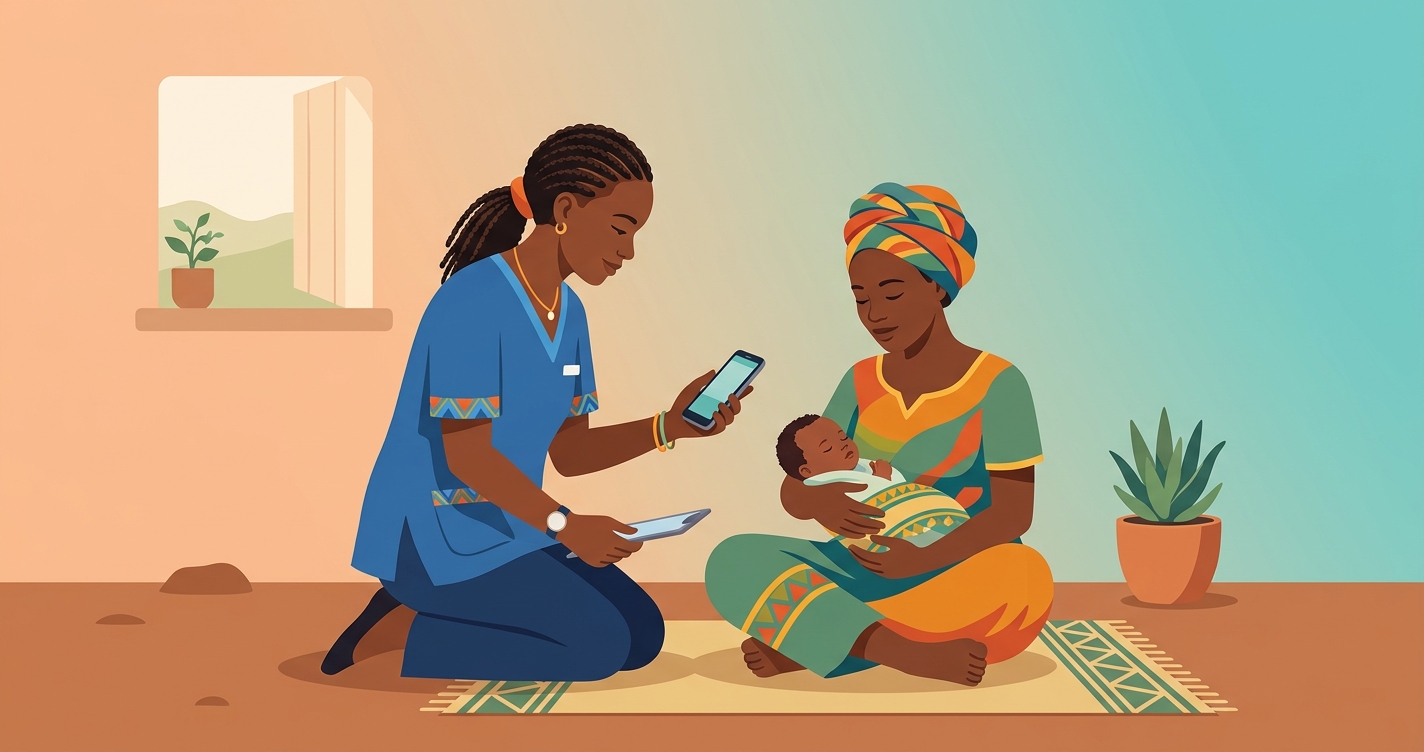
For a new mother or a community health worker in a rural part of Sub-Saharan Africa, a newborn's shallow, rapid breaths can be a terrifying sight. Pneumonia is the world's leading infectious killer of children under five, and a newborn in this region is 11 times more likely to die in their first month than a child born in a high-income country. Fast breathing is one of the earliest and most critical signs of respiratory distress. The ability to accurately identify it can be the deciding factor between timely, life-saving intervention and a tragic outcome. A key challenge is distinguishing the normal, irregular breathing of a healthy infant from the dangerous tachypnea that signals a need for urgent medical care.
"Globally, pneumonia remains the leading infectious cause of death in children, claiming the lives of over 700,000 children under five every year. Four out of every five of these deaths occur in Sub-Saharan Africa and Southern Asia."
- UNICEF Data, 2023
The challenge of newborn fast breathing screening in sub-saharan africa
The World Health Organization (WHO) provides clear guidance for assessing a sick young infant. Through the Integrated Management of Childhood Illness (IMCI) strategy, health workers are trained to count a newborn's breaths for a full 60 seconds. A resting respiratory rate of 60 or more breaths per minute is classified as "fast breathing," a primary indicator for pneumonia and a signal for immediate referral to a clinic or hospital. While simple in theory, this manual process is fraught with challenges in a real-world village setting. Newborns have naturally erratic breathing patterns, and factors like crying, feeding, or a slight fever can temporarily increase their respiratory rate. A study published in the BMJ Global Health found that while community health workers can achieve moderate to high accuracy in diagnosing pneumonia, misclassification of fast breathing remains a significant hurdle. These frontline providers often work under immense pressure, with limited equipment and in noisy environments, making a precise 60-second count difficult to achieve consistently. The difference between 58 breaths and 62 breaths per minute can be subtle, yet it carries the weight of a life-or-death referral decision. This variability highlights a critical gap in community-level diagnostics and the need for more reliable tools for newborn fast breathing screening in Sub-Saharan Africa.
| Sign | Normal Breathing in a Newborn | Signs of Respiratory Distress (Tachypnea) |
|---|---|---|
| Respiratory Rate | 40, 60 breaths per minute at rest. | Consistently over 60 breaths per minute at rest. |
| Breathing Pattern | May be irregular, with short pauses. | Consistently fast and shallow; may be very regular. |
| Chest Movement | Gentle, easy rise and fall of the chest and abdomen. | Severe chest in-drawing (the lower chest pulls in sharply with each breath). |
| Sounds | Quiet, gentle breathing sounds. | Grunting noises with each exhalation; nasal flaring. |
| Color | Normal skin color on torso and face. | A bluish tint to the lips, face, or torso (cyanosis). |
Industry Applications
The widespread proliferation of smartphones across Sub-Saharan Africa offers a powerful tool to bridge this diagnostic gap. Mobile health (mHealth) applications are emerging that can assist community health workers in performing more accurate respiratory assessments.
- Guided Counting Tools: Simple applications can provide an on-screen timer and a tap-based interface for a health worker to log each breath. This structured approach, as demonstrated by apps like RRate developed by researchers at the University of British Columbia, helps ensure a full 60-second count and reduces the cognitive load on the user.
- Automated Analysis: More advanced systems use the phone's camera to measure the subtle movements of a baby's chest and abdomen. By analyzing video frames, these applications can calculate a respiratory rate automatically, removing the potential for human error in manual counting.
- Decision Support: Beyond simple counting, these apps can incorporate the full IMCI guidelines. A health worker can input the respiratory rate along with observations of chest in-drawing or grunting, and the application can provide an immediate classification of the child's condition and recommend the appropriate action (e.g., "Severe Pneumonia: Refer to Hospital Urgently").
Supporting health ministries
For national health programs, the data generated by these mobile screening tools is invaluable. When thousands of community health workers are conducting screenings, the aggregated data can provide real-time insights into disease prevalence, geographic hotspots, and the overall health of the neonatal population. This allows ministries of health and their NGO partners to allocate resources more effectively, manage supply chains for antibiotics like amoxicillin, and measure the impact of their interventions.
Empowering local health workers
For the community health worker, a smartphone with a validated screening app is more than a tool; it is a force multiplier. It enhances their skills, builds confidence in their assessments, and provides a tangible, objective measure to support their referral decisions. This technology helps to formalize their critical role in the primary healthcare system and strengthens the link between the community and the clinic.
Current research and evidence
The use of mobile technology for respiratory screening is an active area of research. Early studies have shown promising results. Researchers like Dr. Walter Karlen, who led the development of the RRate app, have published findings showing that tap-based mobile applications can measure respiratory rates faster and with greater accuracy than the standard manual method. Field studies in Uganda and other parts of Sub-Saharan Africa have demonstrated the feasibility and acceptance of these tools among frontline health workers. The key to successful implementation, as research has shown, is designing solutions that are tailored to the low-resource context, apps must be simple, robust, and able to function in areas with poor connectivity. The focus of current research is shifting from feasibility to large-scale impact, examining how integrating these tools into national health systems affects neonatal mortality rates from pneumonia.
The future of newborn fast breathing screening
The future of neonatal care in low-resource settings will involve a synthesis of human expertise and accessible technology. As smartphone penetration deepens and mobile networks expand, the capacity for sophisticated newborn fast breathing screening in Sub-Saharan Africa will grow. We can anticipate the integration of artificial intelligence to Count breaths. To analyze breathing sounds for signs of stridor or other abnormalities. These tools will not replace the community health worker but will instead augment their ability to make accurate and timely decisions. The goal is to create a system where every child, no matter how remote their village, has access to a rapid and reliable assessment that could save their life.
Frequently asked questions
Q: What is a normal breathing rate for a newborn? A: A healthy newborn's breathing rate at rest is typically between 40 and 60 breaths per minute. This can vary, and babies often have periodic breathing, where they may pause for a few seconds. Consistent breathing above 60 breaths per minute when the baby is calm and at rest is considered fast breathing.
Q: Can I just count my baby's breaths for 15 seconds and multiply by four? A: No. The World Health Organization (WHO) strongly recommends counting for a full 60 seconds. Because a newborn's breathing is often irregular, shorter counting intervals can be highly inaccurate and may either miss a problem or cause unnecessary alarm.
Q: Aside from fast breathing, what are other danger signs I should look for? A: You should seek medical help immediately if you see any of these signs: severe chest in-drawing (the skin over the ribs pulls in tightly with each breath), grunting sounds with every breath, flaring of the nostrils, or if the baby's lips or face turn a bluish color.
Q: How can a phone camera possibly measure breathing? A: The technology, often called remote photoplethysmography (rPPG), uses a smartphone camera to detect tiny, imperceptible changes in skin color caused by blood flow. Advanced algorithms can also analyze the motion of pixels on a video of a baby's chest to count the rise and fall of each breath, providing a highly accurate respiratory rate.
Circadify is at the forefront of developing and deploying mobile health technologies to address critical challenges in global health. By transforming the common smartphone into a powerful diagnostic aid, we are empowering community health workers and supporting health ministries in their mission to end preventable newborn deaths. To learn more about our work and explore potential partnerships, visit the global health section of our blog at circadify.com/blog.