What Offline Health Screening Means for Areas Without Internet
How offline health screening in rural areas works without signal or power, syncing data later, and what ministry and NGO planners should assess before deployment.
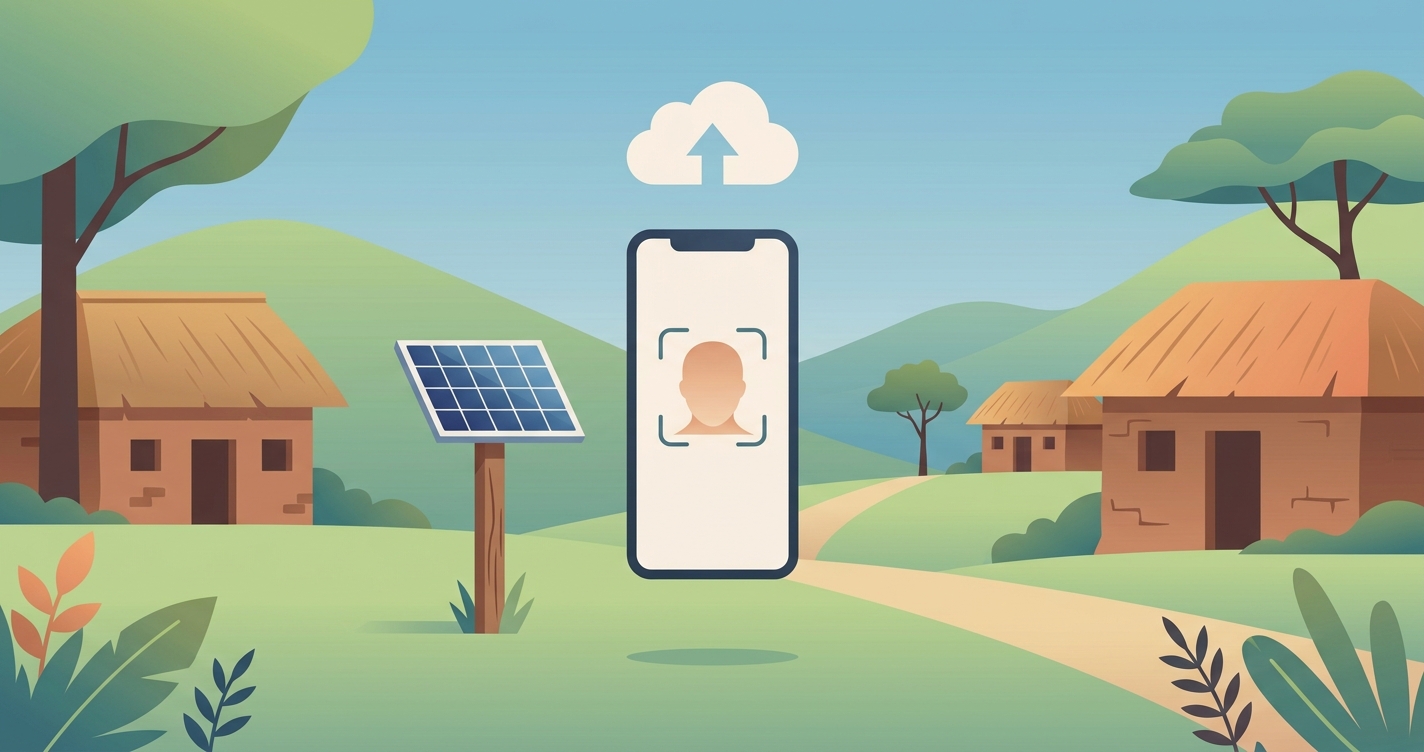
Program planners who design screening campaigns for remote districts run into the same assumption embedded in almost every digital health tool: that a working internet connection will be there when the data is collected. In much of rural Sub-Saharan Africa, it will not be. The decision that matters is not whether a tool uploads to a dashboard, but whether it can capture a vital sign, store it, and survive hours or days before any connection appears. Offline health screening in rural areas is the design philosophy built around that reality, and it changes how ministries and NGOs should evaluate any technology they plan to field.
"Sub-Saharan Africa has the largest mobile internet usage gap in the world. As of the end of 2023, only about 27 percent of the population used mobile internet, and around half the region, close to 600 million people, still lacked access to electricity." - GSMA, The Mobile Economy Sub-Saharan Africa 2024
What offline health screening in rural areas actually requires
The phrase covers more than spotty signal. A tool described as offline-ready has to handle three separate failures that often happen at once: no mobile data, no Wi-Fi, and no reliable power to recharge a device between sessions. A screening application that needs a server call to calculate a result, validate a user, or store a record is useless the moment a community health worker walks beyond tower range. That is a common scenario. GSMA's 2024 figures put the coverage gap, meaning people with no mobile broadband network at all, at roughly 13 percent of the region, while the much larger usage gap of around 60 percent reflects people who live under a signal they cannot reliably afford or sustain.
Offline-first health apps invert the normal logic. Instead of treating the network as the default and offline as the exception, they assume disconnection is the default state. All core functions, capturing a reading, scoring it against thresholds, prompting a referral, run on the device itself. Connectivity becomes an occasional event used only to move data, not to perform the work.
For screening specifically, this means the measurement method itself has to be self-contained. Camera-based approaches such as remote photoplethysmography, which estimates heart rate and other vitals from subtle color changes in facial skin, are attractive here precisely because the computation can run locally on a mid-range smartphone. There is no cuff to charge, no peripheral sensor to pair, and no cloud inference call that stalls without bandwidth.
The table below contrasts how three deployment models behave under field conditions common to rural districts.
| Capability | Cloud-dependent app | Offline-first app | Paper-based screening |
|---|---|---|---|
| Works with no signal | No | Yes | Yes |
| Result calculated on device | No | Yes | Manual, error-prone |
| Survives multi-day power gaps | Limited | Yes, with charging plan | Yes |
| Data syncs to national system | Yes, when online | Yes, deferred batch sync | Slow, manual entry |
| Audit trail and timestamps | Yes | Yes | Weak |
| Risk of lost records | Low | Low to moderate | High |
| Field cost per added site | High | Low | Low but labor-heavy |
How deferred data sync works
The core mechanic of screening without connectivity is the store-and-forward model. A reading taken in a village is written to encrypted local storage with a timestamp and location tag. Nothing is lost if the worker never gets a signal that day. When the device later reaches coverage, at a trading center, a district office, or a supervisor's weekly meeting, the queued records upload in a single batch.
Well-designed low-bandwidth health tools make this sync resilient in a few specific ways:
- Records are compressed and stripped of heavy payloads, so a backlog of hundreds of screenings can upload over a weak 2G or 3G link.
- Sync is incremental and resumable, so a dropped connection mid-upload does not corrupt the batch or force a restart.
- Conflict handling assumes multiple devices and intermittent uploads, so the same patient seen twice does not create duplicate or contradictory records.
- Local data persists until the server confirms receipt, rather than being deleted on send.
This is the difference between no-internet mHealth that simply tolerates being offline and a system genuinely engineered for it. The first loses data when assumptions break. The second treats every upload as eventual and every record as safe until proven delivered.
Industry Applications
Community outreach and house-to-house campaigns
Door-to-door screening covers households that never reach a clinic. Workers may walk routes for a full day with no coverage. An offline-first tool lets them screen continuously and sync only when they return to a connected point, which matches how community health worker programs already operate.
Immunization and nutrition drives
Mass campaigns process large volumes in short windows, often in school yards or markets where many devices compete for thin bandwidth. Deferred batch sync prevents the bottleneck of every device trying to upload live, and keeps throughput high even where the local cell is saturated.
Refugee and displacement settings
Temporary sites frequently lack both grid power and stable connectivity. Solar charging plus offline capture lets screening proceed for weeks before any data reaches a central system, which is often the only workable model in these environments.
Current research and evidence
The infrastructure case for offline-first design is well documented. GSMA's Mobile Economy Sub-Saharan Africa 2024 report describes the region as the least connected in the world, with the largest usage gap globally and a coverage gap that still leaves tens of millions entirely outside mobile broadband. The same body of work notes that the region drove most of the world's mobile coverage growth in 2024, but that population growth continues to outpace electrification, with roughly 600 million people still without reliable electricity.
Implementation research has long pointed the same direction. The WHO's guideline on digital interventions for health system strengthening, published in 2019, stresses that tools must fit the infrastructure realities of the settings where they are deployed rather than assuming connectivity. District Health Information Software 2 (DHIS2), maintained by the University of Oslo's Health Information Systems Programme and used by more than 70 countries, built an offline-capable mobile data capture model precisely because routine reporting from low-connectivity facilities could not depend on live connections.
The pattern across these sources is consistent. Where evaluations report failure, the cause is rarely the measurement science and more often the operational assumption that signal and power will be present. Tools that move the computation onto the device and defer the upload remove the most common point of failure before it happens.
The future of offline health screening in rural areas
Several trends are converging in favor of offline-capable screening. Mid-range smartphones now carry enough processing power to run on-device inference that once required a server, which means camera-based vitals and risk scoring can happen locally without sacrificing speed. Battery capacity and small solar charging kits are cheaper and more rugged than they were five years ago, narrowing the power gap that has limited field tools.
At the same time, national health information systems are standardizing how community data feeds into policy. As more ministries adopt interoperable platforms, the value of an offline tool depends less on its own dashboard and more on whether its deferred sync maps cleanly into the national system. The likely direction is screening that is fully autonomous at the point of care and fully integrated once connected, with the gap between the two measured in hours or days rather than treated as a failure.
For planners, the practical implication is to stop evaluating tools on their best-case online demo and start testing them in airplane mode, on an old phone, after a week without charging. That is the condition that decides whether a deployment reaches the households that need it most.
Frequently asked questions
Does offline health screening still work where there is no mobile signal at all?
Yes. A true offline-first tool performs the entire screening on the device, capturing the reading, calculating the result, and prompting any referral, with no network required. Connectivity is only needed later to move the stored data, not to do the screening itself.
What happens to the data if a device never reaches a connection?
The records stay in encrypted local storage with timestamps and location tags until the device reaches coverage. They are not deleted until the central system confirms receipt, so a long stretch offline does not cause data loss, only delayed reporting.
How is screening done without reliable electricity?
Camera-based methods that run on a standard smartphone need no separate powered equipment, so the only power requirement is keeping the phone charged. Small solar kits or scheduled charging at a connected hub are usually enough to keep devices running through multi-day field rotations.
How do planners verify a tool is genuinely offline-ready?
Test it under failure conditions rather than ideal ones. Run a full screening in airplane mode on a mid-range device, accumulate a backlog of records, then confirm the batch syncs intact over a weak connection. A tool that only works during a live online demo is not offline-ready.
Circadify is working on smartphone-based vital signs screening designed for exactly these conditions, capturing and storing readings where there is no signal or power and syncing when a connection appears. Ministry and NGO planners assessing offline-ready deployment can review field data and partnership options in the global health section at circadify.com/blog.