How can remote villages get vital checks without a doctor nearby?
How remote village health checks in Africa work without a clinician on site, and why mHealth and smartphone screening are reshaping rural outreach.
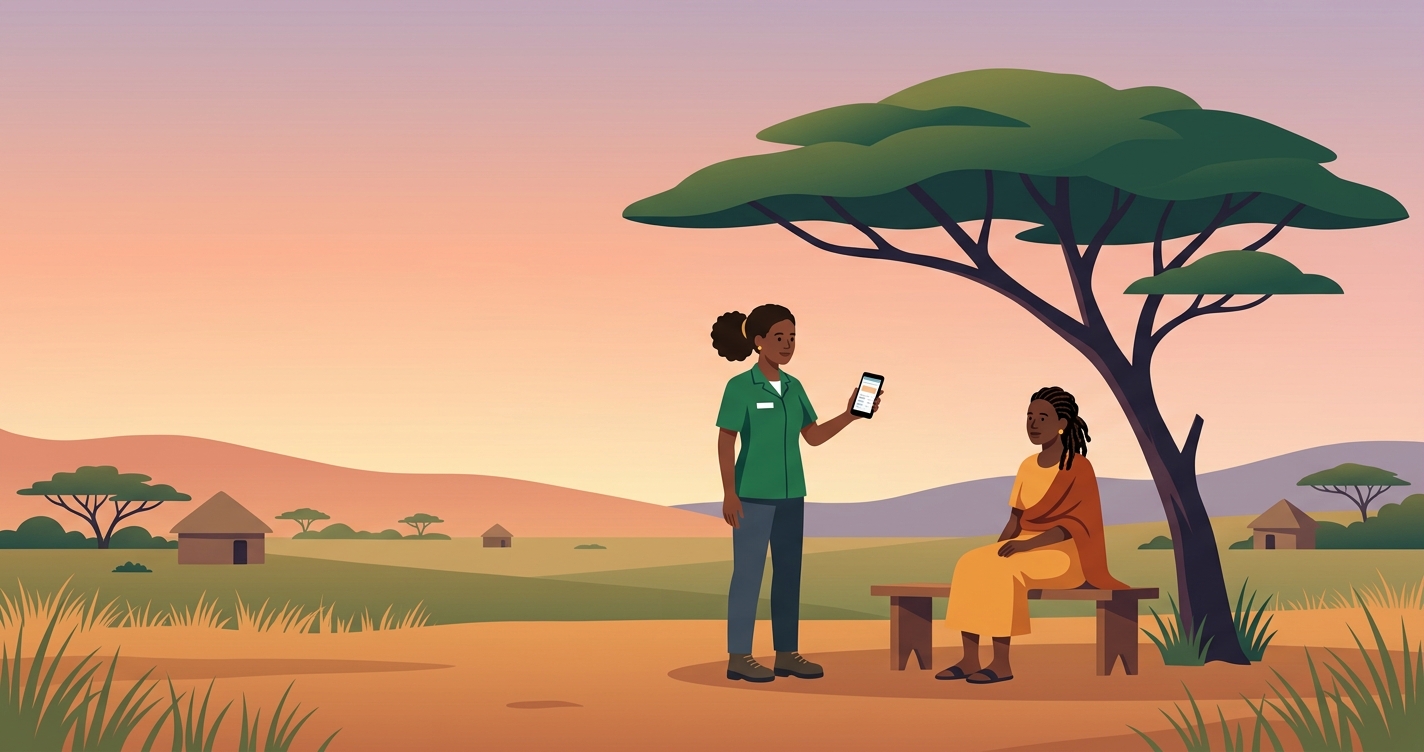
A child runs a fever at midnight in a village four hours from the nearest hospital. A pregnant woman feels dizzy but has no way to know whether her blood pressure has crossed into dangerous territory. These are not edge cases in Sub-Saharan Africa. They are the daily reality for hundreds of millions of people, and they explain why remote village health checks in Africa have become a defining problem for global health planners. The question is no longer whether a doctor can be physically present at every point of need. The question is how essential screening can travel to people who will never reach a clinic in time, and what tools make that possible at population scale.
"More than 170 million people in Sub-Saharan Africa lived over two hours from the nearest hospital as of 2020, and the WHO projects the continent will need an additional 6.1 million health workers by 2030 to meet basic demand.", drawn from geographic access modeling and WHO health workforce projections.
Why remote village health checks in Africa demand a new model
The traditional model assumes that care happens where clinicians and equipment are concentrated, and that patients travel to reach them. That assumption breaks down across most of rural Sub-Saharan Africa. Research published in PNAS by Andy Nelson and colleagues, along with mapping work led by groups including the Heidelberg Institute for Geoinformation Technology, has documented just how thin coverage becomes outside cities. One in eight people in the region lives at least an hour from the nearest health center, and roughly 40 percent of the population sits more than four hours from a referral-level hospital.
Distance is only half the problem. The workforce that would staff a denser network simply does not exist yet. The WHO has reported critical health worker deficits in 36 African countries, with the projected shortfall reaching 6.1 million by 2030. Building enough clinics and training enough clinicians to close that gap on a reasonable timeline is not realistic. So the practical task for WHO and UNICEF program managers, health ministries, and NGOs is different: extend a basic layer of screening outward, using people and tools already present in the community, and reserve scarce clinical capacity for the cases that genuinely need it.
This is where mobile health, or mHealth, enters. The same period that saw the workforce gap widen also saw mobile connectivity spread quickly. The GSMA Mobile Economy Sub-Saharan Africa 2024 report found that 44 percent of the regional population subscribed to a mobile service by the end of 2023, with mobile internet penetration at 27 percent and climbing. A device that millions of community members and frontline workers already carry can become the screening tool that the formal health system never managed to deliver.
Comparing approaches to reaching the unreached
No single method solves rural screening on its own. Program designers usually weigh several, and the trade-offs are concrete.
| Approach | Reach in remote areas | Cost per person screened | Equipment burden | Skill required | Scalability |
|---|---|---|---|---|---|
| Build new clinics | Low (fixed location) | Very high | High | High (clinicians) | Slow |
| Mobile medical caravans | Moderate (periodic visits) | High | High | High | Limited |
| Community health workers with manual tools | Moderate to high | Moderate | Moderate (cuffs, thermometers, supplies) | Moderate | Moderate |
| Telemedicine to a remote doctor | Depends on connectivity | Moderate | Moderate (devices, bandwidth) | Moderate | Moderate |
| Smartphone-based contactless screening | High (worker-portable) | Low | Very low (phone only) | Low to moderate | High |
The bottom row is the one drawing the most attention from outreach planners, because it changes the economics of reaching the last mile. When the screening tool is a phone that needs no cuffs, no needles, no disposable consumables, and no cold chain, the marginal cost of screening one more person falls sharply, and the logistics tail that sinks most rural programs shrinks with it.
Several features make this model fit rural realities:
- A single device replaces a kit of instruments that each need calibration, batteries, and replacement.
- No consumables means no resupply runs to villages that are hard to reach in the first place.
- Lower training requirements let existing community health workers add screening to their visits.
- Digital capture sends results upward for triage and for national health data systems automatically.
- Battery and offline operation suit areas with intermittent power and patchy networks.
How contactless screening actually works in the field
The technology behind a camera-based check
A growing body of work focuses on remote photoplethysmography, or rPPG. The technique uses a standard smartphone camera to detect tiny color changes in the skin caused by blood flowing with each heartbeat. From that signal, algorithms can estimate heart rate, respiratory rate, and related indicators without touching the patient. A 2023 review of rPPG for vital sign monitoring published in the journal Electronics by researchers including Mark van Gastel summarized rapid progress in accuracy, alongside the known challenges of variable lighting, motion, and the need to validate performance fairly across the full range of skin tones.
For rural screening, the appeal is not that a phone replaces a hospital. It is that a phone can perform a fast, non-invasive first check that flags who needs to travel for further care and who does not.
The community health worker as the delivery point
Technology alone reaches no one. Community health workers remain the backbone of primary care across the region, and contactless screening is most useful as something placed in their hands. A worker who already visits households for immunization follow-up or maternal check-ins can add a 60-second vitals capture to each visit. The GSMA and Africa CDC HealthConnekt Africa initiative, which aims to connect health facilities and personnel and equip workers with smart devices by 2030, signals how seriously the sector now takes phone-equipped frontline staff as core infrastructure rather than an experiment.
Triage, not diagnosis
The realistic role of village-level screening is triage. A reading outside expected ranges becomes a prompt: refer, recheck, or escalate. This matters for program managers because it sets honest expectations. The goal is earlier detection of conditions like hypertension, the rapid breathing that signals childhood pneumonia, and warning signs in pregnancy, so that limited referral capacity is used where it counts.
Current research and evidence
The evidence base sits at the intersection of two literatures. On access, geographic modeling work in PNAS and follow-on studies through the EU Joint Research Centre have quantified how far rural populations sit from care, giving planners hard numbers to target. On technology, rPPG validation research through 2023 and 2024 has steadily improved signal processing in real-world conditions, while flagging that accuracy must be demonstrated across diverse populations rather than assumed.
What the field still needs is more field-level evidence: independent studies measuring how contactless screening performs when used by non-specialist workers, in bright sun or dim huts, on real patients rather than lab volunteers. Program managers should treat current tools as a screening and triage layer, pair deployments with monitoring, and insist on transparent reporting of performance across skin tones and conditions. The connectivity trend, documented by the GSMA, gives this work a tailwind that earlier mHealth pilots never had.
The Future of remote village health checks in Africa
The trajectory points toward screening becoming ambient rather than event-based. As smartphone penetration rises past the current 44 percent subscription rate and devices get cheaper, the cost of putting a screening tool in every community health worker's hand keeps falling. Integration is the next frontier: results flowing automatically into national health information systems turn millions of individual checks into population-level surveillance, helping ministries spot outbreaks and chronic disease burdens earlier. The most durable programs will combine contactless screening, trained community workers, and reliable referral pathways into a single system rather than treating any one piece as the answer.
Frequently asked questions
Can a smartphone really replace a doctor for vital checks? No, and that is not the intent. The realistic role is screening and triage: a quick, non-invasive check that flags who needs to reach a clinician and who is likely fine. It extends the reach of scarce clinical staff rather than substituting for their judgment.
What vital signs can contactless smartphone screening capture? Camera-based rPPG methods can estimate indicators such as heart rate and respiratory rate from skin color changes, with research expanding the range. Accuracy depends on lighting, movement, and rigorous validation across different skin tones, which is why field evidence matters.
Why is this better suited to rural Africa than imported medical devices? Smartphones need no consumables, no cold chain, and minimal training, so the logistics and resupply costs that defeat most rural programs largely disappear. A device many workers already own becomes the screening tool, which lowers the cost of reaching the last mile.
How does this connect to universal health coverage goals? By pushing a basic screening layer to communities far from clinics, contactless tools help cover populations the formal system has never reached, generate data for national planning, and direct limited referral capacity to the people who need it most.
Circadify is working on this exact challenge, developing smartphone-based vital signs screening deployed with community health workers in Uganda and gathering field data on how contactless tools perform outside the clinic. Program managers and partners exploring scalable rural outreach can follow the field reports and partnership opportunities in the global health section at circadify.com/blog.