
How to Scale a Health Screening Program Across Sub-Saharan Africa
A step-by-step brief on taking an mHealth screening pilot to national scale across Sub-Saharan Africa, covering logistics, funding, and workforce planning.
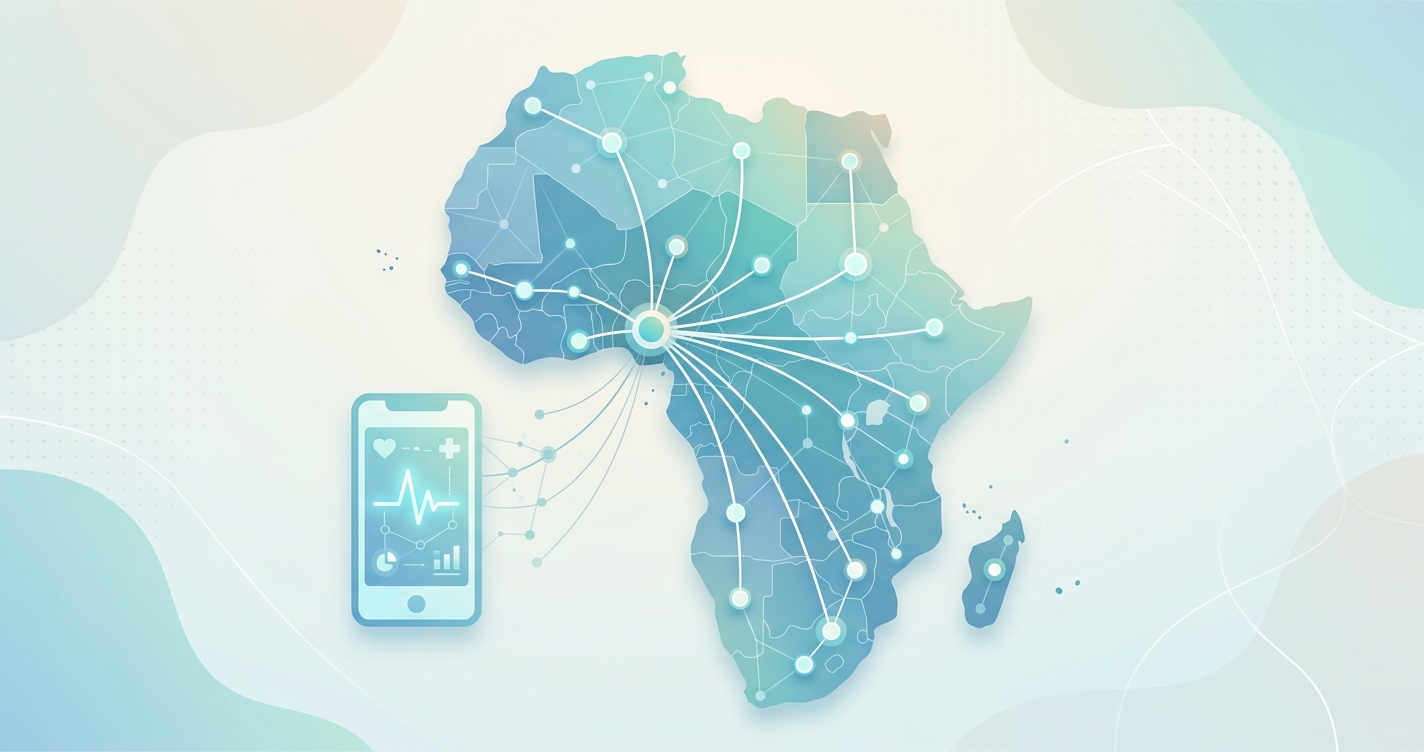
Most health screening pilots in Sub-Saharan Africa work. That is the uncomfortable truth behind the region's slow progress toward population-level early detection. A district pilot reaches its enrollment targets, publishes encouraging numbers, and earns a second round of funding. Then it stops. The gap between a successful pilot and a functioning national program is not a question of whether the technology screens accurately. It is a question of logistics, money, and people, sequenced in the right order. For program managers planning the next phase of an mHealth Sub-Saharan Africa deployment, the work of scaling is a different discipline from the work of piloting, and treating the two as the same exercise is the most common reason national rollouts stall.
The mobile health sector in Africa is projected to reach USD 1.8 billion by 2025, yet a 2025 systematic review guided by the NASSS framework found that the majority of mHealth programs in Sub-Saharan Africa fail to move beyond pilot stage, citing technical, system-level, and infrastructural barriers as the dominant cause.
Why scaling mhealth in sub-saharan africa is a distinct problem
Scaling mobile health programs is not piloting at higher volume. A pilot proves a concept inside controlled conditions: one district, a motivated team, dedicated donor attention, and tolerance for hands-on troubleshooting. National screening rollout removes all of those cushions at once. You inherit weak connectivity in the next province, a payroll system that was never built for thousands of frontline workers, supply chains that break at the last mile, and ministries that need the program to fit existing reporting structures rather than replace them.
A qualitative study published in March 2024 in the Journal of Medical Internet Research, examining perceptions of patients, physicians, and health care executives in Ethiopia, identified 137 determinants of mHealth use, 68 of them barriers and 69 enablers. The sheer number is the lesson. Scaling means managing dozens of interacting variables simultaneously, where a pilot only had to manage a handful. The programs that survive are the ones that plan for the variables they cannot see from inside a single district.
The strategic advantage of camera-based, smartphone-only screening is that it removes one of the heaviest scaling variables: equipment. When a program depends on cuffs, probes, batteries, and calibration, every new region multiplies the procurement and maintenance burden. When the screening tool is software running on a device a health worker may already carry, the marginal cost of adding a region drops sharply. That does not eliminate the logistics problem, but it changes its shape.
| Dimension | Pilot Phase | National Scale Phase |
|---|---|---|
| Geographic scope | Single district or region | Multi-region deployment, including low-connectivity zones |
| Workforce | Dozens of trained, supervised workers | Thousands across a health worker network expansion |
| Funding model | Single donor grant, fixed term | Blended donor, ministry, and recurrent budget lines |
| Supervision | Direct, hands-on | Tiered, data-driven, remote |
| Supply chain | Manual, ad hoc | Integrated into national logistics systems |
| Data systems | Standalone dashboard | Interoperable with national HMIS |
| Risk tolerance | High, experimental | Low, accountable to public health outcomes |
A step-by-step framework for national screening rollout
The sequence matters more than the speed. Programs that rush workforce expansion before funding and data systems are ready tend to recruit faster than they can pay or supervise.
- Stage one: codify the pilot. Document the exact workflow, supervision ratios, referral pathways, and per-screening costs before adding a single new district. Undocumented tacit knowledge does not travel.
- Stage two: secure recurrent financing, not just expansion grants. A program funded only by time-limited grants is planning its own collapse.
- Stage three: integrate data systems with the national health management information system early, so reporting structures grow with the program rather than being retrofitted later.
- Stage four: expand the health worker network in waves, pairing each new region with a trained supervisor cadre drawn from the previous wave.
- Stage five: build redundancy into the supply chain for devices, data connectivity, and power before reaching the hardest-to-serve areas.
Industry applications across the scaling journey
Logistics and multi-region deployment
The last-mile problem defines multi-region deployment. WHO's Regional Office for Africa lists limited network coverage, low technological competence, and insufficient power supply as the recurring obstacles to digital health implementation. Smartphone-based screening that works offline and syncs when connectivity returns addresses the first and third directly. For power, the working assumption in the field is that a community health worker kit costs roughly USD 150 for a smartphone, USD 40 for a solar charger, and USD 480 for an annual data plan, according to operational costing work on rural CHW deployment published in PMC. At national scale those unit costs become the budget. A program that screens with no peripheral equipment keeps that kit lean and the per-worker recurring cost predictable.
Funding and sustainability
The financing trap is structural. Pilots are funded as innovation; national programs must be funded as routine service delivery. A May 2025 narrative review in Frontiers on digital health and health financing argued that durable scale-up depends on integrating digital interventions into national health financing and universal health coverage strategies rather than parallel donor channels. In practice this means program managers should map a transition from donor capital expenditure to ministry-held recurrent expenditure from the first day of the scale plan, with public-private partnerships covering the middle years.
Workforce and health worker network expansion
Workforce is where ambition meets arithmetic. The African Union committed in 2017 to train and deploy two million community health workers by 2025. ReliefWeb reported 1,005,007 deployed, exactly half the target, with the remaining million now pushed to 2030. For a screening program, this CHW base is both the delivery channel and the constraint. Layering a screening protocol onto an already stretched workforce only works if the tool reduces rather than adds workload. Camera-based screening that captures vitals in a single guided session, without the worker assembling and cleaning equipment, is one of the few additions that can plausibly meet that test.
Current research and evidence
The evidence base on scaling is maturing from enthusiasm toward realism. The 2025 NASSS-framework systematic review of barriers to mHealth implementation, adoption, scale-up, and sustainability in Sub-Saharan Africa grouped failure points into three clusters: the technology itself, wider system issues such as governance and interoperability, and socioeconomic and infrastructural conditions. The same body of work consistently names the enablers: rising mobile connectivity, public-private partnerships, and tools that demonstrably reduce health worker workload.
A 2024 analysis in PMC on digital solutions for community and primary health workers drew lessons from multiple African implementations and reached a blunt conclusion that program managers should internalize: digital tools succeed at scale only when they are embedded in existing supervision and incentive structures, not bolted on as separate apps. The WHO Global Strategy on Digital Health 2020-2025 frames the same point at policy level, treating digital health as a means of health system strengthening rather than a standalone product category. For a national screening rollout, the implication is that integration with the human and reporting systems already in place matters as much as the screening accuracy itself.
The future of mhealth sub-saharan africa scaling
The next phase will be shaped by three shifts. First, the device dependency that constrained earlier programs is falling away as software-based screening matures, lowering the marginal cost of each new region. Second, financing is moving from project grants toward integration with universal health coverage budgets, which rewards programs that can show recurrent-cost discipline rather than impressive pilot numbers. Third, the CHW workforce is expanding even if behind target, and the programs positioned to use it are those that reduce, rather than add to, the worker's daily burden.
The programs that reach national scale in the coming years will not be the ones with the most novel technology. They will be the ones that planned logistics, funding, and workforce as a single integrated sequence from the start, and that chose tools light enough to deploy across regions without multiplying the support burden at every step.
Frequently asked questions
What is the most common reason mHealth screening programs fail to scale in Sub-Saharan Africa? Research consistently points to a mismatch between pilot funding and recurrent costs, combined with weak integration into existing workforce and data systems. Programs funded as time-limited innovations rather than routine services tend to collapse when the grant ends, regardless of how well the technology performs.
How much does it cost to equip a community health worker for mobile screening? Operational costing work cited in PMC estimates roughly USD 150 for a smartphone, USD 40 for a solar charger, and USD 480 for an annual data plan per worker. At national scale these unit costs become the dominant recurring budget line, which is why equipment-free screening tools help keep per-worker costs predictable.
Should a screening program expand geographically or deepen workforce coverage first? Sequence funding and data integration before either. Once recurrent financing and interoperable reporting are in place, expand in waves, pairing each new region with supervisors drawn from the previous wave so that supervision quality scales with coverage rather than lagging behind it.
How does equipment-free screening change the scaling math? Removing cuffs, probes, and calibration eliminates one of the heaviest variables in multi-region deployment. The marginal cost and maintenance burden of adding a region drops sharply when screening runs as software on a device the worker already carries.
Circadify is working on this scaling problem directly, pairing smartphone-based vital signs screening already deployed in Uganda with field data that program managers can use to plan logistics, funding, and workforce in sequence. WHO and UNICEF program managers planning a national scale-up can review the partnership models and field evidence in the global health section at circadify.com/blog.