Signs of Tuberculosis Community Workers Can Catch Early
How early TB warning signs and phone-based vital checks help frontline workers triage suspected cases before they spread across rural Africa.
Every TB case that goes undiagnosed for an extra month is a person who keeps coughing, keeps working, and keeps unknowingly exposing a household and a village to an airborne bacterium. For program managers running case-finding campaigns across Sub-Saharan Africa, the bottleneck is rarely the treatment, which is well understood and largely curable. The bottleneck is detection: the gap between when a person first develops symptoms and when a clinician confirms the disease. Effective tuberculosis screening community health workers Africa programs depend on closing that gap at the household level, where the first signs appear long before anyone reaches a clinic. The earlier a frontline worker can recognize a suspected case and triage it, the smaller the transmission chain becomes.
In 2023, Sub-Saharan Africa accounted for roughly 24% of global TB cases and over 33% of TB deaths despite holding only 14% of the world's population, and an estimated 600,000 cases on the continent went undetected that year.
Why tuberculosis screening community health workers Africa programs start with symptoms
TB is a slow disease in its early stages, which is exactly what makes it dangerous. A person can carry active pulmonary TB for weeks while feeling only tired or run down. By the time the cough becomes severe enough to drive someone to a distant clinic, the disease has often advanced and the household has already been exposed. Community health workers (CHWs) sit at the only point in the system where these subtle signals get noticed early, during routine home visits and community gatherings.
The core early warning signs a frontline worker can recognize without any equipment are well documented:
- A persistent cough lasting two to three weeks or longer, especially one that produces sputum or blood
- Drenching night sweats that soak bedding
- Unexplained weight loss and visibly reduced appetite
- Low-grade fever, often in the late afternoon or evening
- Persistent fatigue out of proportion to daily activity
- Chest pain or breathlessness during ordinary tasks
The challenge is that each of these signs overlaps with malaria, HIV-related illness, pneumonia, and ordinary seasonal respiratory infection. Symptom-based screening alone is sensitive but not specific, which means CHWs flag many people who do not have TB and occasionally miss those who do. Adding an objective layer, even a simple one, sharpens the triage decision before scarce diagnostic resources are committed.
Comparing screening approaches at the community level
Different screening methods carry very different costs, skill requirements, and field realities. The table below compares the main options a campaign planner weighs when designing a case-finding workflow.
| Screening approach | Equipment needed | Skill level | Where it works | Main limitation |
|---|---|---|---|---|
| Symptom checklist only | None | Basic training | Any household visit | Low specificity, misses subclinical TB |
| Sputum smear microscopy | Microscope, lab, power | Lab technician | Fixed facilities | Low sensitivity, especially in children |
| Rapid molecular testing | Cartridge device, power, cold chain | Trained operator | District labs, some clinics | Cost per cartridge, supply logistics |
| AI-assisted chest X-ray | Portable X-ray, software | Radiographer support | Mobile camps | High capital cost, transport |
| Symptom checklist + phone-based vitals | Smartphone only | Basic training | Any household visit | Triage aid, not a diagnosis |
The pattern that emerges is consistent across the literature: the most accurate confirmatory tools are also the least portable and most expensive, while the most portable tools are the least specific. The practical goal for community programs is not to replace molecular diagnostics but to route the right people toward them faster and to reduce the number of unnecessary referrals that clog the system.
Where phone-based vital checks fit into TB symptom early detection
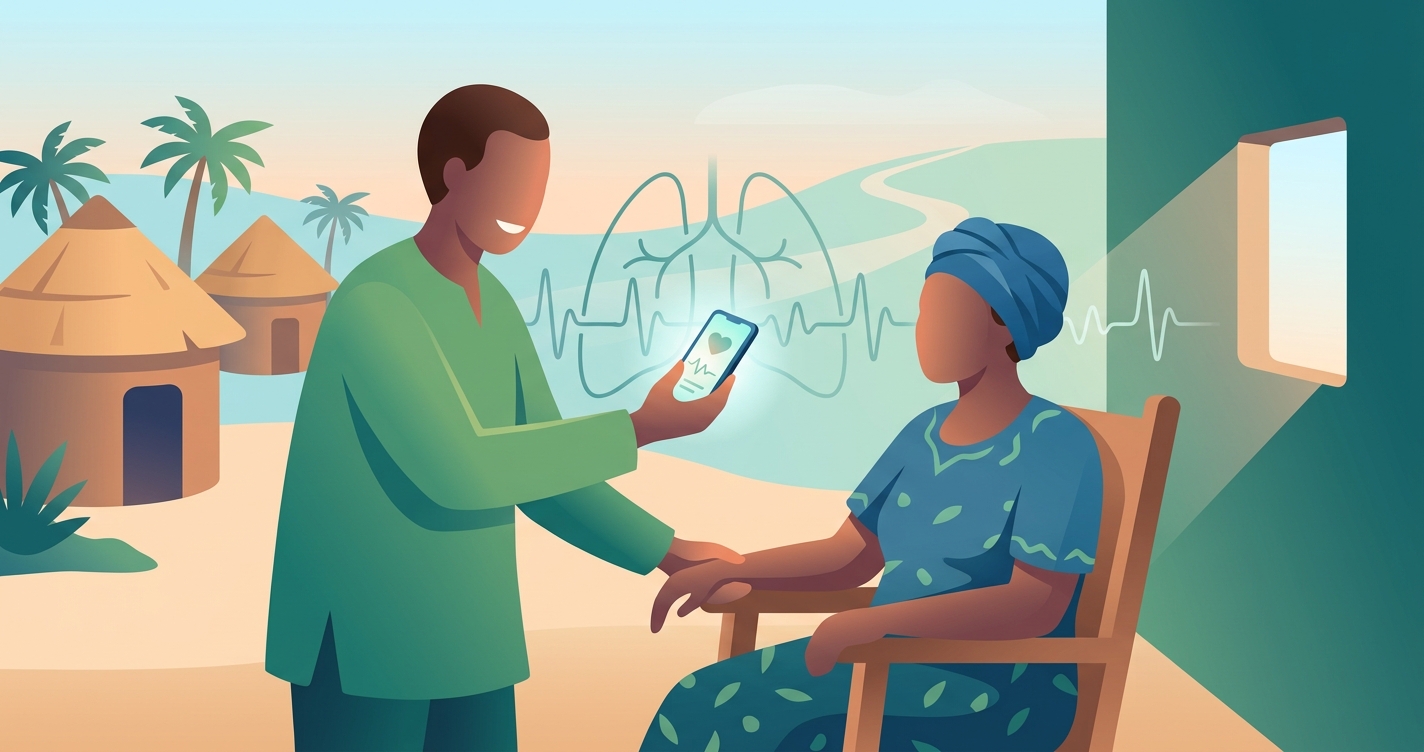
This is where mobile health technology in developing countries is changing the triage step. Contactless vital signs measurement using a smartphone camera, based on remote photoplethysmography (rPPG), lets a worker capture objective physiological signals during the same visit where they ask about cough and weight loss. A person with active pulmonary TB frequently presents with an elevated resting heart rate, a raised respiratory rate, and sometimes a measurable fever pattern. None of these confirm TB on their own, but combined with the symptom checklist they help a CHW separate a likely case that needs urgent referral from a milder respiratory complaint that can be observed.
The advantage in rural settings is the absence of consumables. There is no cuff to calibrate, no probe to sterilize, no cartridge to reorder, and no cold chain to maintain. A worker who already carries a phone can add a structured vitals check to an existing home visit. For contactless vitals rural healthcare deployments, that means the screening footprint does not grow with the size of the campaign, which is the constraint that breaks most equipment-dependent programs.
Triage before transmission
The operational value is speed of decision. A CHW who can document an elevated respiratory rate alongside a three-week cough has a stronger, more defensible reason to escalate that person for sputum collection or referral the same day, rather than scheduling a follow-up that may never happen. In communities where the nearest testing site is hours away, reducing the number of trips required to reach a diagnosis directly shortens the infectious window.
Standardizing what gets recorded
Phone-based workflows also force consistency. Instead of relying on each worker's memory and judgment, the screening app records the same fields for every contact, timestamps them, and links them to a location. For program managers, this turns thousands of scattered home visits into structured community health screening Africa data that can show where suspected cases cluster and whether referrals actually convert into confirmed diagnoses.
Current research and evidence
The evidence base for community-led TB case finding is strong and growing. Reviews of TB REACH projects have repeatedly identified CHW-driven active case finding, contact tracing, and sputum transport as factors associated with higher case notifications and better treatment outcomes. An evaluation in central Mozambique published in PLOS One found that using community health workers for both facility and community-based case finding increased the number of presumptive cases identified and tested.
On the diagnostic side, studies across Ethiopia, Kenya, and Nigeria in 2024 reported that AI-assisted chest X-ray screening outperformed symptom-only screening for identifying active cases, reinforcing the point that symptom checklists need an objective companion. The WHO African Region's 2023 progress update noted that 61% of notified TB patients in 24 African countries were tested with WHO-recommended rapid diagnostics, still short of the 100% access target set for 2027. The detection gap, not the treatment gap, remains the defining problem.
Funding is moving in the same direction. The Global Fund has committed over US$900 million to community health workers for the 2024 to 2026 period, a roughly 32% increase over the prior cycle, signaling that donors increasingly see frontline workers as the engine of case finding rather than a supplement to it. The research consensus is that the missing piece is not a new drug or even a new lab test, but a faster, more consistent way to find suspected cases in the home and move them into the diagnostic pathway.
The future of community TB screening
The direction of travel points toward layered, smartphone-anchored workflows where a single device handles the symptom interview, the objective vitals check, the referral decision, and the data record. As near point-of-care molecular tests reach more districts through 2026, the value of accurate upstream triage rises, because every unnecessary referral consumes a cartridge that a confirmed case needs. The combination of community screening at the door and rapid confirmation at the district level is the model most likely to close the 600,000-case detection gap.
The remaining work is integration rather than invention. Symptom checklists exist. Contactless vitals exist. Molecular confirmation exists. What national TB programs need is a workflow that links them into one continuous pathway a CHW can run on a phone they already own, with data that flows back to district and national dashboards. Programs that treat screening as a software and training problem rather than a hardware procurement problem are the ones most likely to scale.
Frequently asked questions
What are the earliest TB signs a community health worker can spot without equipment? A cough lasting two to three weeks or longer, night sweats, unexplained weight loss, evening fevers, and persistent fatigue are the core early signs. Any one of these, especially the prolonged cough, should prompt a worker to escalate the person for further evaluation.
Can a phone diagnose tuberculosis? No. A smartphone-based check measures vital signs such as heart rate and respiratory rate and helps a worker decide who needs urgent referral. Confirmation still requires a sputum-based or molecular test. The phone improves triage, not diagnosis.
Why do so many TB cases in Africa go undetected? The main barrier is distance and timing. Early symptoms are mild and overlap with common illnesses, the nearest testing site may be hours away, and confirmatory tools like microscopy have low sensitivity. An estimated 600,000 cases on the continent went undetected in 2023.
How does contactless vitals screening help TB case-finding campaigns? It adds an objective layer at the household level with no consumables, sharpening the decision about who to refer. It also standardizes and digitizes what each worker records, giving program managers usable data on where suspected cases cluster.
Circadify is working on this integration problem directly, building smartphone-based vital signs screening that frontline workers can fold into existing TB case-finding visits without new equipment. Program managers and NGOs designing community screening campaigns can explore partnership opportunities and field data in the global health section at circadify.com/blog.