Smartphone Screening vs Pulse Oximetry in Low-Resource Settings: Accuracy and Cost
Comparing smartphone screening and pulse oximetry for vital signs measurement in low-resource settings, covering accuracy data, cost analysis, and field deployment realities.
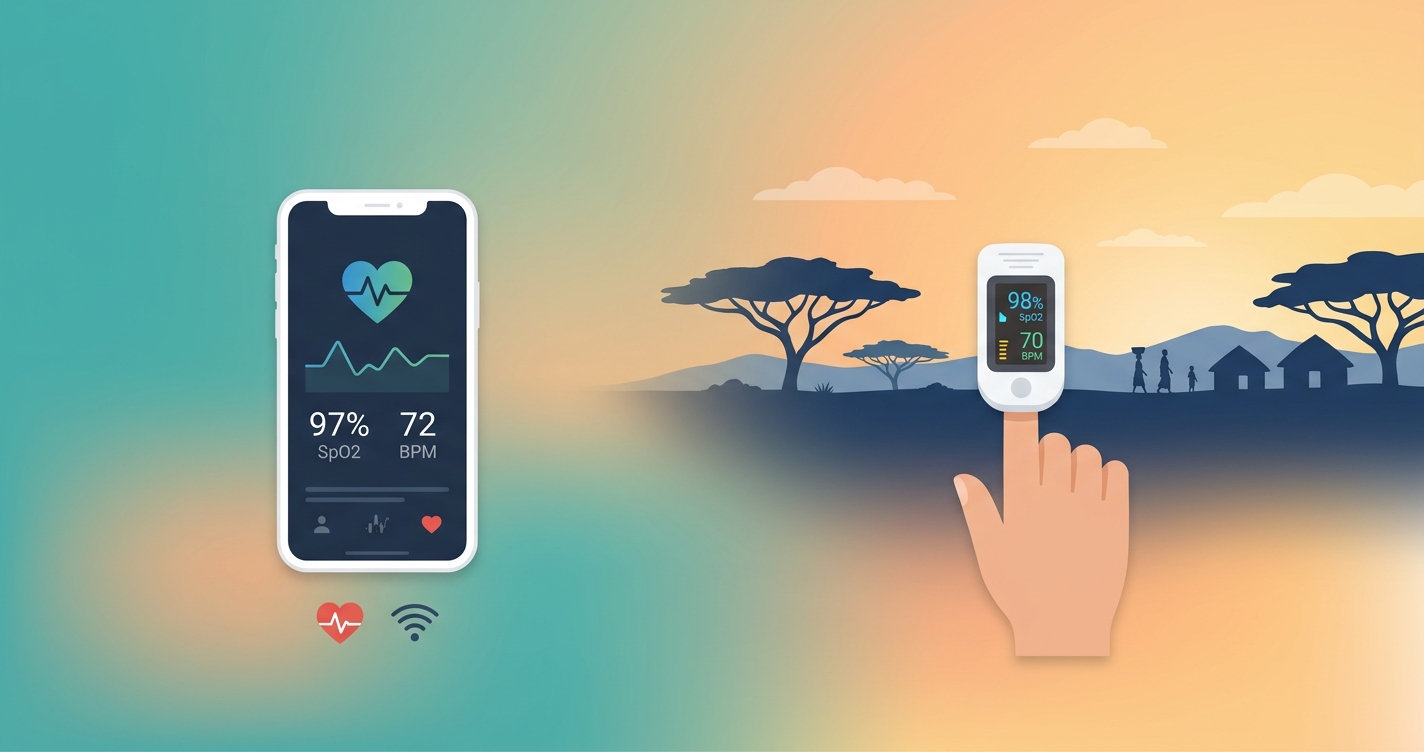
The conversation around smartphone screening vs pulse oximetry in low-resource settings has shifted over the past two years. What started as an academic curiosity — can a phone camera really measure what a dedicated medical device measures? — has become a practical question for program managers deciding how to spend limited budgets across health facilities that often lack both.
"15% of operating beds and 42% of recovery beds in postanesthetic care areas in low and lower-middle income settings lacked a pulse oximeter." — Lifebox Foundation, Smile Train, and Jhpiego survey published in Annals of Surgery
That statistic from the Lifebox Foundation's 2022 report, A Critical Gap: Pulse Oximetry in Low- and Middle-Income Countries, frames the problem well. We're not comparing smartphone screening against a device that's already everywhere. In many of the places where this comparison matters most, the traditional device isn't there either.
How smartphone screening and pulse oximetry actually compare
Pulse oximetry has been the clinical standard for measuring blood oxygen saturation (SpO2) since the 1980s. The technology works by passing two wavelengths of light through tissue — typically a fingertip — and measuring how much each wavelength is absorbed by oxygenated versus deoxygenated hemoglobin. A standard clinical pulse oximeter costs between $30 and $300 depending on the model, and accuracy expectations follow ISO 80601-2-61, which requires a root-mean-square deviation (RMSD) of 3% or less for SpO2 readings between 70% and 100%.
Smartphone-based screening takes two forms. The first uses the phone's built-in camera and flash — you place your finger on the camera lens, and the flash acts as the light source while the camera detects changes in light absorption through the skin. The second, newer approach is remote photoplethysmography (rPPG), which captures subtle color changes in facial skin from a front-facing camera without any physical contact. Both approaches measure the same underlying signal: pulsatile blood volume changes driven by the cardiac cycle.
A 2022 study published in Sensors by Joel Kwan and colleagues at the University of British Columbia evaluated a low-cost smartphone pulse oximeter that interfaced a clinical finger sensor with a smartphone through the headset jack. They found SpO2 accuracy within 2% RMSD across a range of saturation levels. Meanwhile, a study published in eScholarship by researchers at UC San Diego demonstrated a smartphone biosensor app achieving an SpO2 RMSD of 2.2% during controlled "breathe down" hypoxia testing, meeting FDA/ISO standards.
The rPPG approach has matured rapidly. A 2024 review by Phisan Pirzada and colleagues at the University of St Andrews, published in IEEE Sensors Journal, examined rPPG systems for heart rate and SpO2 measurement. They reported validation ranges of 83% to 100% SpO2 with accuracy comparable to contact-based methods under controlled conditions, though they noted sensitivity to environmental factors like ambient lighting and subject motion. A separate 2025 clinical validation study by Zuccotti and colleagues, enrolling adult volunteers from September to November 2024, tested rPPG-derived vital signs captured from a mobile device's front camera against standard clinical measurements. Heart rate and SpO2 showed strong agreement with reference devices.
| Factor | Traditional pulse oximeter | Smartphone finger-based | Smartphone rPPG (contactless) |
|---|---|---|---|
| Per-device cost | $30–$300 | $0 (uses existing phone) | $0 (uses existing phone) |
| SpO2 accuracy (RMSD) | ≤3% (ISO standard) | 2–3% in controlled studies | 2–4% in controlled studies |
| Heart rate accuracy | ±2 bpm typical | ±2–3 bpm | ±2–5 bpm |
| Contact required | Yes (finger clip) | Yes (finger on camera) | No |
| Consumables/maintenance | Probe covers, batteries | None | None |
| Training time for CHWs | 15–30 minutes | 5–10 minutes | 5–10 minutes |
| Infection control risk | Moderate (shared probe) | Low | None |
| Works without electricity | Battery-dependent | Phone battery | Phone battery |
| Works offline | Yes | Depends on app | Depends on app |
| Multi-vital measurement | SpO2 + heart rate only | SpO2 + heart rate | HR, SpO2, RR, BP estimates, stress |
The cost reality on the ground
The cost comparison between smartphone screening and pulse oximetry in low-resource settings goes beyond the sticker price of the device. A pulse oximeter is relatively cheap as medical devices go. But the total cost of ownership in a community health setting includes procurement logistics, maintenance, calibration, battery or power supply, infection control consumables, and replacement when devices break or walk away.
The Lifebox Foundation has distributed over 30,000 pulse oximeters to low-resource hospitals since 2011. Their experience shows that ongoing costs — training, maintenance, battery replacement, and probe covers — often exceed the initial device cost within two years. In a 2022 report, Lifebox documented that many distributed devices were non-functional within 18 months due to broken probes, dead batteries, or lack of replacement parts.
Smartphone-based screening sidesteps most of these logistics. Community health workers in Sub-Saharan Africa increasingly carry smartphones as part of their standard toolkit for data collection, reporting, and communication. Adding a health screening app to a phone they already carry doesn't require a separate procurement cycle, a separate supply chain for consumables, or a separate maintenance protocol.
A 2024 analysis published in BMC Health Services Research examined the cost-effectiveness of digital health tools deployed through community health worker programs in East Africa. The study found that per-screening costs dropped by 40% to 60% when health assessments were integrated into devices that CHWs already carried, compared to programs that required dedicated medical devices.
The math isn't complicated. If a CHW already has a smartphone for their mHealth data collection workflow, the marginal cost of adding vital signs screening is essentially the cost of the software license. Compare that to procuring, distributing, maintaining, and eventually replacing thousands of single-purpose pulse oximeters across a national health system.
Where pulse oximetry still wins
This isn't a clean sweep for smartphones. There are situations where a dedicated pulse oximeter remains the better tool.
Surgical and critical care monitoring
In operating rooms and intensive care units, pulse oximeters provide continuous, real-time monitoring with alarm thresholds. Smartphone screening, whether contact or contactless, isn't designed for continuous monitoring during surgery. The Lancet Global Health Commission on Medical Oxygen Security, published in 2025, emphasized that pulse oximetry remains essential for guiding oxygen therapy in clinical settings. The Commission documented a 70% oxygen coverage gap globally, which exceeds the gaps for HIV/AIDS medicines (24%) and tuberculosis medicines (39%).
Neonatal screening
Pulse oximetry for newborn screening — specifically for critical congenital heart disease — requires accuracy at lower saturation ranges where smartphone-based methods have less validation data. The WHO recommends pulse oximetry screening for newborns, and the accuracy requirements at saturations below 90% remain better served by dedicated devices for now.
Severely hypoxic patients
When SpO2 drops below 80%, the accuracy of all optical methods degrades. But dedicated pulse oximeters with clinical-grade sensors perform better in this range than smartphone cameras. For patients in respiratory distress who need oxygen titration, a clinical pulse oximeter is still the right tool.
Where smartphone screening changes the equation
Community health screening at scale
The typical community health worker visit in rural Sub-Saharan Africa lasts 15 to 30 minutes and covers health education, data collection, referral assessment, and sometimes medication delivery. Adding a pulse oximeter reading requires carrying another device, remembering to charge it, cleaning the probe between patients, and recording the result separately from the rest of the visit data.
Adding a contactless rPPG scan to an existing smartphone workflow takes about 30 seconds and captures multiple vital signs simultaneously — heart rate, respiratory rate, SpO2 estimate, and blood pressure estimate — all automatically logged in the same data system the CHW already uses. The workflow integration advantage is hard to overstate.
Multi-disease screening programs
A pulse oximeter tells you two things: SpO2 and heart rate. Smartphone-based rPPG screening captures a broader set of physiological signals. For community health programs targeting multiple conditions — hypertension screening alongside respiratory disease, for example — a single smartphone scan replaces what would otherwise require multiple dedicated devices.
Programs with limited supply chains
In Francophone West Africa, parts of the Sahel, and remote areas of East Africa, medical device supply chains are fragile. Getting replacement probe covers or batteries to a rural health post can take weeks. Smartphones, by contrast, are part of the consumer supply chain. Phone chargers, power banks, and replacement phones are available at local markets. The supply chain for smartphones is more robust than the supply chain for medical devices in most low-resource settings.
Current research and evidence
The evidence base for smartphone-based vital signs measurement has grown significantly since 2023. A clinical validation study published in 2025 by a team at PMC evaluated rPPG-enabled contactless pulse rate monitoring in cardiovascular disease patients, finding agreement with standard clinical measurements that supported use in monitoring contexts.
A 2025 review by researchers affiliated with Frontiers in Digital Health examined rPPG technology from IntelliProve, reporting that smartphone and laptop camera-derived heart rate measurements achieved 99.4% accuracy against clinical reference devices. The same review noted SpO2 measurement accuracy comparable to contact-based pulse oximetry under controlled conditions.
Research from the University of British Columbia and UC San Diego has demonstrated that smartphone-based SpO2 measurement can meet FDA/ISO accuracy standards. The UC San Diego study, published through eScholarship, showed 2.2% RMSD for SpO2 — well within the 3% threshold required by ISO 80601-2-61.
What remains less clear is how these controlled-environment results translate to field conditions in Sub-Saharan Africa, where lighting varies, patients may be moving, and the CHW operating the device has limited technical training. The gap between lab accuracy and field accuracy is real, and programs deploying smartphone screening should build validation studies into their implementation plans.
The future of vital signs screening in low-resource settings
The trend lines point toward coexistence rather than replacement. Dedicated pulse oximeters will remain necessary in clinical settings — operating rooms, ICUs, neonatal units — where continuous monitoring and alarm functions matter. But for the much larger population-level screening challenge, where the goal is to identify people who need referral to those clinical settings, smartphones are becoming the more practical tool.
The WHO's 2024 Global Digital Health Monitor tracked 23 indicators for digital health readiness across member states. As these indicators migrate to the WHO Data Hub, the infrastructure for evaluating smartphone-based screening at national scale is maturing. Several African health ministries have already incorporated smartphone-based health assessments into their community health worker protocols, using the devices CHWs already carry.
The cost dynamics are shifting too. As rPPG algorithms improve and smartphones get cheaper, the accuracy gap narrows while the cost gap widens. A $50 smartphone that measures five vital signs contactlessly competes differently against a $100 pulse oximeter that measures two.
Frequently asked questions
Can a smartphone really measure SpO2 as accurately as a pulse oximeter?
Under controlled conditions, several studies have demonstrated smartphone SpO2 measurement within 2–3% RMSD, which meets the ISO 80601-2-61 standard of ≤3% RMSD. The UC San Diego study achieved 2.2% RMSD. Field accuracy may vary depending on lighting, motion, and device quality.
Is contactless rPPG screening ready for clinical use?
For clinical monitoring in hospitals, dedicated devices remain the standard. For community-level screening — identifying people who need clinical referral — rPPG has sufficient accuracy for heart rate and SpO2 estimation. A 2025 clinical validation in cardiovascular disease patients showed agreement with standard measurements.
How much does it cost to deploy smartphone screening vs pulse oximetry at scale?
The per-device cost difference is significant: $0 marginal cost for smartphone screening (assuming CHWs already have phones) vs $30–$300 per pulse oximeter. But the bigger savings come from eliminating the separate supply chain for device maintenance, consumables, and replacement. Studies show 40–60% per-screening cost reductions when assessments are integrated into existing smartphone workflows.
What vital signs can smartphone screening measure that pulse oximetry cannot?
A pulse oximeter measures SpO2 and heart rate. Smartphone rPPG can estimate heart rate, respiratory rate, SpO2, blood pressure, and stress levels from a single 30-second facial scan. This multi-vital capability is particularly useful for community health programs screening for multiple conditions.
For organizations designing community health screening programs in low-resource settings, the question is increasingly about workflow integration and total cost of ownership rather than raw device accuracy. Companies like Circadify are developing contactless smartphone-based screening technology specifically for these deployment contexts, where the ability to measure multiple vital signs from a phone camera — without additional hardware — addresses both the access gap and the logistics challenge that traditional pulse oximetry can't solve alone.