
Smartphone vs Traditional Health Screening: Cost Compared for LMICs
A cost comparison of smartphone-based health screening versus traditional clinical screening methods in low- and middle-income countries, examining equipment, staffing, and per-screening economics.
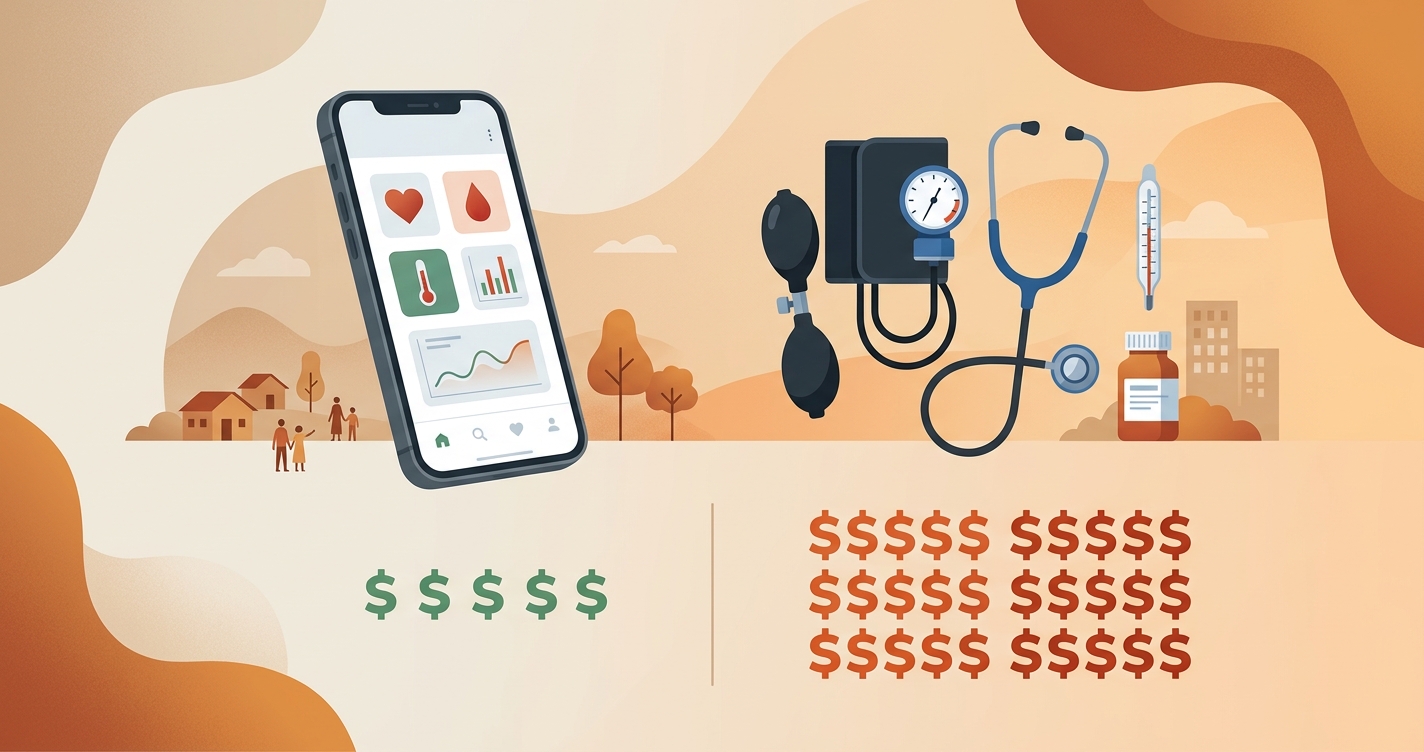
The economics of health screening in low- and middle-income countries have always worked against coverage. Sub-Saharan African nations spend a median of $41 per person per year on health, according to the WHO African Region Health Expenditure Atlas (2023). That figure covers everything — not just screening, but treatment, infrastructure, salaries, pharmaceuticals. When governments and NGOs try to stretch those dollars into population-level screening programs, the arithmetic gets uncomfortable fast.
Smartphone-based screening changes that arithmetic. But by how much, and where exactly do the savings show up? The answer depends on which costs you count and how you measure them.
"The cost of not screening is always higher than the cost of screening — but only if you can actually afford to screen. That is the paradox of preventive health in resource-limited settings." — Dr. Agnes Binagwaho, Vice Chancellor, University of Global Health Equity, Rwanda (Lancet Global Health, 2023)
What traditional health screening actually costs in LMICs
Traditional health screening in low-resource settings requires trained clinical staff, dedicated equipment, consumable supplies, cold chain logistics for certain tests, and physical infrastructure. For a basic cardiovascular risk screening — blood pressure, heart rate, and blood glucose — a health facility needs at minimum a sphygmomanometer, a pulse oximeter, a glucometer with test strips, and a trained nurse or clinical officer to operate them.
The WHO's Package of Essential Noncommunicable Disease Interventions (PEN) estimated that equipping a primary health facility for basic NCD screening costs between $1,500 and $4,000 in initial capital expenditure, depending on the country (WHO PEN Technical Package, 2020). That figure does not include recurring costs for consumables, calibration, maintenance, or replacement.
Consumables add up quickly. Glucometer test strips cost $0.25–$0.50 per test in bulk procurement for LMICs, according to a 2023 analysis by PATH. A single sphygmomanometer cuff requires replacement every 12–18 months in high-use settings. Pulse oximeter probes degrade with use, and replacement probes cost $15–$30 each.
The staffing component is often the largest expense. A 2024 scoping review published by Mvundura et al. in BMC Health Services Research found that community health worker programs focused on screening in sub-Saharan Africa cost between $12.57 and $26,556 per quality-adjusted life year gained — a range so wide it mostly reflects the enormous variation in what "screening" means from one program to the next.
Equipment cost breakdown: traditional screening station
| Item | Unit cost (USD) | Lifespan | Annual cost per unit |
|---|---|---|---|
| Digital sphygmomanometer | $35–$80 | 2–3 years | $12–$40 |
| Pulse oximeter (fingertip) | $25–$60 | 1–2 years | $13–$60 |
| Glucometer | $15–$30 | 2 years | $8–$15 |
| Test strips (500/year) | $0.30 each | Single use | $150 |
| Thermometer (digital) | $5–$15 | 1–2 years | $3–$15 |
| Carrying case/supplies | $20–$50 | 2 years | $10–$25 |
| Total equipment | $196–$305/year |
These numbers look small in isolation. The problem is scale. A district health program covering 50 community health workers, each conducting 8–15 household visits per day, needs 50 complete kits. Equipment loss, theft, damage from rain or dust, and supply chain disruption in rural areas push real-world costs 30–50% above procurement price, according to field estimates from Living Goods, an NGO operating CHW programs in Uganda and Kenya.
What smartphone-based screening costs
Smartphone screening eliminates most equipment line items. The screening tool is the phone itself, which community health workers in most LMIC programs already carry. A 2022 study by Braun et al. in Frontiers in Digital Health found that 78% of CHW programs in sub-Saharan Africa had already distributed smartphones to field workers for data collection, reporting, and communication by 2021.
Where CHWs already have smartphones, the marginal cost of adding a screening application is close to zero in hardware terms. The phone camera performs the measurement. The software processes the signal. No test strips, no calibration, no replacement parts.
Where programs need to procure smartphones specifically for screening, the picture is still favorable. A basic Android smartphone capable of running camera-based vital sign measurement costs $60–$120 in LMIC markets. That phone also handles data reporting, GPS tracking, communication, and health education materials — functions that would otherwise require separate devices or paper systems.
Cost comparison: smartphone vs traditional screening per 1,000 screenings
| Cost category | Traditional screening | Smartphone screening |
|---|---|---|
| Equipment procurement | $196–$305/year | $60–$120 (phone, one-time) |
| Consumables (annual) | $150+ (test strips alone) | $0 |
| Equipment maintenance/replacement | $50–$100/year | Phone case: $5 |
| Training time | 3–5 days clinical training | 1–2 hours app training |
| Time per screening | 5–10 minutes | 30–60 seconds |
| Data entry | Manual (paper or parallel digital) | Automatic |
| Calibration required | Yes (quarterly) | No |
| Infection control supplies | Alcohol swabs, gloves ($20–$40/year) | None needed (contactless) |
| Estimated cost per screening | $1.50–$4.00 | $0.08–$0.25 |
The per-screening cost estimates above draw on program-level data from several sources: Mvundura et al.'s 2024 review of CHW program costs, PATH's 2023 diagnostics cost analysis for LMICs, and operational data published by Living Goods and Last Mile Health. The smartphone figure assumes a phone lasting 2 years and conducting 10 screenings per day over 250 working days.
Where the real savings accumulate
The direct cost comparison tells part of the story. Several less obvious cost factors push the gap wider.
Supply chain elimination. Traditional screening requires ongoing procurement cycles for consumables. In rural sub-Saharan Africa, supply chains for medical consumables are unreliable. A 2022 study by the Global Fund found that 34% of health facilities in their surveyed countries experienced stockouts of essential diagnostic supplies at least once per quarter. Smartphone screening has no supply chain for consumables because there are no consumables.
Training cost reduction. Teaching a community health worker to use a sphygmomanometer properly takes time. Incorrect cuff sizing, improper arm positioning, and digit transposition during manual recording all introduce errors. The WHO estimates that clinical measurement training for CHWs requires 3–5 days of supervised instruction (WHO CHW Guideline, 2018). App-based screening — point the camera, wait 30 seconds, read the result — can be taught in a single training session. Living Goods reported in their 2023 annual report that CHWs in Uganda learned to use smartphone-based screening tools in under 2 hours of training.
Throughput improvement. A CHW conducting traditional vital sign screening spends 5–10 minutes per patient on measurement, recording, and equipment handling. Smartphone screening takes 30–60 seconds. Over an 8-hour workday with 10 household visits, that time difference translates to 45–90 additional minutes available for other health activities — or 2–4 additional households visited per day. Over a year, the cumulative productivity gain is substantial.
Data quality and integration. Paper-based recording from traditional screening requires a separate data entry step, introducing transcription errors and delays. A 2021 analysis by Chandani et al., published across multiple LMIC country studies, found that digital data capture by CHWs reduced data entry errors by 47% compared to paper-based systems. Smartphone screening captures data digitally at the point of care with automatic timestamps and GPS coordinates, eliminating the entire transcription step.
What smartphone screening cannot replace
Honesty about limitations matters here. Smartphone-based vital sign screening using remote photoplethysmography measures heart rate, respiratory rate, blood pressure trends, and stress indicators. It does not replace blood glucose testing, malaria rapid diagnostic tests, HIV testing, or any screening that requires a biological sample.
For programs focused specifically on NCD risk screening — hypertension detection, cardiovascular risk assessment, respiratory monitoring — smartphone screening can handle the vital sign component at a fraction of the cost. For programs that need laboratory-grade diagnostics, the phone becomes a complement to traditional tools, not a replacement.
The practical implication for program designers: smartphone screening is best deployed as a first-pass triage tool. Screen everyone cheaply with the phone, then direct limited clinical resources toward the individuals whose readings warrant follow-up testing.
Where each method fits
| Screening need | Traditional tools needed? | Smartphone sufficient? |
|---|---|---|
| Blood pressure trend detection | No | Yes |
| Heart rate and rhythm screening | No | Yes |
| Respiratory rate monitoring | No | Yes |
| Stress and autonomic function | No | Yes |
| Blood glucose measurement | Yes | No |
| Malaria rapid diagnostic test | Yes | No |
| HIV screening | Yes | No |
| Hemoglobin/anemia estimation | Yes | Emerging research |
| Body temperature | Yes (thermometer) | No |
The Uganda case
Uganda provides a useful reference point because it has one of the largest community health worker networks in East Africa — over 180,000 Village Health Teams (VHTs) operating across the country, according to Uganda's Ministry of Health. The country spends approximately $50 per person per year on health (WHO GHED, 2023), and NCD screening at the community level has historically been limited by equipment availability.
Circadify has been deploying smartphone-based vital sign screening with community health workers in Uganda. The deployment demonstrated that adding contactless screening to existing CHW workflows required minimal incremental cost — the phones were already in the field, and training time was measured in hours rather than days. The screening data feeds directly into digital health information systems, bypassing the paper-to-digital bottleneck that slows traditional programs.
Programs like these point toward a model where population-level vital sign screening becomes economically feasible at national scale — something that the traditional equipment-per-worker model has not achieved in most LMIC settings.
What the research says about cost-effectiveness
Several recent studies and reviews have examined the cost-effectiveness of digital health interventions in LMICs. A 2025 rapid systematic review published in JMIR by researchers examining 25 years of digital health toward universal health coverage found that digital tools consistently reduced per-encounter costs while increasing coverage in low-resource settings. The review covered 45 studies across 25 LMICs and found that mobile health interventions showed favorable cost-effectiveness ratios in the majority of cases.
A separate analysis by researchers at the WHO African Regional Office, published in their 2023 Health Expenditure Atlas, noted that countries spending less than $50 per capita on health face the steepest barriers to screening coverage — precisely the countries where low-cost smartphone alternatives offer the greatest marginal benefit.
The economic argument is not theoretical. The Global Fund's 2024 investment case estimated that digital diagnostic tools could reduce per-test costs by 40–60% in tuberculosis and HIV screening programs. While those programs use different digital tools than camera-based vital sign screening, the underlying cost dynamic — eliminating consumables, reducing training, automating data capture — follows the same pattern.
Frequently asked questions
Can smartphone screening replace all traditional health screening?
No. Smartphone camera-based screening measures vital signs through remote photoplethysmography. It handles heart rate, respiratory rate, blood pressure trends, and stress indicators. It does not test blood glucose, detect malaria parasites, or perform any test requiring a biological sample. It works best as a first-pass triage tool that identifies individuals who need further clinical assessment.
How much does a smartphone screening program cost to launch?
If community health workers already carry smartphones — as they do in most digitized CHW programs — the incremental cost is the software and a brief training session. If phones need to be procured, budget $60–$120 per device. A program equipping 100 CHWs with phones and training would cost roughly $8,000–$14,000 in total, compared to $20,000–$35,000 for equivalent traditional screening kits plus training.
Is smartphone screening accurate enough for clinical decisions?
Research on rPPG technology has shown strong correlation with clinical-grade devices for heart rate and respiratory rate measurement. A 2024 review published in IEEE Transactions on Biomedical Engineering found rPPG heart rate measurements within ±2–5 BPM of reference devices across multiple studies. For community-level screening — where the goal is identifying individuals who need clinical follow-up rather than making final diagnoses — this level of accuracy supports the triage use case.
What about areas with poor internet connectivity?
Smartphone-based screening works offline. The phone camera captures the data, the on-device algorithm processes it, and results display immediately. Data can sync to central systems when connectivity becomes available. This offline-first design is specifically important for rural areas in sub-Saharan Africa where cellular coverage is intermittent.
Looking ahead
The cost gap between smartphone and traditional screening will likely widen. Phone prices in LMIC markets continue to fall — Counterpoint Research reported in 2025 that the average selling price of smartphones in Africa dropped 12% between 2022 and 2024. Meanwhile, medical consumable costs are subject to supply chain pressures and inflation that have increased procurement costs for many LMIC health programs.
For global health organizations, governments, and NGOs designing screening programs in low-resource settings, the economic case for smartphone-based vital sign screening is becoming difficult to ignore. It does not eliminate the need for clinical-grade diagnostics, but it brings population-level vital sign screening within reach of health budgets that cannot support traditional equipment-intensive approaches.
Circadify is working with partners in East Africa to scale this model — bringing contactless vital sign screening to community health programs through the smartphones already in health workers' hands. More information on deployment partnerships is available at circadify.com.