Solar-Powered Health Screening: Vitals Without the Grid
How solar-charged smartphones enable continuous vital-sign screening in off-grid African villages, eliminating the data-power paradox for community health.
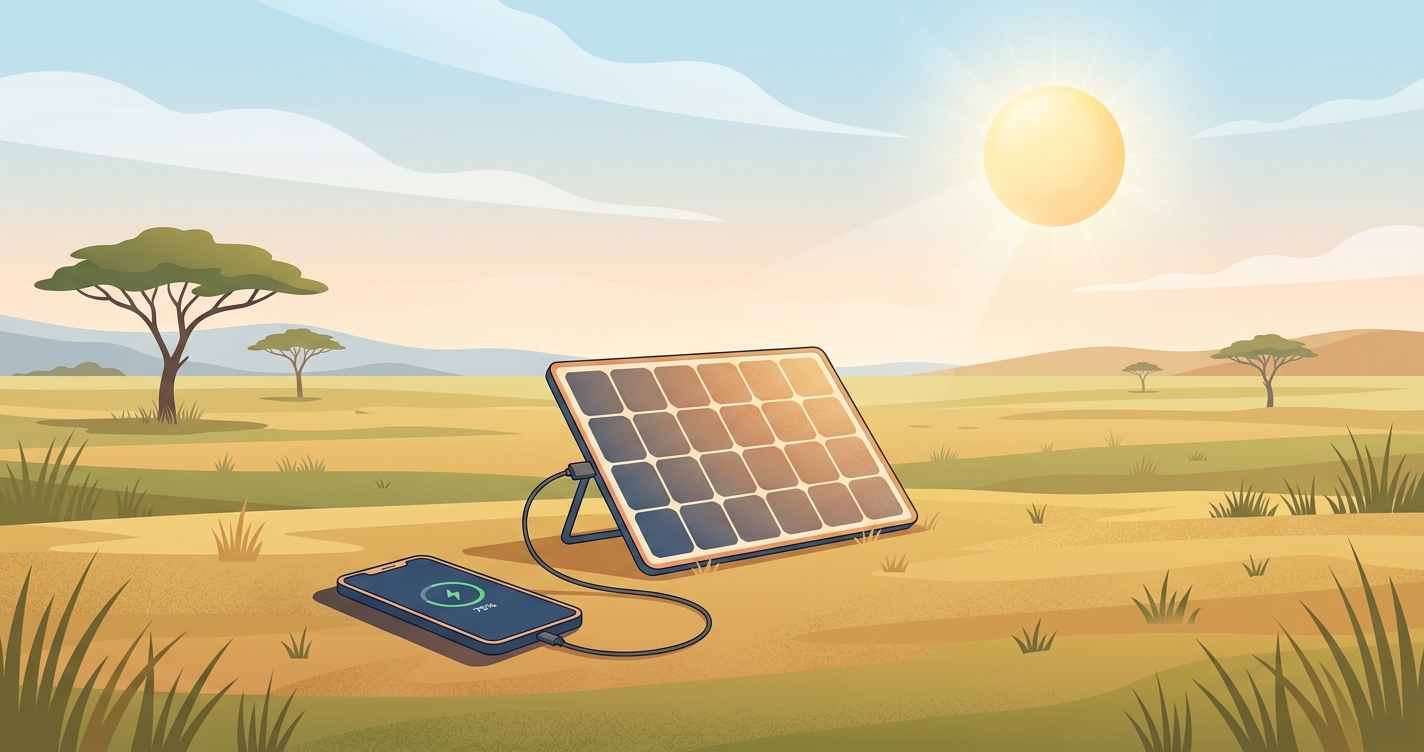
When program managers evaluate digital health tools for remote populations, the conversation often centers on software capabilities, data security, and clinical accuracy. Yet the most frequent point of failure for these deployments is far more mundane: a dead battery. In regions where the electrical grid is intermittent or non-existent, the promise of mobile health is heavily constrained by the physical reality of power distribution. Historically, international donors have shipped complex electronic medical devices to rural clinics, only to watch those devices turn into expensive paperweights when the national grid fails or the diesel for the local generator runs out. As ministries of health shift toward smartphone-based diagnostic tools, implementing solar powered health screening Africa has emerged as a logistical necessity rather than a supplementary feature. You cannot run a continuous population health program when community health workers spend three days a week walking to the nearest town just to pay for charging their devices.
"Approximately 15 percent of healthcare facilities in Sub-Saharan Africa operate with zero access to electricity, and only 40 percent maintain a reliable power supply. The expansion of mobile health systems cannot succeed unless we solve the foundational energy gap that leaves frontline workers holding dead hardware." , World Health Organization, Electrification of Health-Care Facilities Report, 2023
The data-power paradox in solar powered health screening africa
Deploying contactless vitals rural healthcare systems requires reconciling high processing demands with low energy availability. The shift toward camera-based measurement algorithms, such as remote photoplethysmography (rPPG), allows a standard smartphone to measure heart rate, respiratory rate, and oxygen saturation without peripheral hardware. However, running these complex video-processing algorithms continuously drains battery life far faster than standard communication applications.
Laura J. Haxton and Jennifer L. St. Clair, in their 2023 publication in Global Health: Science and Practice, describe this tension as the "data-power paradox." The very systems designed to capture high-quality, granular health data in low-resource settings simultaneously demand more power than those settings can provide. When a community health worker is forced to choose between preserving battery life for emergency phone calls and running a health screening application, the screening application is quickly abandoned. The operational reality of mHealth Sub-Saharan Africa deployments dictates that digital tools must be completely energy-independent to achieve high adherence rates.
Implementing solar technology directly at the point of care changes this equation entirely. Rather than relying on centralized clinic electrification, which requires massive capital investment, complex supply chains, and years of infrastructure development, program managers are equipping workers with decentralized, portable solar arrays and high-capacity power banks. This approach decouples the diagnostic capacity of the worker from the geographic reach of the national electrical grid, creating a highly resilient network of independent screening nodes.
| Feature | Grid-Dependent Screening Systems | Solar-Powered Smartphone Screening |
|---|---|---|
| Hardware Requirements | Peripheral diagnostic machines, wall monitors | Standard smartphone, 20W portable solar panel, power bank |
| Operational Continuity | Fails during frequent power grid load-shedding | Operates indefinitely independent of grid status |
| Capital Expenditure | High upfront costs for generators and fuel | Low upfront cost, minimal recurring maintenance |
| Mobility | Fixed to the clinic room with the power outlet | Fully portable for door-to-door village screening |
| CHW Financial Burden | Worker pays out-of-pocket at town charging kiosks | Zero charging cost to the frontline worker |
To maintain continuous operation in off-grid environments, procurement teams standardizing health technology without electricity typically specify the following hardware minimums:
- High-efficiency portable solar panels (15W to 20W) capable of charging a 20,000mAh power bank within a single daylight cycle.
- Smartphones with internal battery capacities exceeding 5,000mAh.
- Thermal management systems to prevent device overheating during intense solar charging in high-ambient-temperature environments.
- Applications designed for offline processing, storing encrypted health data locally until a cellular connection becomes available.
- Ruggedized, redundant charging cables to prevent a single point of failure in the field.
Industry applications for off-grid medical screening
The decoupling of health screening from the electrical grid expands the operational footprint of several major global health initiatives, allowing clinical assessments to happen in locations previously considered too remote for digital health deployments.
Community case management
Community health workers serve as the first line of defense in rural healthcare systems. When a child presents with a high fever in the middle of the night, assessing their respiratory rate is critical for differentiating between standard illnesses and severe pneumonia. Solar-charged smartphones allow workers to perform contactless respiratory assessments using the device's camera, utilizing stored solar energy from the day to power the hardware during nighttime emergencies. This capability prevents unnecessary midnight travel to distant clinics while ensuring severe cases are escalated immediately.
National immunization campaigns
Immunization drives require rapid, high-volume throughput across vast geographic areas. Workers setting up temporary vaccination sites under tents or in village squares are already burdened with maintaining the cold chain for vaccines, a task that consumes whatever limited solar or generator power is available. They cannot afford to allocate additional power to diagnostic equipment. Solar-backed smartphones enable rapid, on-the-spot screening for underlying conditions before vaccine administration, drawing entirely on their own independent power ecosystems. This ensures the campaign moves quickly without sacrificing patient safety or compromising the vaccine cold chain.
Non-communicable disease tracking
Chronic condition management requires longitudinal data over years, not just isolated measurements. Tracking hypertension across rural populations fails if blood pressure cuffs break, if their internal batteries die, or if there is no place to plug them in. Camera-based smartphone vital assessments, sustained by personal solar chargers, allow continuous monthly tracking of cardiovascular indicators in populations that have never had access to a permanent clinic. This consistency transforms off-grid medical screening from a reactive emergency tool into a proactive public health instrument.
Current research and evidence
The absolute necessity of energy-independent health strategies is heavily supported by recent field data and international audits. The 2023 World Health Organization electrification database indicates that nearly one billion people globally are served by healthcare facilities with unreliable or no electricity. In Sub-Saharan Africa specifically, the reliance on mobile phones for informal health work is nearly universal; studies analyzing community health worker practices across Ghana, Ethiopia, and Malawi found that over 97 percent of workers use their personal mobile devices for clinical communication, patient tracking, and data entry.
However, the financial and operational burden of charging these devices often falls squarely on the workers themselves. Research analyzing the daily routines of these workers indicates that those stationed in off-grid areas sometimes spend up to 10 percent of their monthly stipend paying for charging at commercial kiosks, not to mention the hours lost in transit. By formalizing solar-powered infrastructure as a core component of digital health procurement, rather than treating it as an optional, secondary accessory, ministries of health eliminate this financial friction and drastically improve data reporting compliance. Haxton and St. Clair (2023) note that digital health interventions paired with reliable solar power access demonstrate significantly lower attrition rates among community health workers compared to grid-dependent programs.
Furthermore, data from off-grid solar deployments in East Africa confirms that when health workers are relieved of the cognitive and financial burden of device charging, the frequency and consistency of patient screenings increase dramatically. The integration of power solutions directly into the mHealth deployment strategy represents a fundamental shift in how global health non-governmental organizations design their programs.
The future of health technology without electricity
The next generation of rural diagnostic tools will optimize for energy efficiency directly at the software level. Currently, processing heavy video feeds for remote photoplethysmography analysis requires significant CPU allocation, which inevitably drains battery life. Future developments will focus on edge-processing algorithms that require a fraction of the computational power, extending the number of clinical screenings a single smartphone can perform on one charge. By minimizing the energy cost per scan, health ministries can expand screening populations without requiring larger, heavier power banks.
Hardware manufacturers are also iterating rapidly on integrated solar technology, moving away from bulky external panels toward highly efficient, ruggedized solar skins built directly into the smartphone casing or carrying cases. This integration will reduce the physical footprint of the gear a community health worker must carry while ensuring the device passively harvests energy throughout the workday. The trajectory of global health technology is moving away from the assumption of centralized infrastructure and toward absolute autonomy at the point of care.
Frequently asked questions
Why is grid electricity insufficient for rural health screening programs? In many parts of Sub-Saharan Africa, grid access is either non-existent or subject to frequent, unpredictable load-shedding. Health screening requires continuous device uptime; a program cannot pause patient care simply because the local power lines are down. Decentralized solar power ensures community health workers are never locked out of their diagnostic tools.
How does solar charging affect the lifespan of a smartphone battery? High ambient temperatures combined with direct solar charging can degrade internal lithium-ion batteries over time. To mitigate this, modern off-grid deployments utilize separate solar power banks. The solar panel charges the durable power bank during the day, and the smartphone draws power from the bank, protecting the phone's internal battery from heat stress and voltage fluctuations.
Can solar-powered smartphones run complex diagnostic software like rPPG? Yes. While processing vital signs through camera data (rPPG) is computationally intensive, modern smartphones possess adequate processing power. The primary limitation is battery drain, which is resolved by equipping the health worker with high-capacity, solar-rechargeable power banks, ensuring the device remains operational throughout a full day of village screenings.
Does off-grid screening require an active internet connection? No. The most effective digital health tools for remote environments are engineered for offline processing. The smartphone uses its internal processor to calculate vital signs on the device itself. The data is encrypted and stored locally, automatically syncing with national health databases only when the worker returns to an area with cellular reception.
As global health programs transition toward decentralized care models, Circadify is addressing this space by developing smartphone-based assessment tools engineered for low-resource, off-grid environments. By removing the need for peripheral hardware and minimizing computational load, we help ensure that clinical measurement capacity remains active regardless of local infrastructure constraints. To read our latest field data and explore how energy-independent screening is being deployed across the region, visit our Partnership + field data hub at circadify.com/blog.