Training Community Health Workers on Contactless Vitals: A Guide
How global health programs train community health workers on contactless vitals screening using smartphones, covering curriculum design, field supervision, and competency assessment.
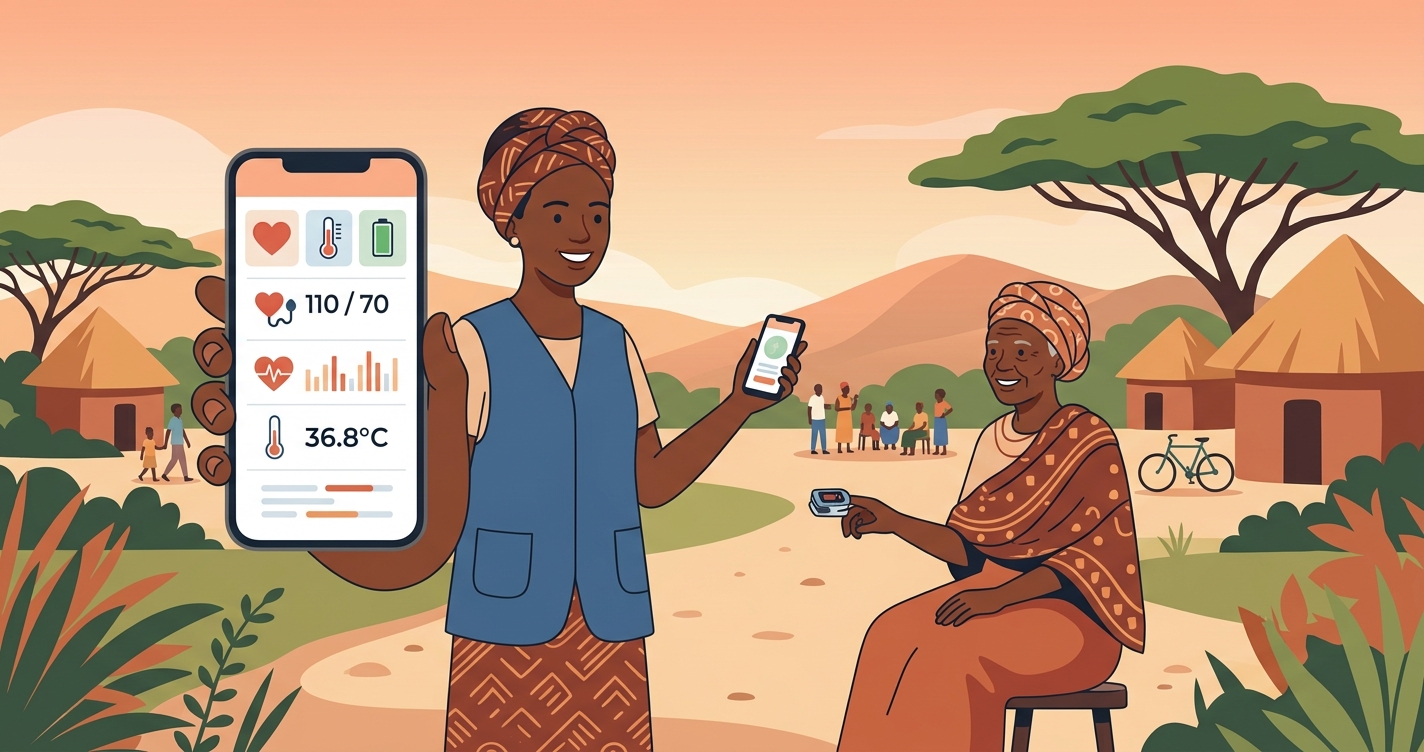
Training community health workers on contactless vitals is becoming one of the more concrete challenges in global health technology deployment. The hardware question is basically solved — most CHWs already carry smartphones. The software exists. But the gap between handing someone a phone with an app on it and getting reliable screening data from 15 household visits a day is almost entirely a training problem. Programs that get the training model wrong end up with expensive smartphones collecting dust, or worse, with screening data nobody trusts.
This analysis looks at what actually works when training CHWs on contactless screening technology, where programs commonly fail, and what the emerging evidence says about building lasting competency in low-resource settings.
"The biggest barrier to digital health adoption among community health workers is not technology access — it is structured, contextually appropriate training that builds genuine confidence rather than rote compliance." — Dr. Maryse Kok, Royal Tropical Institute (KIT), Amsterdam, Human Resources for Health (2023)
Why contactless vitals change the CHW training equation
Traditional vital sign training for health workers at any level involves teaching instrument operation — how to position a blood pressure cuff, how to read a pulse oximeter display, how to interpret a thermometer reading. Each device requires its own training module, practice sessions, and competency checks. For CHWs in Sub-Saharan Africa, this training was often theoretical because the instruments themselves were unavailable in the field.
Contactless vitals screening through remote photoplethysmography (rPPG) shifts the training model. The instrument is a smartphone camera. The interface is a single application. The CHW positions the phone, initiates a scan, and reads results from the screen. The technical operation is simpler than using a blood pressure cuff.
But the training needs don't disappear. They shift. Instead of teaching instrument handling, programs need to train CHWs on scan quality (lighting, subject positioning, motion artifacts), result interpretation (what the numbers mean, when to refer), data management (uploading results, maintaining records), and clinical integration (how screening fits into existing visit protocols).
The PATH Foundation published a model digital literacy curriculum for CHWs in 2024 that identifies four competency layers: basic phone operation, application navigation, data entry and upload, and clinical decision-making from digital outputs. Most programs are reasonably good at the first two layers and weak on the last two.
Training models that programs are actually using
The evidence from East and West African deployments points toward a few distinct training approaches, each with different trade-offs.
Cascade training
The most common model. A small team of master trainers — usually nurses or clinical officers — receives intensive instruction, then trains district-level supervisors, who train CHWs directly. The WHO CHW guideline (2018) recommends this approach for scaling. The problem is information degradation. By the time training reaches the CHW, the clinical nuance around result interpretation has often been stripped away. A 2024 evaluation of cascade-trained CHWs in Liberia by Last Mile Health found that while 89% could operate the screening application correctly, only 54% could accurately identify when vital sign readings warranted urgent referral.
Peer learning clusters
Groups of 8-12 CHWs meet weekly with a supervising clinician to practice screening, review cases, and troubleshoot problems. IntraHealth International piloted this approach in Rwanda for smartphone-based eLearning modules and reported higher knowledge retention at six months compared to one-off classroom training (Public Health Challenges, 2024). The group setting creates informal accountability — CHWs who struggled with scan technique got coached by peers who had figured it out, not just by distant supervisors.
Blended digital-classroom models
Amref Health Africa has been developing next-generation digital learning tools for CHWs that combine short video modules on smartphones with periodic in-person practical sessions. The approach lets CHWs learn at their own pace between visits while still getting hands-on practice with a trainer present. Early results from Kenya suggest better competency scores than classroom-only training, though sample sizes are small.
| Training model | Typical duration | Strengths | Weaknesses | Best suited for |
|---|---|---|---|---|
| Cascade (train-the-trainer) | 2-3 day initial + 1 day refresher | Scales to thousands of CHWs quickly, low cost per trainee | Knowledge degradation at each level, weak on clinical interpretation | Large national programs with limited training budget |
| Peer learning clusters | Ongoing weekly sessions (1-2 hours) | Builds sustained competency, peer accountability, catches problems early | Requires consistent supervisor availability, harder to scale | Programs with strong district supervision infrastructure |
| Blended digital-classroom | Self-paced modules + quarterly in-person sessions | Flexible scheduling, standardized content, good retention | Requires reliable phone charging and some data connectivity | Programs where CHWs have consistent smartphone access |
| Mentorship pairing | 2-4 weeks shadowing experienced CHW | Deep practical exposure, builds confidence | Extremely resource-intensive, not scalable for large cohorts | Pilot programs and initial deployments |
The scan quality problem
The single most common training failure in contactless vitals deployment is scan quality. rPPG technology measures subtle color changes in facial skin caused by blood flow. If the subject's face is partially shaded, if the phone is moving, if the ambient light is too low, the scan produces unreliable results or fails entirely.
Circadify's field deployment in Uganda surfaced this clearly. The company's blog documenting field lessons noted that initial scan failure rates were higher than expected, largely because CHWs were scanning in environments the training hadn't adequately prepared them for — under tree canopy with dappled light, in dark indoor rooms, with subjects who moved during the scan.
Effective training programs now include what one program manager in Kampala called "failure drills" — deliberately practicing scans in poor conditions so CHWs learn to recognize and correct problems before they waste a household visit on unusable data. This means training outdoors in mixed lighting, training with fidgeting children, training in rooms with only a single window for light.
A study published in JMIR mHealth and uHealth (2023) examining smartphone-based health assessments by CHWs found that structured practice with immediate feedback on scan quality improved success rates from 61% to 87% over a two-week training period. The researchers (Agarwal et al., Johns Hopkins Bloomberg School of Public Health) emphasized that training duration mattered less than training structure — concentrated practice with feedback outperformed longer but less structured programs.
Result interpretation and referral decisions
Capturing a vital sign reading is only useful if the CHW knows what to do with it. This is where training gaps cause the most downstream damage. A CHW who records a blood pressure estimate of 160/100 but doesn't recognize it as a referral trigger has generated data without clinical value.
Training programs are handling this differently depending on the CHW's existing clinical knowledge:
In programs where CHWs have prior health training (such as Uganda's Village Health Teams), training focuses on mapping contactless vital sign outputs to existing referral protocols. CHWs already know that high blood pressure means refer — they just need to learn what the numbers on the screen correspond to.
In programs where CHWs are community volunteers with minimal health background, training requires building clinical interpretation from scratch. This takes longer and requires more ongoing supervision. The Buikwe District digital health study in Uganda (published in BMC Digital Health, 2025) found that CHWs with prior health training reached competency on contactless vitals interpretation in roughly one week, while community volunteers required three to four weeks with ongoing mentorship.
Referral threshold cards
Several programs have found success with laminated reference cards that CHWs carry during household visits. The card lists vital sign ranges (heart rate, respiratory rate, blood pressure estimate) with color-coded zones — green for normal, yellow for monitor/recheck, red for immediate referral. This reduces the cognitive load during field visits and compensates for training gaps in clinical interpretation.
| Vital sign | Green (normal) | Yellow (recheck/monitor) | Red (refer immediately) |
|---|---|---|---|
| Heart rate (adult) | 60-100 bpm | 50-59 or 101-120 bpm | Below 50 or above 120 bpm |
| Respiratory rate (adult) | 12-20 breaths/min | 21-25 breaths/min | Above 25 or below 10 breaths/min |
| Blood pressure estimate | Below 130/85 | 130-140/85-90 | Above 140/90 or below 90/60 |
| Stress index | Low to moderate | High | Very high with symptoms |
Source: Adapted from WHO IMCI referral guidelines and field program protocols in East Africa.
Supervision after initial training
Training that stops at the classroom door fails. Every program that has reported sustained CHW competency on digital screening tools includes ongoing supervision as a core component, not an afterthought.
The WHO's 2018 guideline on CHW programmes is direct about this — supervision frequency correlates more strongly with CHW performance than initial training duration. For contactless vitals specifically, supervision serves two functions: checking that scan technique remains adequate (quality assurance) and verifying that referral decisions are clinically appropriate (clinical governance).
Digital tools create a supervision opportunity that paper-based programs lacked. When a CHW uploads screening results with timestamps, GPS coordinates, and scan quality metadata, a district supervisor can review screening patterns remotely. They can identify a CHW whose scans are consistently failing (suggesting technique problems), a CHW who never refers despite high readings (suggesting interpretation problems), or a CHW whose screening volume dropped off (suggesting motivation or logistics problems).
The Financing Alliance for Health reported in 2022 that programs investing in data-driven supervision models showed 40% higher CHW retention rates than those relying on periodic physical supervision visits alone. Digital screening data makes this kind of remote supervision practical at scale.
What doesn't work
Some patterns consistently undermine contactless vitals training, based on published field reports and program evaluations:
One-off classroom training without field follow-up. CHWs perform well in controlled training environments and then struggle when conditions change. Programs that train in classrooms but don't include field practice see competency drop-off within weeks.
Training that ignores local context. A training module designed for urban CHWs in Nairobi doesn't transfer well to rural CHWs in northern Uganda. Housing types, lighting conditions, patient demographics, and disease burden all affect how screening works in practice. The medrxiv preprint by Bellemo et al. (2025) on deploying smartphone-based AI in LMICs specifically flags "designing the solution to fit local context" as one of the primary success factors.
Overloading CHWs with technical detail. CHWs don't need to understand how rPPG algorithms extract pulse signals from facial video. They need to know: how to position the phone, what makes a scan fail, what the numbers mean, and when to refer. Programs that front-load technical explanation at the expense of practical skill-building produce CHWs who can explain the technology but can't use it reliably.
Ignoring CHW feedback loops. CHWs who encounter problems in the field and have no mechanism to report them or get solutions stop using the tool. Programs need two-way communication channels — not just top-down training, but bottom-up problem reporting.
Current research and evidence
The evidence base for training CHWs on contactless vitals is still forming. Most published research addresses CHW digital health training broadly, with contactless screening as a subcategory.
Dr. Asha George at the University of the Western Cape has published extensively on CHW programme design and argues that training effectiveness depends on whether programs treat CHWs as professionals or as volunteers — professional CHW cadres with structured career pathways invest more in training and show better skill retention (Health Policy and Planning, 2022).
The Living Goods and Government of Uganda partnership has been one of the larger-scale implementations of digitally-equipped CHWs, with over 12,000 CHWs using smartphones for health service delivery. Their internal evaluations show that continuous performance management — regular data review, targeted coaching, and peer benchmarking — outperforms initial training intensity as a predictor of long-term screening quality.
Amref Health Africa's Leap platform, which provides mobile learning to health workers across 35 African countries, has trained over 1.2 million health workers since its launch. While most training has focused on clinical protocols rather than contactless screening specifically, the platform's data suggests that health workers who complete refresher modules at least monthly maintain competency at rates 2.5 times higher than those who only receive initial training.
Building training programs that actually stick
The programs producing the best results share a few common elements, none of which are particularly surprising but all of which require deliberate investment.
They train in the field, not just the classroom. They pair initial instruction with ongoing supervision. They give CHWs simple decision aids (like the referral threshold cards) rather than expecting memorization. They build feedback loops so field problems reach program designers. And they treat training as a continuous process rather than a one-time event.
For global health organizations considering contactless vitals deployment, the training model deserves as much planning attention as the technology selection. A program that deploys contactless screening technology like Circadify's rPPG platform with a well-designed training model will produce useful population health data. The same technology deployed with a weak training model will produce a folder of unreliable scan results and a cohort of CHWs who quietly stopped using it. The technology is ready. The training question is where the real work is. For more on Circadify's approach to community health screening, visit circadify.com.
Frequently asked questions
How long does it take to train a CHW on contactless vitals screening?
Initial training typically takes 3-5 days for CHWs with prior health experience and 2-4 weeks for community volunteers. But the initial period is only the beginning — programs report that reliable field competency develops over 4-8 weeks of supervised practice. The Buikwe District study in Uganda found that prior health training cut the learning curve roughly in half.
What's the biggest reason contactless screening training fails?
Scan quality in real-world conditions. Training environments are controlled — good lighting, cooperative subjects, stable phone positioning. Field environments are not. Programs that don't include "failure drills" in variable lighting and with uncooperative subjects see high scan failure rates after deployment.
Do CHWs need to understand how rPPG technology works?
No. They need to know how to use it, not how it works. Effective programs teach practical operation (positioning, lighting, timing), result interpretation (what the numbers mean), and decision-making (when to refer). Technical explanations of photoplethysmography algorithms don't improve field performance and may overwhelm CHWs with unnecessary complexity.
How do programs maintain CHW competency over time?
The most effective approach combines regular data review by supervisors (identifying CHWs whose scan quality or referral patterns are declining), periodic refresher training (monthly short modules outperform quarterly full-day sessions), and peer learning groups where CHWs troubleshoot problems together. Digital screening data makes remote supervision practical in ways that paper-based programs couldn't support.