What happens when a community health worker serves 10,000 people alone?
A single community health worker serving 10,000 people creates immense strain, leading to burnout and reduced quality of care. We analyze the impact of high community health worker catchment sizes.
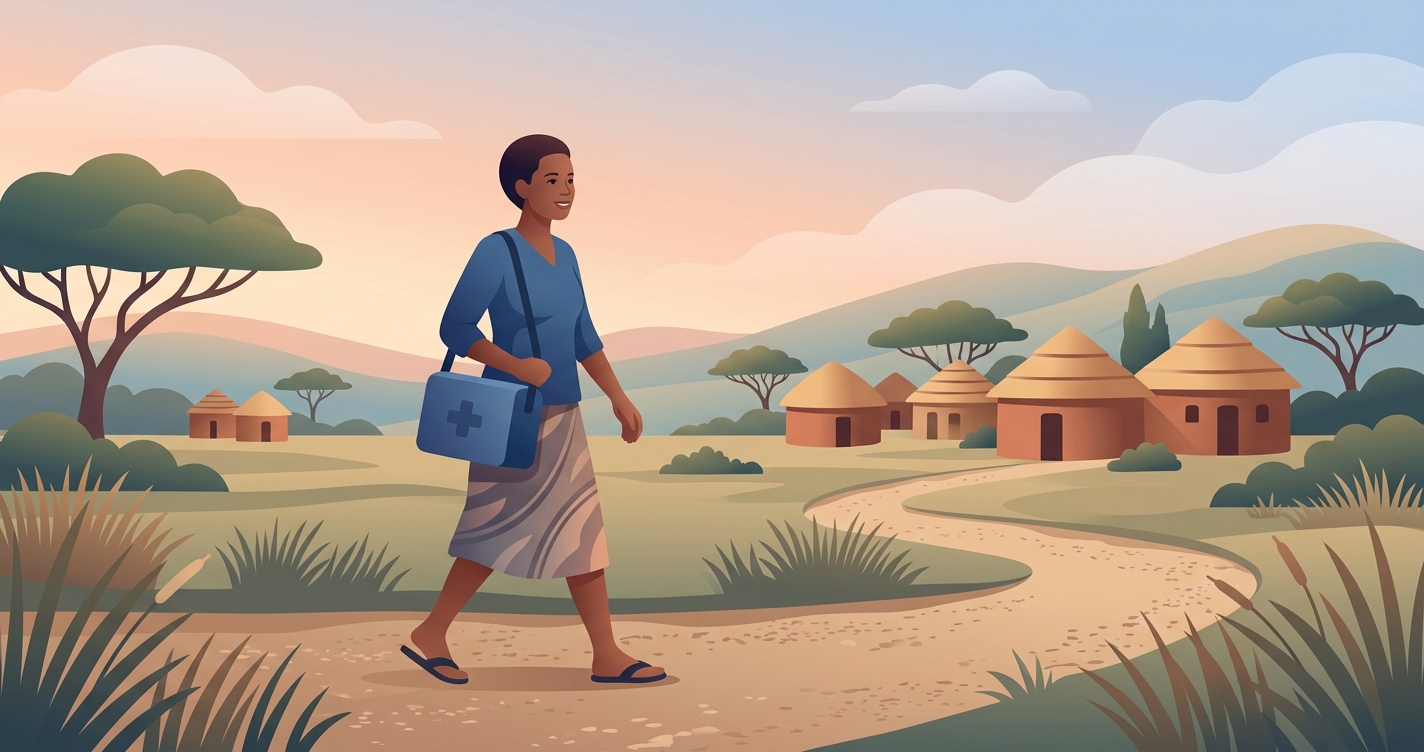
The image of a lone community health worker (CHW) responsible for the well-being of 10,000 people is a stark representation of the workforce challenges in global health. While this scenario may seem extreme, it reflects the immense pressure placed on frontline health systems in many low- and middle-income countries. The community health worker catchment size, or the number of people a single CHW is assigned to cover, is a critical variable that determines the effectiveness of health programs, the quality of patient care, and the sustainability of the health workforce itself. When this number is too high, the system begins to break down, with significant consequences for both the CHW and the community they serve.
"Approximately 97.7% of Community Health Workers (CHWs) in low- and middle-income countries...report experiencing a high workload."
- Workload and emerging challenges of community health workers in low- and middle-income countries: A mixed-methods systematic review, PLOS One (2022)
The Problem with a 1:10,000 Ratio
A single community health worker serving a population of 10,000 is an untenable model for healthcare delivery. The World Health Organization (WHO) does not prescribe a universal ratio for CHWs to population, as the ideal number is highly dependent on local context, including population density, disease burden, and the specific tasks assigned to CHWs. However, a catchment size of 10,000 far exceeds any reasonable expectation of what one individual can manage effectively.
In such a scenario, a CHW is transformed from a proactive health promoter into a reactive crisis manager. Their work becomes a constant triage, where they can only attend to the most urgent cases. Preventive care, health education, and relationship-building, the core functions that make CHWs so effective, are inevitably sacrificed. This leads to a cascade of negative outcomes, including decreased quality of care, poor health outcomes for the community, and high rates of burnout for the CHW. A 2022 systematic review in PLOS One highlighted the immense pressure on these health workers, with multiple tasks and lack of transportation being primary drivers of their heavy workload.
| Feature | Sustainable CHW Catchment Size | Unsustainable CHW Catchment Size (e.g., 1:10,000) |
|---|---|---|
| Focus of Care | Proactive, preventive, health promotion | Reactive, emergency response |
| Scope of Services | Comprehensive: includes health education, screening, follow-up | Limited: focused on urgent cases only |
| Community Relationships | Strong, built on trust and regular contact | Weak, transactional, and infrequent |
| Quality of Care | High, with personalized attention and continuity of care | Low, with rushed interactions and high risk of errors |
| Data Collection | Accurate and consistent | Incomplete and unreliable |
| CHW Well-being | Manageable workload, high job satisfaction | High stress, burnout, and attrition |
| Program Sustainability | High, with a stable and motivated workforce | Low, with constant staff turnover and service disruption |
The consequences of an unmanageable community health worker catchment size
When a CHW is stretched too thin, the entire health system suffers. The consequences of an excessive community health worker catchment size can be seen across several key areas:
- Increased CHW Burnout and Attrition: Burnout among healthcare workers in Sub-Saharan Africa is a well-documented crisis, with some studies showing prevalence as high as 87%. Overwhelming workloads are a primary driver of this trend. When CHWs are consistently overworked and undersupported, they are more likely to leave their positions, leading to a constant churn that destabilizes health programs and disrupts continuity of care.
- Decreased Quality of Care: A CHW responsible for 10,000 people cannot provide high-quality care to all of them. Household visits become shorter and less frequent. Health screenings are rushed. Follow-up with patients is inconsistent. This can lead to missed diagnoses, poor management of chronic conditions, and a general decline in the community's health status.
- Erosion of Trust: The effectiveness of CHWs is built on their close relationship with the community. When a CHW is rarely seen and only appears during emergencies, that trust erodes. Community members may become less likely to seek care or follow the CHW's advice, undermining the entire purpose of the program.
Industry Applications
The challenges of an overwhelming community health worker catchment size are not just theoretical. They have real-world implications for how health programs are designed and implemented.
Maternal and child health
In maternal and child health, CHWs play a vital role in ensuring that pregnant women attend antenatal care, deliver in a health facility, and receive postnatal follow-up. A CHW with a manageable caseload can build a relationship with an expectant mother, monitor her health throughout her pregnancy, and ensure she and her baby receive the care they need. A CHW serving 10,000 people may only be able to register the pregnancy and then reappear if a crisis occurs.
Chronic disease management
For chronic diseases like hypertension and diabetes, regular monitoring and patient education are key. CHWs are increasingly being tasked with this role. However, if their catchment size is too large, they can only conduct sporadic screenings. Consistent follow-up and support for lifestyle changes become impossible, leading to poor health outcomes for patients.
Data collection and reporting
CHWs are a critical source of data for national health information systems. They collect information on births, deaths, disease outbreaks, and other vital statistics. An overworked CHW is more likely to submit incomplete or inaccurate data, which can have serious consequences for public health planning and resource allocation.
Current research and evidence
Research consistently shows that CHW programs are most effective when CHWs have a manageable workload and are well-supported. The WHO's 2018 guideline on health policy and system support for CHW programs emphasizes the need for supportive supervision, fair remuneration, and a defined scope of work. While the guideline does not set a specific CHW to population ratio, it stresses that the number should be based on a careful analysis of local needs and resources.
A 2020 study by researchers at the University of the Witwatersrand in South Africa found that high workloads and inadequate support were major contributors to burnout among CHWs. This is consistent with findings from across the continent, which paint a picture of a dedicated but overstretched workforce.
The future of community health worker programs
Addressing the challenge of unmanageable community health worker catchment size is essential for the future of primary healthcare in Africa. This requires a multi-faceted approach:
- Investing in the Workforce: Ministries of health and their partners must commit to hiring and training more CHWs to ensure that catchment sizes are realistic.
- Optimizing Workflows: New technologies can help to optimize CHW workflows, allowing them to be more efficient and effective. Mobile health (mHealth) tools can be used for data collection, patient scheduling, and remote support from supervisors.
- Defining Roles Clearly: The role of the CHW must be clearly defined. They cannot be expected to be all things to all people. A focused scope of work allows them to develop expertise and deliver high-quality services.
Ultimately, the goal is to create a system where every CHW is empowered to do their best work, and every community receives the care it deserves.
As the global health community continues to grapple with these challenges, companies like Circadify are working to address this space by developing technologies that can support and enhance the work of CHWs in the field. To learn more about how smartphone-based screening can be deployed in partnership with community health programs, visit circadify.com/blog.
Frequently asked questions
What is a reasonable catchment size for a community health worker? There is no single answer to this question, as the ideal catchment size depends on many factors, including population density, geographic terrain, the local disease burden, and the specific tasks the CHW is expected to perform. However, ratios in the range of 1 CHW per 1,000 people are often cited as a more manageable target.
How does a large catchment size affect data quality? When CHWs are responsible for too many people, they have less time for accurate and thorough data collection. This can lead to underreporting of vital events, inaccurate disease surveillance, and poor-quality data being fed into national health information systems.
What is the role of technology in managing CHW workload? Mobile health (mHealth) technology can help to streamline CHW workflows, reduce paperwork, and improve the quality of data collection. For example, a smartphone app can guide a CHW through a screening protocol, automatically upload data to a central server, and provide decision support in the field. This can help to make CHWs more efficient, but technology alone cannot solve the problem of an overwhelming workload.