What Is Last-Mile Health? How Mobile Screening Reaches Remote Communities
Last-mile health uses mobile screening to reach remote communities lacking clinic access. How smartphone-based tools are changing primary care delivery in underserved regions.
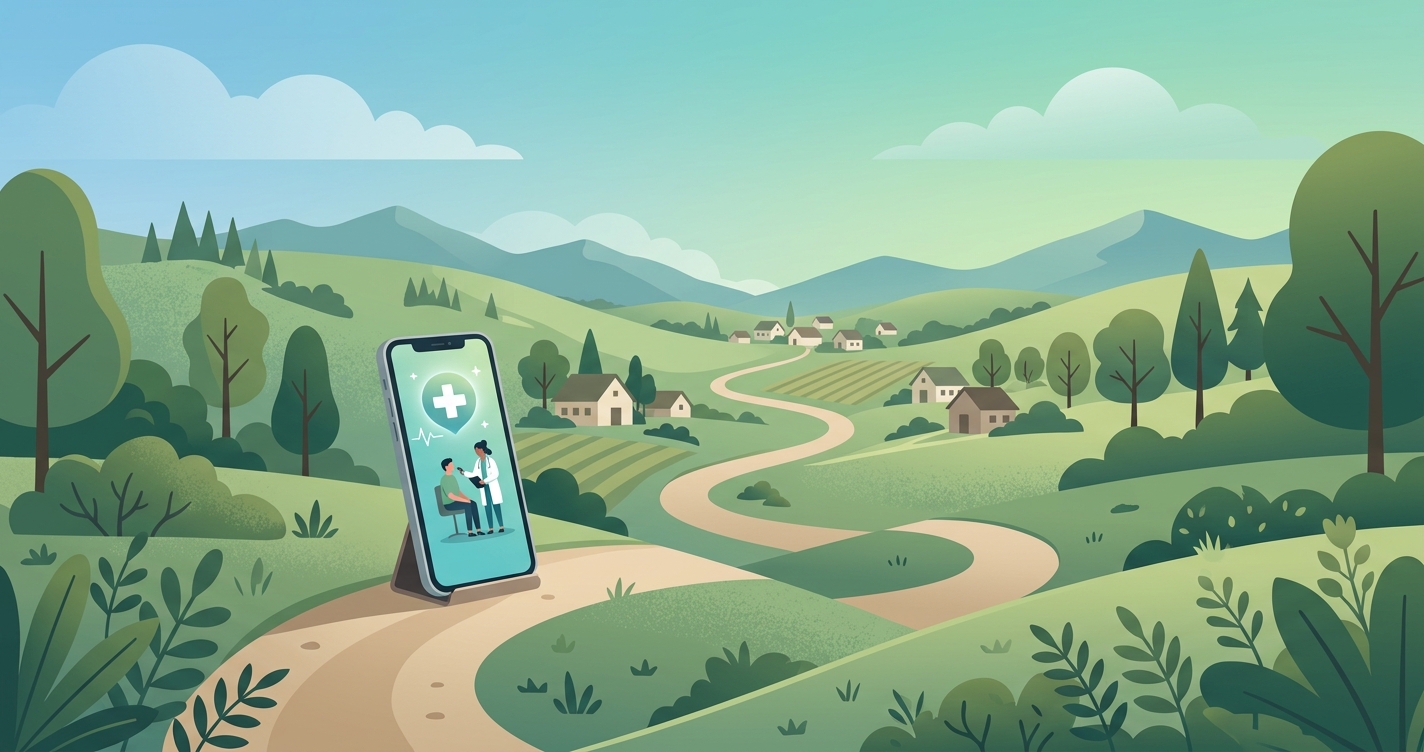
Two billion people live beyond the functional reach of a health system. That number comes from the WHO's 2023 Universal Health Coverage monitoring report, and it has barely moved in a decade. The people counted in that figure don't lack healthcare because nothing exists. They lack it because what exists can't get to them. That gap between the nearest clinic and the most remote household is what global health professionals call the last mile — and it's where people die from conditions that are treatable everywhere else.
Last-mile health mobile screening remote delivery models have started to close that gap. Not by building clinics — there isn't the money or the workforce for that — but by pushing basic screening capability to the point of contact between community health workers and the populations they serve.
"The challenge has never been that we don't know what kills people in remote areas. We know exactly what kills them. The challenge is that we can't see them early enough to do anything about it." — Dr. Raj Panjabi, co-founder of Last Mile Health, speaking at the World Health Assembly, 2023
What "last mile" actually means in health systems
The term borrows from telecommunications and logistics. In those industries, the last mile is the final stretch of delivery — from the distribution hub to the customer's door. It's typically the most expensive and logistically difficult segment per unit delivered.
In health, the concept maps directly. A national hospital exists. District health centers exist. But the village three hours by motorcycle from the nearest health post — that's the last mile. And in Sub-Saharan Africa, South Asia, and parts of Southeast Asia, that village isn't an edge case. It's where a significant share of the population lives.
The Lancet Commission on Diagnostics, led by Dr. Kenneth Fleming at the University of Oxford (published 2021), estimated that 47% of the global population has little or no access to diagnostics. The deficit concentrates in low- and middle-income countries, and within those countries, it concentrates in rural and remote areas. You don't need to model this out further — almost half the world can't get a basic health screening.
Community health workers are the existing infrastructure in these settings. Liberia has roughly 4,200 trained CHWs serving remote communities through its National Community Health Assistant Program. Ethiopia's Health Extension Program employs over 40,000 health extension workers. Uganda fields approximately 180,000 Village Health Team members. These workers already visit households, already carry phones, and already collect health data — usually on paper.
The mobile screening question is whether you can push a meaningful level of diagnostic capability to these workers using the phones they already have.
How mobile screening works at the last mile
The mechanics are fairly straightforward. A CHW visits a household or gathers a group at a community meeting point. They open a screening app on a smartphone. The patient — or the CHW on the patient's behalf — completes a health assessment that can range from a symptom questionnaire to a camera-based vital signs scan.
The technology behind camera-based screening is remote photoplethysmography (rPPG). A standard phone camera captures subtle changes in skin color caused by blood flow beneath the surface. From that video, algorithms extract heart rate, respiratory rate, blood oxygen estimates, and blood pressure approximations. The foundational work was published by Verkruysse, Svaasand, and Nelson at Eindhoven University of Technology in Optics Express (2008). Since then, the field has moved from proof of concept to field-grade tools.
What makes this relevant for last-mile health is what it doesn't require: no blood pressure cuff, no pulse oximeter, no stethoscope, no consumables. The CHW's phone is the device. In settings where a basic diagnostic kit costs $200-400 and breaks without repair infrastructure, that matters.
A 2024 study published in PLOS Digital Health by Mawazo et al. examined mobile technology-enabled primary care in rural Indonesia. They found that individuals receiving the mHealth intervention had an 18% lower risk of all-cause mortality over five years compared to those receiving standard care. The effect was driven by earlier identification of treatable conditions — hypertension, diabetes, respiratory infections — that would have gone undetected until they became emergencies.
Comparing last-mile screening approaches
| Approach | Equipment needed | Training time | Conditions screened per visit | Connectivity requirement | Cost per screening |
|---|---|---|---|---|---|
| Traditional outreach (CHW + paper forms) | Paper registers, pen | 2-5 days | 1-2 (symptom-based) | None | $0.50-1.00 (labor only) |
| Basic mHealth (questionnaire apps) | Smartphone | 1-2 days | 3-5 (algorithm-guided) | Intermittent (sync later) | $0.30-0.80 |
| Point-of-care diagnostics (rapid tests) | Test kits, supplies | 3-7 days | 1 per test type | None | $2-15 per test |
| Camera-based contactless screening (rPPG) | Smartphone only | 1-2 hours | 4-6 vital signs simultaneously | Offline-capable, sync later | $0.10-0.30 |
| Mobile health clinic (vehicle-based) | Vehicle, equipment, staff | Weeks (team training) | Full clinical range | On-site connectivity typical | $15-50 per patient visit |
Data compiled from WHO mHealth Technical Evidence Review (2023), Last Mile Health operational reports (2024), and published cost-effectiveness analyses in BMJ Global Health.
The cost differential between approaches matters because last-mile programs operate on thin budgets. A 2023 analysis by the Disease Control Priorities Network (DCP3) found that community-based screening programs in Sub-Saharan Africa average $3-5 per capita annually. At those budget levels, the cost per screening event determines how many people you can reach.
Where mobile screening is actually deployed
Liberia's National Community Health Assistant Program
Last Mile Health, the organization co-founded by Dr. Raj Panjabi, has partnered with Liberia's government since 2007. Their model trains and pays community health workers as formal employees of the health system — not volunteers. By 2024, the program covered over 1.3 million people in remote areas of Liberia. CHWs use mobile tools for data collection, patient tracking, and increasingly, basic health screening. A 2024 blog post from the organization detailed three digital innovations being integrated: geospatial mapping for coverage gaps, mobile data aggregation platforms, and decision-support tools embedded in CHW workflows.
Ethiopia's Health Extension Program
Ethiopia's HEP is one of the largest CHW programs globally. Over 40,000 health extension workers serve as the primary point of contact for rural populations. A 2022 evaluation published in The Lancet Global Health by Assefa et al. found that the program contributed to a 32% reduction in under-five mortality between 2005 and 2019. Mobile phone-based reporting and supervision tools were layered onto the program starting in 2016, with mixed results — connectivity remained a persistent barrier in remote woredas (districts).
Uganda's Village Health Teams
Uganda's VHTs were established in 2001 and have grown into a network of roughly 180,000 workers. A 2024 study by Kansiime et al. published in BMC Primary Care assessed mHealth tool adoption among VHTs in Kampala's Banda Parish. The top barrier wasn't technology skill — it was time. CHWs already managing integrated community case management for childhood diseases found that adding another screening tool meant extending already-long household visits. Programs that succeeded embedded screening into existing visit workflows rather than layering it on top.
Indonesia's rural primary care trial
The 2024 PLOS Digital Health study in rural Indonesia stands out because it tracked outcomes over five years — longer than most mHealth evaluations. The 18% mortality reduction was associated with earlier detection and referral. The intervention combined mobile health records, screening protocols, and referral coordination, all running on standard smartphones.
What the evidence says about effectiveness
The evidence base for mobile screening in last-mile settings is larger than it was five years ago, though it remains uneven.
A systematic review by Osei and Mashamba-Thompson published in BMC Medical Informatics and Decision Making (2021) assessed mHealth interventions for community health workers across 36 studies. They found consistent improvements in data quality, screening coverage, and referral rates. Mortality and morbidity outcomes were harder to attribute directly to the mobile tool versus the broader program.
The WHO's 2023 guideline on digital interventions for health system strengthening recommended mobile health tools for CHW decision support, data capture, and patient tracking — all functions that underpin screening programs. The recommendation was rated as "context-specific," meaning effectiveness depends heavily on implementation quality.
What the reviews consistently flag is that the technology itself is rarely the bottleneck. Implementation is. A 2024 review in JMIR mHealth and uHealth by Agarwal et al. found that mHealth interventions in low-resource settings underperform when they assume persistent connectivity, when they add tasks to already-overloaded CHW workflows, or when supervision systems aren't adapted to the digital tools.
The connectivity problem — and how programs work around it
Most remote communities where last-mile screening matters have poor or absent internet connectivity. The GSMA's 2023 State of Mobile Internet Connectivity report found that while 4G population coverage in Sub-Saharan Africa reached 50%, actual mobile internet usage was far lower — only 27% of the population. The gap between coverage and usage reflects device limitations, data costs, and network quality.
For screening tools, this means offline-first design is a requirement, not a feature. Data captured during a scan needs to store locally and sync when connectivity appears — whether that's hours or days later. Programs that tried real-time data transmission in rural settings encountered dropout rates that made the data unreliable.
The offline constraint also affects which screening technologies work. Symptom questionnaires are fully offline by design. Camera-based rPPG screening can process on-device without a server connection. Rapid diagnostic tests don't need connectivity at all. The more a screening method depends on cloud processing, the less it works at the last mile.
Workforce questions that technology doesn't answer
The hardest part of last-mile screening isn't the technology. It's what happens after the screen.
A CHW in a remote village in Liberia screens a woman and finds elevated blood pressure. Now what? The nearest health facility with antihypertensive medication might be three hours away by foot. The referral pathway exists on paper but breaks down in practice. A 2023 analysis by Mamo et al. in Global Health Action found that referral completion rates from CHW programs in East Africa averaged 40-60% — meaning up to half of referred patients never reached the facility.
Mobile screening creates demand that the existing health system may not be equipped to absorb. This is the paradox that program managers talk about quietly: screening more people efficiently surfaces more conditions, which requires more treatment capacity, which doesn't exist at the last mile. Solving the screening problem without addressing the treatment gap risks frustrating both health workers and patients.
Some programs have responded by expanding what CHWs can treat locally — community-based management of acute malnutrition, treatment of uncomplicated malaria and pneumonia, initiation of oral rehydration. Rwanda's community health program, analyzed by Condo et al. in BMJ Global Health (2014, with updated data through 2022), showed that expanding CHW treatment protocols reduced facility referral burden by 30% while maintaining comparable outcomes for targeted conditions.
Frequently asked questions
What does "last-mile health" mean?
Last-mile health refers to delivering healthcare services to populations in the most remote and underserved areas — the final stretch between existing health infrastructure and the people who need care. The term comes from logistics and telecommunications, where the "last mile" is the hardest and most expensive segment of delivery.
How do community health workers use mobile screening?
CHWs use smartphone-based tools during routine household visits or community gatherings. These tools range from guided symptom questionnaires to camera-based vital signs scanning using rPPG technology. The screening results are stored on the phone and synced to health information systems when connectivity is available.
Does mobile screening actually reduce mortality?
A five-year study in rural Indonesia (Mawazo et al., PLOS Digital Health, 2024) found an 18% reduction in all-cause mortality associated with mobile technology-enabled primary care. The effect was attributed to earlier identification of treatable conditions. Other studies show consistent improvements in screening coverage and referral rates, though long-term mortality data remains limited.
What happens when connectivity is poor?
Effective last-mile screening tools work offline by default. Data is collected and processed on the device, then synced when connectivity becomes available — sometimes hours or days later. Programs that require real-time connectivity consistently underperform in remote settings.
Where this is heading
The trajectory is toward more capable screening at lower cost, pushed further from centralized facilities. Camera-based tools like those being developed by Circadify are part of this shift — replacing equipment-dependent screening with smartphone-only approaches that work in the hands of community health workers, even in settings with no connectivity, no electricity, and no supply chain for consumables.
The gap between what's technologically possible and what's operationally deployed remains large. But governments are formalizing CHW workforces, mobile networks are expanding (slowly), and screening tools are getting cheaper. Organizations like Last Mile Health in Liberia and government programs in Ethiopia and Uganda are proving that the model works when implementation is done carefully.
For global health organizations and government health programs evaluating mobile screening approaches, Circadify's work in community health screening offers a look at what camera-based contactless screening looks like when deployed in the field.