What Is Multi-Disease Screening? One Smartphone Scan Explained
Multi-disease screening via a single smartphone scan is changing how community health programs detect hypertension, anemia, and respiratory illness in low-resource settings.
What Is Multi-Disease Screening? One Smartphone Scan Explained
For decades, screening for multiple diseases at once meant a clinic visit, a trained nurse, and a bag full of instruments. Blood pressure cuff for hypertension. Pulse oximeter for respiratory problems. Hemoglobin test for anemia. Each condition got its own device, its own protocol, its own line item on a budget that was already too thin. Multi-disease screening using a smartphone and a single scan changes that math entirely, and it is starting to reshape how community health programs operate in the places where they are needed most.
"Non-communicable diseases account for 74% of all deaths globally, with more than three-quarters of those deaths occurring in low- and middle-income countries." — WHO Global NCD Report, 2024
What multi-disease screening actually means
The term gets used loosely, so it is worth being precise. Multi-disease screening refers to the simultaneous assessment of risk indicators for more than one condition from a single point-of-contact interaction. In traditional clinical settings, this might mean a panel of blood tests drawn from one sample. In field settings, the concept has been harder to implement because each measurement historically required its own equipment.
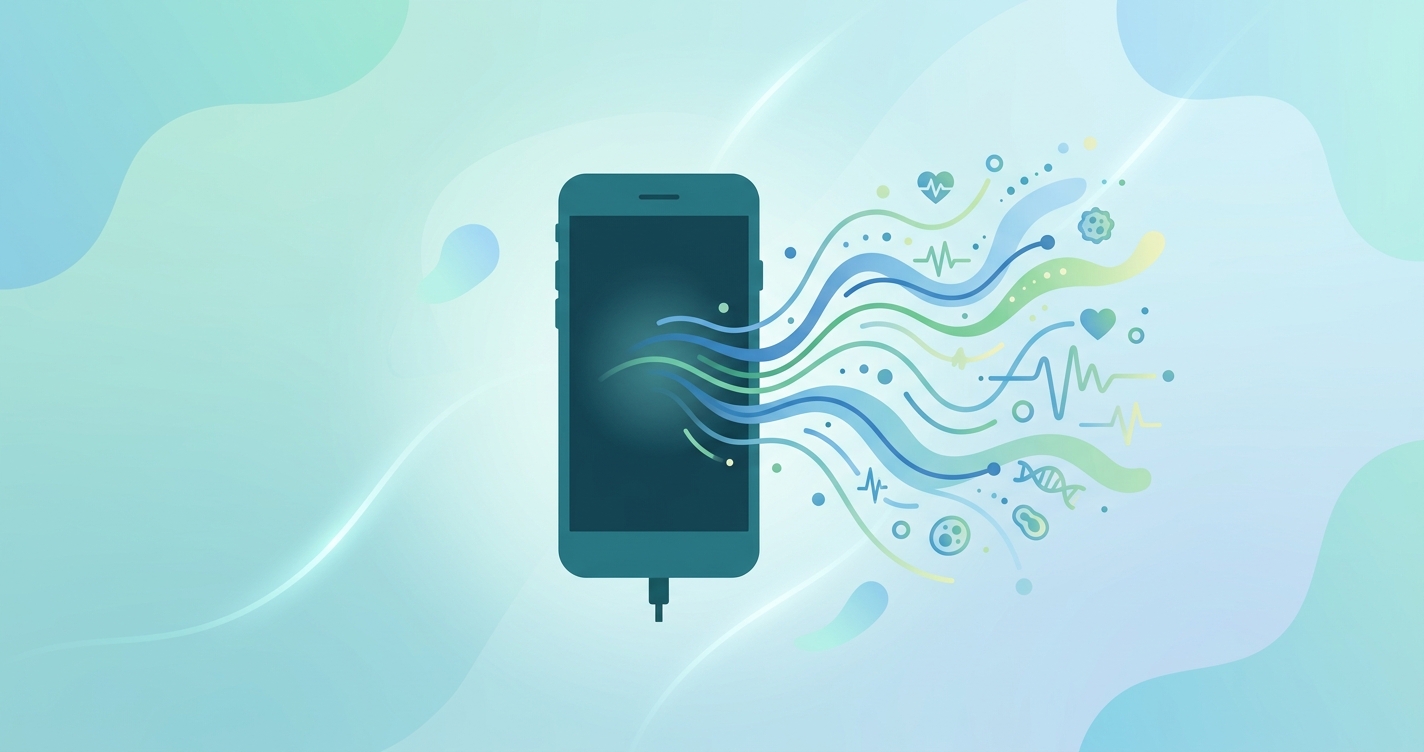
Smartphone-based screening collapses that problem. A single 30-second face scan using remote photoplethysmography (rPPG) can extract heart rate, respiratory rate, blood pressure estimates, oxygen saturation signals, and heart rate variability data. From those measurements, a trained algorithm can flag risk indicators for cardiovascular disease, respiratory illness, chronic stress, and other conditions that share overlapping physiological markers.
This is not a theoretical capability. Verkruysse et al. demonstrated cardiac pulse measurement from standard video as early as 2008. Poh et al. at MIT extended the approach to multi-parameter extraction in 2010 and 2011. The literature now includes hundreds of peer-reviewed studies refining the technique across skin tones, lighting conditions, and device types (Wang et al., IEEE Transactions on Biomedical Engineering, 2017).
How a single smartphone scan captures multiple vital signs
The underlying technology is rPPG. When the heart beats, blood pulses through capillaries beneath the skin, causing micro-changes in skin color that are invisible to the naked eye but measurable by a camera sensor. A smartphone's front camera records the face at roughly 30 frames per second for about 30 seconds. From that video:
Heart rate comes from the dominant frequency of the pulsatile color signal. The green channel carries the strongest photoplethysmographic signature because of how hemoglobin absorbs light at that wavelength.
Respiratory rate is extracted from respiratory-induced amplitude modulation of the cardiac signal. Breathing changes thoracic pressure, which modulates blood flow in a predictable way.
Blood pressure estimation relies on pulse wave analysis. The shape and timing of each individual pulse wave in the facial video correlates with arterial stiffness and peripheral resistance.
Oxygen saturation uses the ratio of red to infrared-range signal components, similar in principle to a pulse oximeter but captured at a distance.
Heart rate variability measures the beat-to-beat variation in cardiac timing, which is a marker for autonomic nervous system function, stress, and cardiovascular risk.
One scan. Five categories of physiological data. No cuffs, no clips, no consumables.
Single scan vs. traditional multi-device screening
| Parameter | Traditional field screening | Contact wearable | Smartphone rPPG scan |
|---|---|---|---|
| Heart rate | Stethoscope or pulse oximeter | Chest strap or wrist sensor | Front camera, 30 seconds |
| Respiratory rate | Manual count over 60 seconds | Chest impedance belt | Camera-detected modulation |
| Blood pressure | Sphygmomanometer with cuff | Oscillometric cuff device | Pulse wave analysis from video |
| Oxygen saturation | Finger pulse oximeter | Wrist-based optical | Red/IR ratio from facial video |
| Stress indicators (HRV) | ECG with electrodes | Wrist optical sensor | Beat-to-beat timing from rPPG |
| Equipment cost per worker | $200-$500 for kit | $80-$200 per device | $0 additional (uses existing phone) |
| Training time | 3-5 days minimum | 1-2 hours | Under 90 minutes |
| Physical contact | Required for every measurement | Required (worn on body) | None |
| Consumables | Batteries, cuffs, calibration supplies | Charging cables, replacement bands | Software updates only |
| Conditions screened per interaction | Usually 1-2 per instrument | 1-2 per device | 4-5 simultaneously |
Sources: WHO Medical Device Technical Series (2020); UNICEF mHealth Evidence Review (2023).
Why this matters for community health programs
The WHO estimates a deficit of 4.2 million health workers across Sub-Saharan Africa. Community health workers, roughly 1.3 million across the continent according to UNICEF's 2023 count, are the primary point of contact for most rural populations. These workers already do household visits, immunization tracking, and health education. They carry phones. What they typically do not carry is a blood pressure cuff, a pulse oximeter, and a glucometer.
Multi-disease screening through a smartphone removes the equipment bottleneck. A CHW who previously could only ask questions and visually assess a patient can now capture quantitative vital sign data on every visit. That data can be uploaded, aggregated, and analyzed at the district or national level, which matters for disease surveillance and resource allocation.
There is a practical consideration that does not get discussed enough: screening compliance. When a CHW has to pull out three separate devices, explain each one, and run each test sequentially, the visit takes longer and the patient is more likely to disengage. A single 30-second scan is a fundamentally different interaction. It is faster, less intrusive, and requires no physical contact, which matters in communities with cultural sensitivities around medical touching.
Hypertension detection as a case study
Hypertension prevalence exceeds 30% in most Sub-Saharan African countries, according to the WHO African Region NCD Country Profiles (2024). Detection rates remain below 40%. That gap is not a medical mystery. It is a logistics problem. You cannot detect hypertension if nobody measures blood pressure, and nobody measures blood pressure because the equipment, training, and clinical infrastructure are not where the people are.
Smartphone-based blood pressure estimation deployed through CHW networks could close that detection gap. The CHW is already at the household. The phone is already in the CHW's hand. The measurement takes 30 seconds and produces a structured data record that flows into national health information systems.
Maternal health screening
Pre-eclampsia is a leading cause of maternal death across Sub-Saharan Africa, and it is detected through blood pressure measurement. Many women in rural areas receive no hemodynamic monitoring during pregnancy because their antenatal care visits happen at facilities with no functioning equipment. Integrating multi-disease screening into routine antenatal protocols would mean every visit produces at least a basic cardiovascular assessment.
Respiratory illness and epidemic preparedness
The COVID-19 pandemic put a spotlight on respiratory rate and oxygen saturation as triage tools. In future outbreak scenarios, contactless screening at border crossings, displacement camps, and community gathering points offers both speed and infection control advantages. You can screen a queue of people without touching anyone and without passing devices between patients.
Current research and evidence
The research base for rPPG-based vital sign measurement is substantial and growing. A few recent reference points:
A 2023 medRxiv preprint (DOI: 10.1101/2023.01.14.23284548) evaluated smartphone-based vital sign monitoring accuracy using rPPG across diverse populations, finding the approach suitable for preliminary screening though noting continued need for validation against clinical-grade instruments.
A 2025 preprint from medRxiv (DOI: 10.64898/2025.12.29.25343175) examined deploying smartphone-based AI interventions through community health workers in low- and middle-income countries, focusing on practical implementation barriers including connectivity, device variability, and workflow integration.
The WHO's September 2024 statement on digital health and NCDs explicitly called for expanded use of digital screening tools to prevent millions of deaths from non-communicable diseases, citing smartphone-based assessment as a priority area.
PATH's 2024 compendium of innovations for NCDs in LMICs documented multiple smartphone-based screening approaches, noting that "manual and time-consuming risk assessments are not consistently applied within primary health care in low-and-middle-income countries" and identifying camera-based vital sign capture as a tool to address that gap.
A JMIR mHealth study (2024) on the feasibility of mHealth apps for community-based screening in Rwanda found high acceptability among both health workers and patients, though it also highlighted the need for offline functionality and simplified user interfaces.
The road ahead for multi-disease smartphone screening
Two things need to happen for this technology to scale beyond pilot programs.
First, validation studies need to cover the full range of populations, skin tones, lighting environments, and device types that exist in real deployment settings. Laboratory accuracy does not automatically translate to field accuracy. The research community knows this, and studies are increasingly conducted in field conditions rather than controlled lab settings.
Second, integration into existing health information systems needs to be straightforward. A measurement that lives only on a CHW's phone is useful to that CHW in that moment. A measurement that flows into a district-level dashboard, gets flagged by a surveillance algorithm, and triggers a referral protocol is useful to an entire health system. The data architecture matters as much as the sensing technology.
There is also the question of trust. Health ministries, program managers, and the communities themselves need to understand what the technology does and does not do. It is a screening tool. It identifies people who need further evaluation. It does not replace clinical diagnosis. Getting that framing right from the beginning prevents the cycle of hype and disappointment that has plagued many digital health interventions in low-resource settings.
Frequently asked questions
How accurate is smartphone-based multi-disease screening compared to traditional instruments?
Accuracy varies by parameter. Heart rate measurement via rPPG has been extensively validated and performs well against reference devices. Blood pressure and oxygen saturation estimation are less mature and should be treated as screening-level measurements rather than diagnostic. The technology identifies who needs further evaluation, not who has a confirmed condition.
Does the smartphone need an internet connection to perform a scan?
Not necessarily. The core signal processing can happen on-device. Connectivity is needed to upload results to central databases, but the scan itself can work offline. Several deployment architectures use batch upload when the CHW returns to a location with connectivity.
Does skin tone affect the accuracy of rPPG measurement?
Early rPPG research was conducted primarily on lighter skin tones, and performance degraded for darker skin. More recent algorithms, particularly those using deep learning and multi-channel signal extraction, have narrowed this gap substantially. Wang et al. (2017) and subsequent work have specifically addressed robustness across skin tones, though continued validation in diverse populations remains important.
What conditions can a single smartphone scan screen for?
A single scan provides data relevant to cardiovascular risk (heart rate, blood pressure, HRV), respiratory health (respiratory rate, oxygen saturation), and chronic stress. These markers overlap with risk indicators for hypertension, heart failure, COPD, pre-eclampsia, and general cardiovascular disease. The scan does not diagnose any of these conditions but flags individuals for follow-up.
Multi-disease screening through a single smartphone scan is not a future concept. The technology exists, the research supports it, and early deployments are producing real data. Organizations like Circadify are building the tools that make this kind of screening deployable at scale, turning any smartphone into a multi-parameter vital signs instrument. For global health programs operating with limited budgets and vast populations, that changes what is possible.
Related reading: Smartphone-Based Vital Signs in Sub-Saharan Africa: How It Works, Community Health Workers and Contactless Screening