What Is rPPG? Remote Photoplethysmography for Global Health Explained
How remote photoplethysmography (rPPG) works and why it matters for global health screening in low-resource settings across Sub-Saharan Africa and beyond.
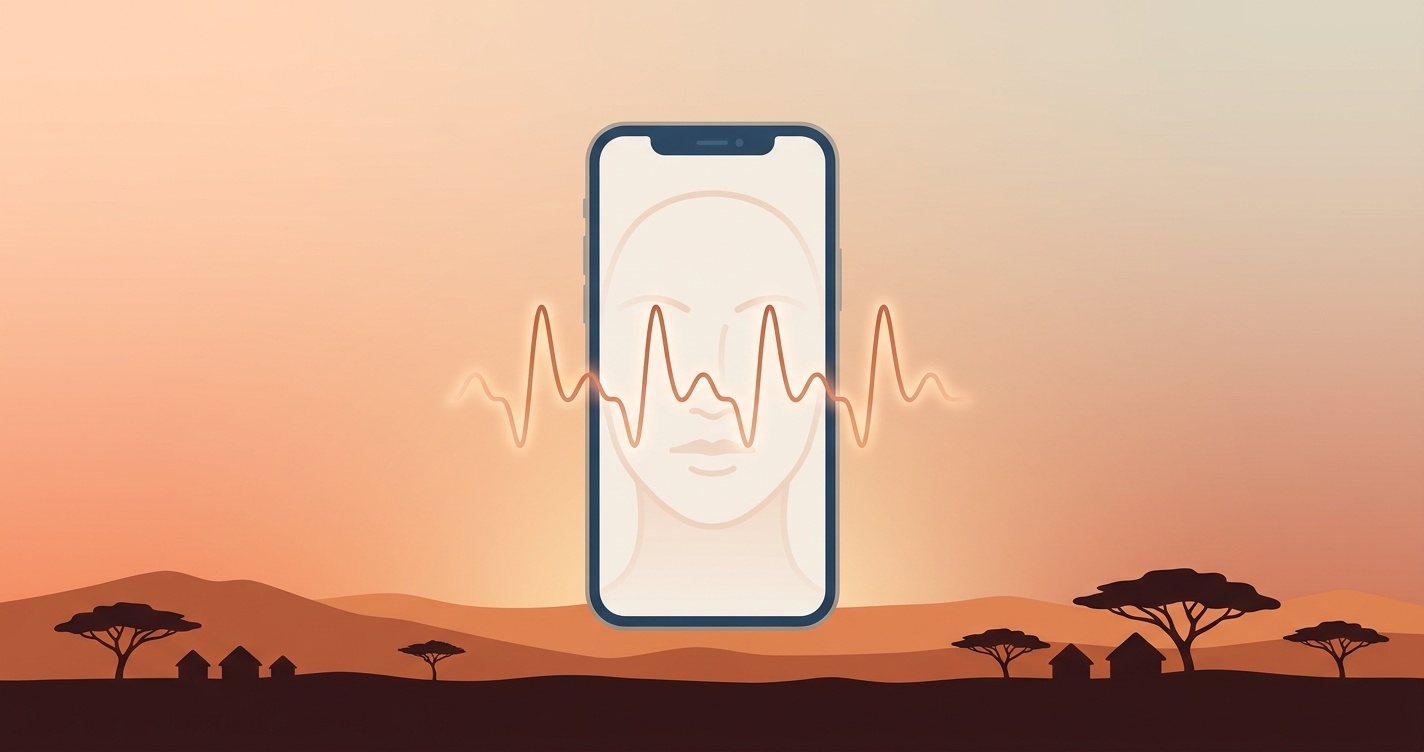
For a technology that could change how billions of people access basic health screening, rPPG remote photoplethysmography for global health is still poorly understood outside computer vision research circles. The acronym gets thrown around in digital health pitch decks and WHO working group reports, but the actual mechanics — what happens between a camera pointing at someone's face and a heart rate number appearing on screen — tend to get glossed over. That gap between buzzword and understanding has real consequences. The decisions being made right now about which screening technologies to deploy across Sub-Saharan Africa, Southeast Asia, and Latin America depend on program managers actually grasping what this technology can and cannot do.
"The camera-based measurement of vital signs is not science fiction. The physics have been understood since 2008. What has changed is that the smartphone in a community health worker's pocket now has sufficient processing power to run these algorithms in real time." — Dr. Wim Verkruysse, whose 2008 paper in Optics Express first demonstrated that a standard RGB camera could detect the blood volume pulse signal from human skin under ambient light.
How Remote Photoplethysmography Actually Works
The core principle is simpler than most people expect. Every time your heart beats, it pushes a pulse of blood through your body. That blood reaches the tiny capillaries near the surface of your facial skin. Hemoglobin in red blood cells absorbs and reflects light differently depending on how much blood is present at any given microsecond. These changes are invisible to us, but a camera sensor — even a cheap smartphone camera — picks them up.
Verkruysse et al. published the foundational proof in Optics Express in 2008, showing that the green channel of standard RGB video contained a usable photoplethysmographic signal. The green channel works best because hemoglobin has a strong absorption peak around 540 nanometers, right in the green wavelength range. Since then, researchers at institutions including MIT, Philips Research, and the University of Oulu have refined the signal extraction methods considerably.
The measurement pipeline on a modern smartphone runs roughly like this: the front camera captures video of the subject's face at 30 frames per second for about 30 seconds. On-device algorithms isolate the face region, track it across frames, and extract the subtle color fluctuations from the skin pixels. Signal processing filters out motion artifacts and lighting noise. From the cleaned blood volume pulse signal, algorithms derive heart rate (from pulse frequency), respiratory rate (from amplitude modulation patterns), and in some implementations, blood pressure estimates and stress indicators from heart rate variability analysis.
All of this happens on the phone's processor. No cloud. No internet required. No external hardware.
Why This Matters for Global Health — The Numbers
The WHO estimates that roughly half the world's population lacks access to essential health services. In Sub-Saharan Africa, the physician-to-population ratio sits at approximately 0.2 per 1,000 people, compared to 2.6 per 1,000 in Europe (WHO Global Health Workforce Statistics, 2023). Community health workers fill that gap — there are an estimated 5 million CHWs operating across the continent according to UNICEF — but they typically work with minimal diagnostic equipment. A blood pressure cuff, a thermometer if they're lucky, and not much else.
Meanwhile, smartphone penetration in Sub-Saharan Africa reached 51% in 2024 according to the GSMA, and is projected to hit 75% by 2030. The phones are already there. The question is whether software running on those phones can meaningfully expand the diagnostic capability of frontline health workers.
| Factor | Traditional Screening Equipment | rPPG Smartphone Screening |
|---|---|---|
| Hardware cost per screening point | $200–$2,000 (BP cuff, pulse oximeter, thermometer kit) | $0 incremental (uses existing smartphone) |
| Training time for CHW | 2–5 days for multi-device operation | 15–30 minutes for app operation |
| Maintenance and calibration | Regular calibration required; replacement parts needed | Software updates delivered over-the-air |
| Vital signs captured per session | Typically 1–2 per device | Heart rate, respiratory rate, stress index, and blood pressure trend in one 30-second scan |
| Power requirements | Batteries or charging for each device | Single smartphone battery, shared across all functions |
| Data entry | Manual recording, often paper-based | Automatic digital capture with metadata |
| Supply chain complexity | Multiple devices from multiple vendors, each with accessories | One device, one app |
That table tells a specific story. It's not that rPPG replaces clinical-grade diagnostics — it doesn't, and nobody credible is making that claim. The argument is that in settings where the alternative is no vital signs measurement at all, a smartphone-based screening tool that captures approximate readings is categorically better than a clipboard and a visual assessment.
The Physics Behind the Signal: What the Camera Actually Sees
To understand the global health implications, it helps to understand what's happening at the photon level. When ambient light hits facial skin, some of it is absorbed by melanin in the epidermis, some penetrates deeper and interacts with blood vessels in the dermis, and some is reflected back toward the camera. The portion that penetrates to the dermal layer is partially absorbed by hemoglobin, and the degree of absorption changes with each cardiac cycle as blood volume in the capillary bed fluctuates.
A 2023 review published in Biomedical Signal Processing and Control by researchers at the University of Oulu (Bousefsaf et al.) catalogued over 90 distinct rPPG algorithms developed between 2008 and 2023. The field has moved through several generations: early methods used simple color channel averaging, followed by blind source separation techniques like ICA (Independent Component Analysis), then model-based approaches like the POS (Plane-Orthogonal-to-Skin) method developed by Wang et al. at Eindhoven University of Technology in 2017, and most recently deep learning approaches that learn to extract the pulse signal directly from video frames.
Each generation has improved robustness to the two biggest challenges: motion artifacts (the subject moving during measurement) and lighting variation (changes in ambient illumination during the capture window). Both of these matter enormously in field conditions where a community health worker is scanning people outdoors, under trees, in doorways — not in a controlled clinical environment with consistent fluorescent lighting.
The Skin Tone Question
Any honest discussion of rPPG for global health has to address melanin. Higher melanin concentration in darker skin tones absorbs more of the incoming light before it reaches the dermal blood vessels, which reduces the signal-to-noise ratio of the blood volume pulse signal. Nowara et al. (2020) documented that darker skin tones significantly reduce rPPG signal strength.
This is not a theoretical concern. If you're deploying rPPG technology in Sub-Saharan Africa, the population you're screening predominantly has Fitzpatrick skin types V and VI. Signal quality in these populations is the single most important technical challenge for global health applications.
Recent work has tackled this directly. A December 2025 study published by researchers at the National University of Singapore demonstrated that polarized light techniques can improve PPG signal accuracy across all skin tones. Deep learning models trained on diverse datasets — specifically including darker skin tones in training data rather than treating them as edge cases — have also shown marked improvements. The gap is closing, but anyone who tells you it's fully solved is selling something.
How Community Health Workers Use rPPG in the Field
Here's what deployment actually looks like in practice: a CHW arrives at a household during a routine community visit. They open a screening app on their smartphone, hold it at arm's length facing the person being screened, and capture a 30-second video. The app processes the video locally and displays vital sign readings on screen. The CHW records any readings that fall outside normal ranges and makes a referral decision — does this person need to visit a clinic, or are they within acceptable parameters?
This workflow fits into existing community health program structures. Organizations like Living Goods in Uganda and Kenya, Last Mile Health in Liberia, and Medic Mobile (now Medic) across multiple countries have already built digital workflows where CHWs use smartphones for case registration, symptom assessment, and referral. Adding a vital signs screening step is an incremental capability expansion rather than a wholesale program redesign.
Where rPPG Screening Fits in the Care Cascade
- Primary screening at household level — CHWs identify individuals with abnormal vital signs who may not have recognized symptoms
- Antenatal care visits — Maternal blood pressure and heart rate monitoring without requiring a clinic visit for every check
- Chronic disease follow-up — Hypertension and cardiovascular risk monitoring between clinic appointments
- Mass screening events — Community health days where hundreds of people need rapid triage
- Post-discharge monitoring — Patients sent home from hospitals who need vital signs tracking during recovery
Current Research and Evidence
The evidence base for rPPG in controlled laboratory settings is substantial. A 2023 meta-analysis by Moco et al. published in Physiological Measurement found that heart rate measurement via rPPG achieves mean absolute errors of 2–5 beats per minute under controlled conditions, which is within the range that clinicians consider acceptable for screening purposes.
Field validation in low-resource settings is thinner, and that gap matters. Laboratory accuracy does not automatically translate to field accuracy. Lighting varies. Subjects move. Camera quality differs across phone models. Several research groups are running field validation studies right now — the results over the next 12–18 months will determine how aggressively public health organizations deploy this technology.
The WHO's 2023 Digital Health Classification framework includes remote physiological monitoring as a recognized digital health intervention category. The organization's position has shifted from cautious observation toward active interest in how smartphone-based vital signs capture could support universal health coverage goals, particularly in countries where traditional screening infrastructure cannot scale fast enough to meet demand.
| Research Area | Current Status | Key Researchers / Institutions |
|---|---|---|
| Heart rate accuracy across skin tones | Active improvement; deep learning approaches reducing bias | Nowara et al. (Rice University); NUS Singapore polarization research |
| Respiratory rate extraction | Moderate accuracy; less studied than heart rate | Bousefsaf et al. (University of Oulu) |
| Blood pressure estimation | Early stage; correlational rather than absolute measurement | MIT Media Lab; Philips Research |
| Field validation in LMICs | Limited studies; expanding in 2025–2026 | Various NGO-academic partnerships |
| Motion artifact robustness | Significantly improved with deep learning | Wang et al. (Eindhoven University of Technology) |
| Offline-first processing | Mature; fully on-device pipelines operational | Multiple commercial implementations |
The Future of rPPG in Global Health Programs
Where this goes over the next five years comes down to three things: field validation data, integration into existing digital health platforms, and regulatory clarity from health authorities in deploying countries.
Field validation is the big one. Organizations like the Bill & Melinda Gates Foundation and USAID have funded digital health interventions in low-resource settings for years, but they require evidence before recommending deployment at scale. The studies running now in East Africa and South Asia will either open the floodgates or pump the brakes.
Integration matters because community health programs don't adopt standalone tools well. rPPG screening has to plug into the digital health systems CHWs already use — platforms like DHIS2, CommCare, and Medic's community health toolkit. If a CHW has to switch between apps or manually re-enter data, adoption drops off fast.
Companies like Circadify are working in this space, building rPPG screening capabilities designed specifically for deployment conditions in low-resource settings. The company has active work in East Africa, which puts it among a small number of organizations testing contactless vital signs screening where the need is most acute. More information on their approach is available at circadify.com/blog.
Frequently Asked Questions
Does rPPG work without internet?
Yes. The entire measurement process — video capture, signal extraction, vital signs calculation — runs on the smartphone's processor. Internet connectivity is not required for screening. Data can be synchronized to central servers later when the device connects to a network.
How accurate is rPPG compared to traditional devices?
Under controlled conditions, rPPG heart rate measurement has been shown to achieve mean absolute errors of 2–5 beats per minute (Moco et al., Physiological Measurement, 2023). Field accuracy in uncontrolled environments is still being validated, and results vary depending on lighting, subject movement, and skin tone. It is currently positioned as a screening tool rather than a replacement for clinical-grade diagnostics.
Does skin tone affect rPPG accuracy?
Higher melanin concentration does reduce signal strength, which has historically affected accuracy in darker skin tones. Recent advances in deep learning models and polarized light techniques (NUS Singapore, 2025) are narrowing this gap, though it remains an area of active research and improvement.
What vital signs can rPPG measure?
Current rPPG implementations can measure heart rate, respiratory rate, and stress indicators (via heart rate variability). Blood pressure estimation is possible but remains less mature — most implementations provide trend data rather than absolute measurements. Research into SpO2 (blood oxygen saturation) estimation from video is also advancing but is not yet considered reliable for clinical decisions.