
Why do a billion people still live hours from the nearest clinic — and what's changing?
Globally, distance remains a primary barrier to healthcare. We analyze the global health gap caused by the distance to clinics and explore how mobile health technology is changing the landscape.
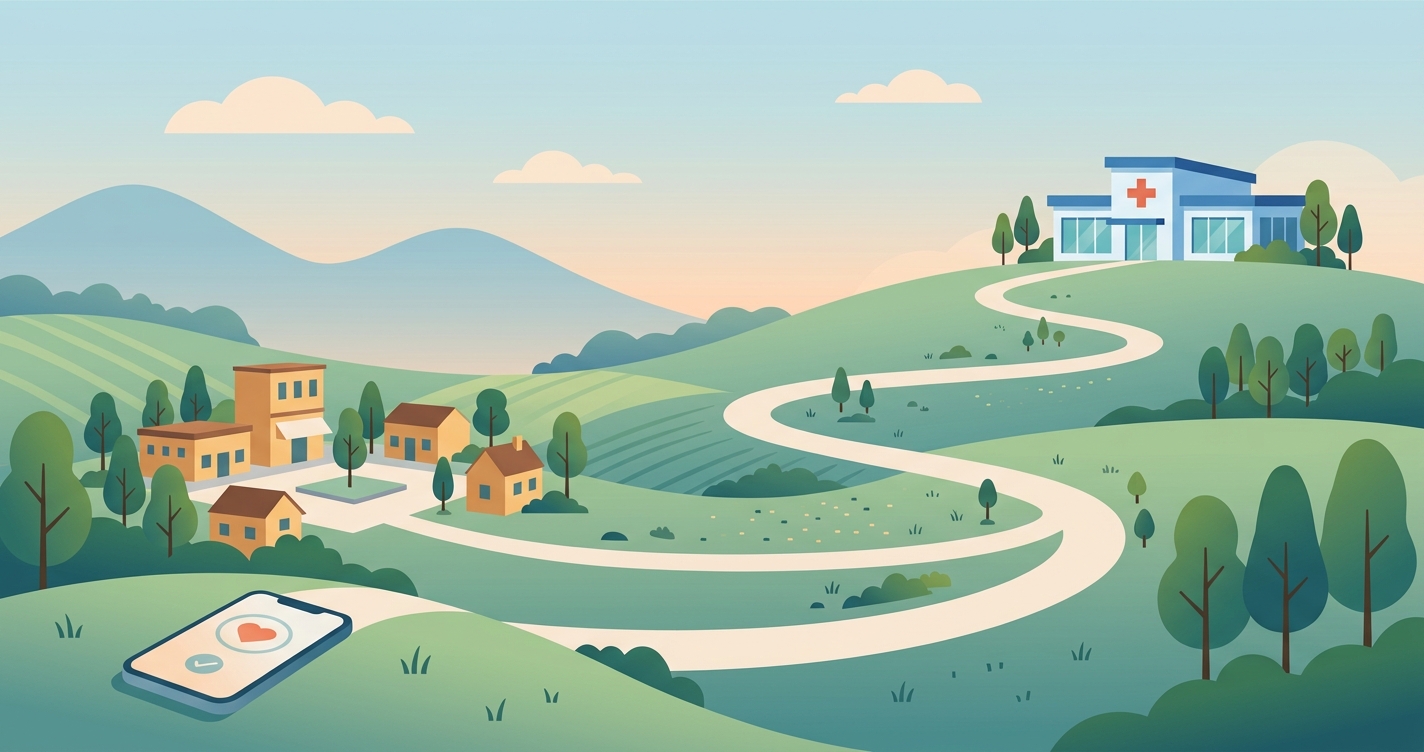
For billions of people, the difference between sickness and health isn't the availability of a cure, but the distance to a clinic. While medical science has achieved unprecedented advances, the simple geography of where people live remains one of the most stubborn barriers to care. In many low- and middle-income countries, particularly in Sub-Saharan Africa, a trip to a healthcare facility can mean a journey of several hours, often on foot. This isn't an inconvenience; it's a fundamental obstacle that defines health outcomes for a significant portion of the world's population, creating a profound global health gap based on little more than a postal code.
"In Sub-Saharan Africa, about one in six people lives more than two hours away from a public hospital, and one in eight is at least an hour from any health center. This travel time is a critical determinant of healthcare access and patient outcomes."
- World Health Organization, 2022
The anatomy of the distance to clinic global health gap
The distance to clinic global health gap is not a new problem, but its persistence in the 21st century is telling. The core issue is a mismatch between where people live and where healthcare services are located. In many regions, healthcare infrastructure is heavily concentrated in urban centers, leaving vast rural and peri-urban populations underserved. Research from the World Bank shows a direct correlation between travel time to a health facility and its utilization for both preventative and emergency care. When a clinic is hours away, a minor illness can become a major one simply because a timely diagnosis was out of reach.
Several factors contribute to this enduring challenge:
- Underfunded Infrastructure: National health budgets in many Sub-Saharan African countries are insufficient to build and maintain a dense network of primary care facilities that can reach every community. The African Development Bank Group noted in its "Strategy for Quality Health Infrastructure in Africa 2022-2030" that significant investment is needed to close this gap.
- Workforce Distribution: There is a severe shortage of healthcare workers, and those who are trained are disproportionately located in cities. Sub-Saharan Africa has a health worker-to-population ratio of just 1.3 per 1,000 people, far below the WHO's recommended minimum of 4.5.
- Geographic and Transport Barriers: Poor road networks, lack of affordable transportation, and seasonal challenges like flooding can make even a relatively short distance an insurmountable obstacle. A 2021 study by K. O. Osinubi et al. published in PLOS One found that transportation was a primary barrier to accessing maternal healthcare for women in multiple African countries.
These factors combine to create a system where a person's health is often dictated by their proximity to a physical building. This reality has forced a rethinking of what a "clinic" is and how care can be delivered.
| Feature | Traditional Clinic-Based Care | Mobile Health (mHealth) Approach |
|---|---|---|
| Location | Fixed, centralized buildings | Decentralized, patient's location |
| Accessibility | Limited by distance and transport | High, via smartphone or CHW |
| Equipment | Requires imported, expensive devices | Minimal, uses smartphone sensors |
| Operating Cost | High (staffing, utilities, maintenance) | Low (software-based, minimal hardware) |
| Data Collection | Manual, paper-based records | Automated, real-time digital data |
| Scalability | Slow and capital-intensive | Rapid and cost-effective |
How mobile health is closing the distance
The proliferation of mobile phones across Sub-Saharan Africa, where mobile penetration exceeds 90% in many countries, is fundamentally altering the healthcare landscape. Instead of bringing patients to clinics, mobile health (mHealth) brings screening and monitoring tools to patients.
Empowering community health workers (chws)
Community Health Workers are the frontline of healthcare delivery in many rural areas. They are trusted members of the community who provide basic health services, education, and referrals. Equipping CHWs with smartphone-based tools dramatically expands their capabilities. With a simple smartphone app, a CHW can screen for vital signs like blood pressure, heart rate, and respiratory rate without any traditional medical equipment. This allows them to identify at-risk individuals during routine household visits, effectively turning every home into a preliminary screening point and bridging the distance to clinic global health gap.
Decentralizing health screening
Large-scale health initiatives, such as immunization campaigns or malnutrition screening programs, often struggle with the logistics of reaching thousands of people. Mobile screening technology removes the need to transport bulky and expensive equipment to remote locations. Aid organizations can deploy teams with just smartphones to screen large populations quickly and efficiently, gathering critical health data that can inform public health strategy and resource allocation.
Enabling data-driven interventions
One of the most significant advantages of mHealth is the ability to capture high-quality health data in real time. When a CHW screens a patient in a village, the data can be instantly (or later, if offline) uploaded to a central dashboard. Health ministries and NGOs can monitor population health trends, track disease outbreaks, and measure the impact of their programs with a level of accuracy that was previously impossible. This data is crucial for designing effective policies and allocating resources where they are needed most.
Current research and evidence
The impact of distance on health is well-documented. A study led by Dr. Adewale A. Adepoju at the University of Ibadan (2020) found that for every 10-kilometer increase in distance to a primary health center in rural Nigeria, the likelihood of a child receiving a full course of vaccinations decreased by 15%.
Conversely, evidence is growing for the effectiveness of mHealth in mitigating this gap. Research published in The Lancet Global Health by Dr. Alain Labrique and his team at the Johns Hopkins Global mHealth Initiative (2018) analyzed multiple mHealth programs and found that they consistently improved health-seeking behaviors and adherence to treatment regimens by reducing the friction of travel and cost. They concluded that mobile technology, when properly integrated into health systems, acts as a powerful "spatial equalizer."
The future of 'clinic-less' healthcare
The trend is moving towards what could be called 'clinic-less' healthcare models, where the point of care is wherever the patient is. Technologies like remote photoplethysmography (rPPG), which uses a smartphone camera to measure vital signs from a person's face, are at the forefront of this shift. These contactless methods eliminate the need for any physical equipment beyond the phone itself, making health screening more accessible and scalable than ever before. As these technologies mature and gain wider adoption, the traditional model of a centralized clinic as the sole access point for healthcare will become increasingly obsolete for routine screening and monitoring.
Frequently asked questions
What is the biggest barrier to healthcare access in Sub-Saharan Africa? While many factors exist, distance to a health facility is consistently cited by researchers and international organizations as one of the most significant barriers. It intersects with poverty, lack of transportation, and weak infrastructure, compounding the challenge.
How does mobile health work without an internet connection? Many modern mHealth platforms are designed with an "offline-first" approach. Data is collected and stored securely on the smartphone in areas without connectivity and is later synced to a central server when a connection becomes available. This is critical for use in remote and rural settings.
Is smartphone-based screening as accurate as traditional methods? Smartphone-based screening technology, particularly for vital signs, has undergone significant development to ensure it meets standards for non-clinical and screening use cases. While not intended to replace diagnostic tools in a hospital, it provides reliable measurements for initial screening and population-level health monitoring, allowing for effective triage and referral.
The challenge of the distance to clinic global health gap is immense, but it is not insurmountable. As mobile technology becomes more powerful and ubiquitous, it offers a clear path forward for building more equitable and accessible health systems. Circadify is actively working in this space, developing and deploying smartphone-based health screening solutions to help partners like NGOs and health ministries close the distance and bring care to everyone, everywhere. To learn more about our work and field data from Sub-Saharan Africa, visit our global health section at circadify.com/blog.