Health Technology Where There Are No Clinics: How It Works
How health technology deployments reach populations with no nearby clinics, from smartphone-based screening to offline-first diagnostics used by community health workers.
About 400 million people in Sub-Saharan Africa live more than two hours from the nearest hospital. Many live more than an hour from any health facility at all. A 2022 study published in Nature Communications by Weiss et al. mapped travel times to healthcare across the continent and found that distance remains the single strongest predictor of whether someone receives care during a medical emergency. The clinics that global health planners draw on maps often don't exist in practice — they're unstaffed, under-equipped, or closed during the hours people actually need them.
Health technology no clinics deployment is a phrase that would have sounded contradictory ten years ago. Today it describes a growing category of field programs where the technology goes to the patient because no facility exists within reach.
"The assumption that healthcare requires a building is the root constraint. Once you remove it, the design space for reaching underserved populations opens dramatically." — Dr. Alain Labrique, Director of Digital Health, WHO, speaking at the 2024 Global Digital Health Forum
What "no clinic" actually means on the ground
It helps to be specific about the problem. "No clinic" doesn't always mean zero infrastructure. It can mean:
A health post that has a building but no trained staff. The WHO African Region's 2023 health workforce report found that 36 of 47 countries in the region have fewer than 1 physician per 10,000 population. Health posts in rural areas are often staffed by a single community health worker with limited training.
A facility that exists but lacks functional equipment. The WHO Medical Device Technical Series documented that roughly 40% of medical equipment at district health facilities across Sub-Saharan Africa is non-functional at any given time. A blood pressure cuff that doesn't work is the same as no blood pressure cuff.
A clinic that's technically reachable but practically inaccessible. During rainy season in parts of Uganda, roads between villages and trading centers become impassable for weeks. A clinic 8 kilometers away might as well be 80.
The population living in these conditions is not small. A spatial analysis by Ouma et al. (2018), published in BMC Medicine, estimated that across Sub-Saharan Africa, approximately 29% of the population cannot reach a hospital within two hours of travel.
How health technology fills the gap without buildings
The approaches that work in these settings share common characteristics. They don't require reliable electricity. They don't assume internet connectivity. They don't depend on supply chains for consumable medical supplies. And they put diagnostic capability in the hands of people who are already present in the community.
Community health workers as the delivery platform
The most effective health technology deployments in clinic-free settings use community health workers (CHWs) as the infrastructure. Ethiopia's Health Extension Worker program, one of the largest in the world, deploys roughly 38,000 workers to rural communities. Uganda's Village Health Team system has a similar structure. Rwanda's community health program trains roughly 45,000 CHWs.
These workers already visit households. They already know the families. The technology question becomes: what tools can you put in their hands that produce clinically useful data?
Smartphone-based diagnostics
Smartphones have become the primary diagnostic platform for no-clinic deployments. The reasons are practical. Smartphone penetration in Sub-Saharan Africa reached 64% in 2025 according to GSMA data. Even where personal ownership is lower, health programs can distribute shared devices to CHW teams at a fraction of the cost of traditional medical equipment.
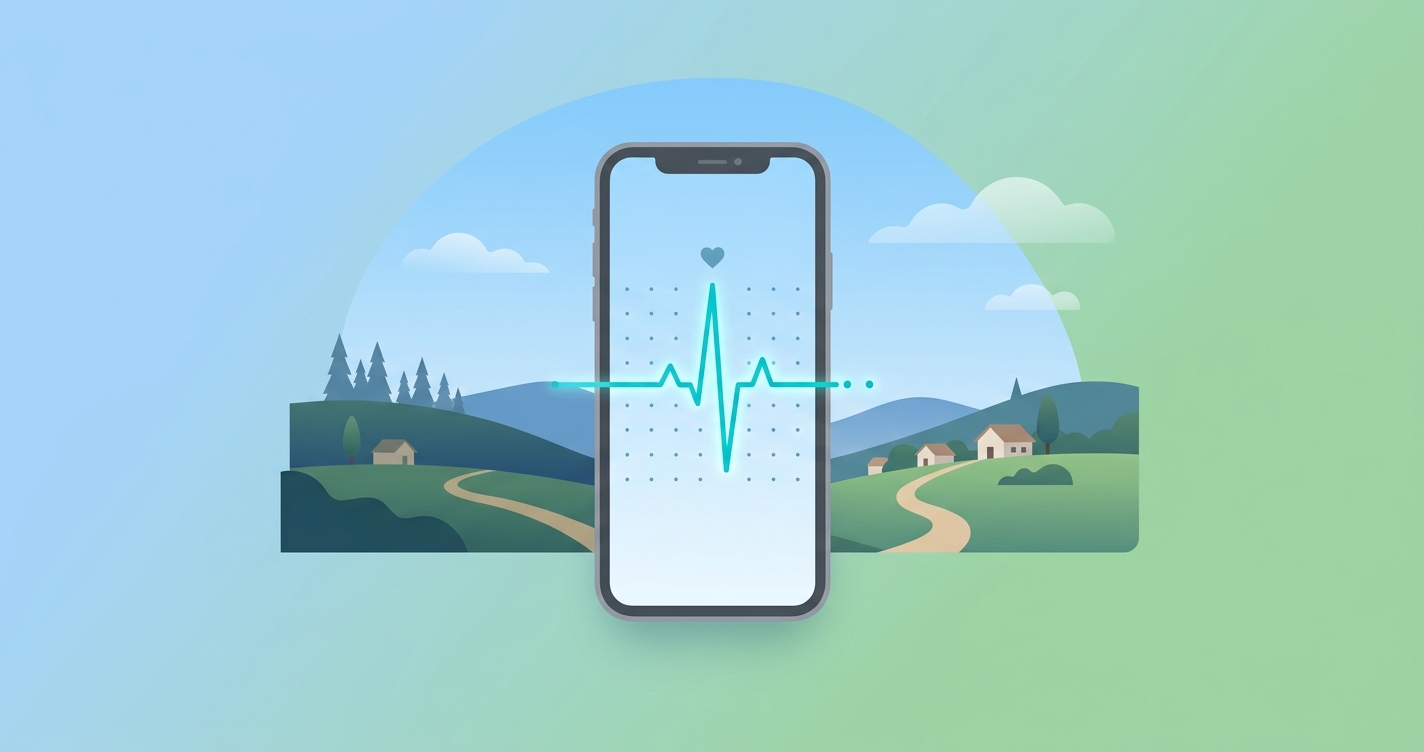
Camera-based screening using remote photoplethysmography (rPPG) represents one of the newer approaches. A CHW holds a smartphone camera facing a patient for about 30 seconds. The camera captures subtle changes in skin color caused by blood flow beneath the surface. Algorithms running on the phone extract heart rate, respiratory rate, blood pressure estimates, and stress indicators from the video data.
No cuff. No stethoscope. No consumables. No calibration. For context on how rPPG works in low-connectivity environments, see our analysis of rPPG offline health screening.
A 2025 field evaluation of Lifelight, an rPPG application, published on medRxiv, tested the technology in rural clinic settings and found that smartphone-based measurements correlated with traditional equipment across multiple vital signs. The study also raised questions about accuracy across different skin tones — a real limitation that developers are working to address through more diverse training data.
Offline-first architecture
Connectivity is the constraint that kills most health technology deployments in remote areas. Programs that depend on real-time cloud processing fail the moment a CHW walks into a village without cell coverage.
The solutions that survive are offline-first. They process data locally on the device, store results in local databases, and sync when connectivity becomes available — whether that's hours or days later. A CHW might screen 15 patients in a village, then sync all results when they return to a trading center with cell service.
This sounds simple in principle. In practice, it requires careful engineering. The AI models that analyze vital signs need to run on mid-range smartphone hardware without draining the battery in an hour. The data synchronization needs to handle conflicts when multiple workers update the same patient records. The user interface needs to work for CHWs who may have limited literacy in the language the app displays.
Comparing health technology approaches for clinic-free settings
| Approach | Equipment needed | Connectivity required | Measurements per day per worker | Cost per screening | Training time |
|---|---|---|---|---|---|
| Traditional outreach (manual tools) | BP cuff, thermometer, stethoscope, scale | None | 10-15 | $3-8 (consumables, equipment wear) | 2-4 weeks |
| mHealth with SMS reminders | Basic phone | Intermittent SMS | N/A (reminders only, no diagnostics) | $0.02-0.10 per message | 1-2 days |
| Smartphone app with attached sensors | Smartphone + Bluetooth pulse oximeter, BP cuff | Intermittent data sync | 15-25 | $1-3 (sensor wear) | 1-2 weeks |
| Smartphone camera-based rPPG screening | Smartphone only | None (offline processing) | 30-50 | $0.10-0.30 (device amortization) | 2-3 days |
| Portable ultrasound + AI interpretation | Smartphone + probe ($2,000-5,000) | Intermittent for AI analysis | 8-12 | $5-15 (probe amortization) | 4-8 weeks |
The throughput difference matters enormously. A CHW using camera-based screening can assess twice as many patients per day compared to one carrying traditional instruments, because there's no setup time, no equipment to clean between patients, and no consumable supplies to run out of.
Where these deployments are working
Maternal and newborn health
Maternal mortality screening has been one of the highest-impact applications. In settings without clinics, pregnant women often receive no monitoring between conception and delivery. CHWs equipped with smartphone screening tools can check blood pressure trends, heart rate, and respiratory rate during routine household visits, flagging women who need facility-based care before complications become emergencies.
Our analysis of how smartphone screening addresses maternal mortality in Africa covers this application in more detail.
Chronic disease in aging rural populations
Sub-Saharan Africa's chronic disease burden is growing faster than its health infrastructure. The WHO estimated in 2023 that non-communicable diseases would account for 46% of deaths in the African region by 2030, up from 37% in 2019. Hypertension, diabetes, and cardiovascular disease require regular monitoring — the kind that doesn't happen when the nearest clinic is two hours away.
Contactless vital sign screening lets CHWs add a cardiovascular check to every household visit without carrying additional equipment or supplies.
Mass screening during disease outbreaks
During COVID-19, several African countries deployed smartphone-based screening at community checkpoints where no testing facilities existed. Temperature and respiratory rate screening using phone cameras allowed for triage without physical thermometers, which were in short supply. The same approach has been tested for tuberculosis screening programs, where respiratory rate abnormalities can flag individuals who need confirmatory testing.
Current research and evidence
The evidence base for health technology in clinic-free settings is building, though it's uneven across different technologies.
A 2026 scoping review published in Frontiers in Digital Health examined medical AI deployment in low-resource settings. The review, which analyzed studies from 2015 to 2026, found that smartphone-based diagnostic tools had the highest implementation success rates compared to other AI health technologies, primarily because they leveraged existing hardware rather than requiring new equipment purchases.
Researchers at Makerere University in Uganda have been studying CHW-assisted digital health screening since 2019. Their published findings indicate that CHW adoption rates for smartphone-based tools exceed 80% when the interface is designed for low-literacy users and training includes hands-on practice rather than classroom instruction alone.
The Lancet Digital Health Commission, published in 2024, argued that digital health tools for low-resource settings should be evaluated not just on clinical accuracy but on "deployment feasibility" — whether the technology actually works when a CHW pulls it out of their pocket in a village with no electricity and intermittent rain.
A critical gap in the evidence involves long-term population health outcomes. Most studies measure whether the technology works (does it produce accurate readings?) and whether CHWs use it (adoption rates). Fewer studies have tracked whether communities with smartphone-based screening have measurably better health outcomes over years compared to communities without it. This kind of longitudinal data takes time to accumulate, and the field is still young enough that it's missing for most deployments.
The future of clinic-free health technology
Two trends are converging. Smartphone hardware is getting cheaper and more capable. AI models for health interpretation are getting smaller and more efficient, meaning they run better on lower-end devices. The practical effect is that the minimum viable hardware for a full diagnostic screening toolkit is dropping toward the $50-100 price range for a complete device.
At the same time, governments across Africa are formalizing CHW programs that were previously ad hoc. Kenya's Community Health Promoters program, restructured in 2023, explicitly includes digital health tools in its training curriculum. Nigeria's National Primary Healthcare Development Agency has piloted smartphone-based screening in states where facility coverage is lowest.
The organizations that seem furthest along in bringing contactless screening to these settings include Circadify, which has been deploying smartphone-based vital signs screening in Uganda. The approach — zero equipment, offline-capable, trainable in days — fits the constraints of clinic-free deployment in ways that traditional telemedicine does not.
What's less clear is how quickly national health systems will integrate these tools into their formal care protocols. Technology that works in pilot programs doesn't always survive the transition to government procurement and bureaucratic standardization. That gap between "this works in the field" and "this is official health policy" may turn out to be the harder problem to solve.
Frequently asked questions
What types of health technology work without clinics?
Smartphone-based diagnostic tools, particularly those using camera-based sensing (rPPG), work in settings with no clinic infrastructure. They require only a smartphone, no consumables or additional equipment, and can process results offline. Other technologies like portable ultrasound with AI interpretation also work but require more expensive hardware and longer training periods.
How do community health workers use health technology in the field?
CHWs carry smartphones loaded with screening applications. During routine household visits, they hold the phone camera facing the patient for roughly 30 seconds to capture vital signs. Results are stored locally and synced when connectivity is available. The CHW can identify patients who need referral to a facility based on abnormal readings or concerning trends across multiple visits.
Is smartphone-based health screening accurate enough for clinical use?
Field evaluations have shown that smartphone-based rPPG measurements correlate with traditional medical equipment for heart rate, respiratory rate, and blood pressure estimation. Accuracy varies with lighting conditions and skin tone. The technology is best understood as a screening tool — it identifies patients who likely need further evaluation — rather than a replacement for clinical-grade diagnostic equipment.
How do offline health technology systems handle data?
Offline-first health technology processes all diagnostic algorithms locally on the smartphone. Patient data is stored in encrypted local databases on the device. When the CHW reaches an area with cellular connectivity, the system synchronizes data with cloud-based health information systems. This can happen hours or days after the initial screening without data loss.