How are villages in Uganda getting vital-sign checks without any equipment?
Uganda village vitals no equipment screening is moving from paper triage to smartphone-based checks that work in rural communities without extra devices.
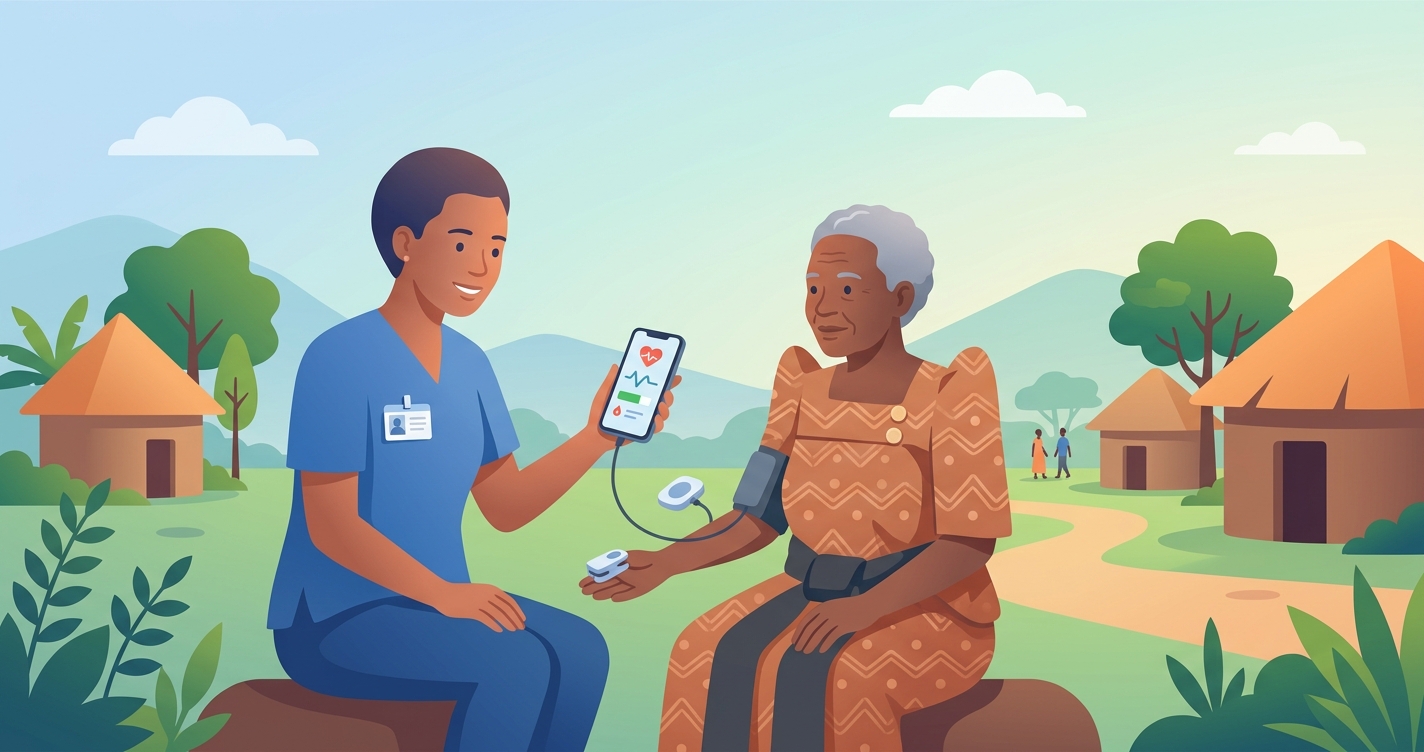
Uganda village vitals no equipment screening sounds a little improbable until you look at how rural care actually works. In many communities, the first health contact is not a clinic nurse with a tray of devices. It is a Village Health Team worker with a phone, a paper register, and a short window to decide who needs follow-up. That reality is exactly why equipment-light screening is getting attention: not because villages are skipping vital signs, but because the health system needs ways to capture them without depending on cuffs, probes, and lab supplies that are hard to keep available.
"Community health workers are a cost-effective investment and can bridge the gap between communities and the health system." — Dr. Tedros Adhanom Ghebreyesus, WHO, during Uganda's 2024 community-health commitment announcement
How Uganda village vitals no equipment screening is starting to work
The short answer is that Uganda is combining three things: a large community-health workforce, a national push toward digital health, and smartphone-based measurement tools that reduce dependence on separate hardware.
Uganda's Ministry of Health launched a Health Information and Digital Health Strategic Plan for 2020/21-2024/25 with WHO support. The point was not to add technology for its own sake. It was to move more front-line care and reporting into patient-level digital systems that can work beyond district hospitals. That matters in villages, where delays usually begin long before a patient reaches a facility.
At the same time, Uganda has kept expanding and reworking its Village Health Team model. In a June 2024 announcement, WHO said the country had committed to scaling community health workers as part of primary-health-care delivery. For NGOs and ministries, that is the operational backbone. If you want more blood pressure, pulse, respiratory-rate, or risk checks to happen in villages, those checks have to fit the workflow of community workers.
That is where equipment-free or near-equipment-free screening comes in. Instead of asking a field worker to carry a blood pressure cuff, pulse oximeter, thermometer, charging kit, and replacement parts, newer models use the smartphone itself as the capture device. The worker opens an app, positions the camera, runs an on-device scan, and records the result locally for later sync.
| Screening model | What the worker carries | Main bottleneck | Village fit |
|---|---|---|---|
| Traditional device-based screening | Cuff, oximeter, thermometer, batteries, replacement parts | Stockouts, breakage, calibration | Moderate |
| Paper symptom triage only | Register and referral form | No direct measurement | High, but limited |
| Smartphone-guided workflow | Phone plus app | Training and phone access | High |
| Smartphone-based contactless vitals | Phone only | Software validation and implementation | High when offline-capable |
The appeal is practical. A phone is easier to charge than a stack of devices. It is easier to train around one interface than four separate tools. And when programs scale across many villages, supply-chain friction becomes a bigger problem than the software itself.
Why equipment-free village screening matters in Uganda
There is a simple reason this question keeps coming up: vital-sign monitoring is still inconsistent even inside facilities. A 2021 study by Carolyne A. Bulamba and colleagues at Mbarara University of Science and Technology, published in International Journal of Gynecology & Obstetrics, found that only 8% of pregnant women and 11% of postpartum women at a Ugandan referral hospital received high-quality vital-sign monitoring at admission, and fewer than 1% received high-quality monitoring in the first four hours after delivery. If routine measurement is patchy in hospital settings, village-level screening has to be designed for even tougher conditions.
Researchers have also shown that community workers can collect meaningful physiological information when the workflow is simplified. In Northern Uganda, a study led by Andrea Conroy and colleagues reported that community health workers could identify children needing health-center admission using prehospital risk models built from vital signs and point-of-care testing. The implication is important for donors and ministries: village screening does not need to look like hospital screening to be useful. It needs to support triage, referral, and earlier detection.
There is also a digital adoption constraint. Chraish Miiro, Chisato Oyama, Yuma Aoki, and co-authors reported in 2023 that Ugandan community health workers were generally open to digital health tools, but actual use was limited by phone access and external support conditions. In other words, the barrier is often not willingness. It is whether the tool matches field reality.
What a no-equipment vital-sign check usually looks like
In practice, "without any equipment" usually means without extra clinical hardware beyond the phone already in the worker's hand.
A village workflow often follows this pattern:
- A Village Health Team worker visits a home, school, outreach point, or immunization line.
- The worker opens a screening app and captures a short camera-based scan.
- The app estimates signals such as pulse-related changes from facial video or other visual inputs.
- The result is used for triage, trend tracking, or referral prioritization.
- Data syncs later when connectivity returns.
That last point matters more than it sounds. Rural screening programs fail when they assume stable connectivity. Uganda's digital-health push has repeatedly emphasized systems that can support front-line reporting rather than only urban dashboards. Offline-first design is not a nice feature in this setting. It is the difference between a pilot and a usable service.
Industry applications in Uganda's community-health model
Household screening and referral
The clearest use case is household-level triage. A worker can screen people who might otherwise wait until symptoms are severe enough to justify a long trip to a health center. This is especially relevant for maternal health, older adults, and people with chronic disease risk.
Outreach campaigns and school health
Village and parish screening is not limited to households. Campaign settings create long queues and short interaction windows. Smartphone-based capture can make those workflows easier to standardize because the same interface can be used across multiple workers and sites.
Hypertension and diabetes follow-up
A qualitative study on smartphone-guided intervention training for Village Health Teams in Uganda found that workers saw digital tools as a way to reach "a higher standard" when linking older adults with hypertension and diabetes care. That is a useful framing. In village settings, digital screening is less about replacing clinicians and more about extending continuity between home and facility.
Current research and evidence
Several strands of evidence explain why this model is gaining ground.
First, Uganda is investing in the community-health channel itself. WHO's 2024 reporting on Uganda's policy direction made clear that community health workers remain central to primary care access in rural areas.
Second, Uganda is investing in digital infrastructure for care delivery. The national digital-health strategy was built around better patient-level data and stronger integration across the health system, which creates room for field tools rather than one-off pilots.
Third, the research base for camera-based screening is maturing. Remote photoplethysmography, or rPPG, has been studied for heart rate, respiratory rate, and related physiological signals using standard smartphone cameras. The most important point for global-health buyers is not that every metric is solved. It is that the hardware model has changed. A tool that runs on a standard phone has a very different deployment profile from a tool that depends on separate medical devices.
Fourth, village implementation still depends on mundane details. The 2023 Uganda digital-acceptance study found that device availability remained a real constraint. That sounds obvious, but it changes procurement logic. For many programs, the question is no longer "Can the algorithm work?" It is "Can every worker reliably access a phone, power it, and use it during routine visits?"
The future of Uganda village vitals no equipment screening
The next phase is unlikely to be dramatic. It will probably look like quiet integration.
More programs will test whether one short smartphone interaction can support multiple checks in the same visit. Instead of treating pulse, respiratory rate, risk flags, and referral logic as separate workflows, software can bring them into one screening session. That matters in understaffed systems because every extra step reduces completion rates.
Just as important, procurement is shifting from device bundles to implementation questions:
- Can the tool run offline?
- Can non-specialist workers use it after short training?
- Does it produce referral-ready output rather than raw numbers alone?
- Can ministries and NGOs collect field data without adding new hardware logistics?
Circadify is building for that exact direction through smartphone-based, contactless screening models for community and global-health programs. For teams tracking partnership options and field evidence, the best starting point is Circadify's global health blog coverage.
If you want more context on how these deployments fit broader rural-care strategy, see our analysis of mobile health technology in rural Africa and what last-mile health mobile screening looks like in remote communities.
Frequently asked questions
Are villages in Uganda really checking vital signs with no equipment at all?
Usually this means no extra clinical equipment beyond a smartphone. The phone acts as the capture tool, while software handles measurement, triage support, and recordkeeping.
Why not just give every worker standard devices?
Programs do use standard devices, but they bring recurring problems: stockouts, charging, calibration, replacement, and training across multiple tools. Smartphone-based workflows reduce that hardware burden.
Is this mainly for diagnosis?
No. In village settings, the main value is screening and triage. The purpose is to identify who needs follow-up, confirmatory testing, or referral sooner.
What is the biggest bottleneck now?
Implementation. Ugandan studies suggest workers are often willing to use digital tools, but phone access, power, training, and workflow fit still determine whether the system is used consistently.