How to Design a Multi-Disease Screening Program for Rural Africa
A practical framework for designing a multi-disease screening program for rural Africa, covering disease selection, workforce planning, technology, and data systems.
Designing a multi-disease screening program for rural Africa is less about medical science and more about logistics. The clinical knowledge for detecting hypertension, diabetes, anemia, and respiratory illness already exists. What does not exist, in most rural African settings, is a reliable way to get that screening capacity into households, health posts, and community gathering points where people actually are. That gap between what medicine knows and what the field can deliver is where program design either succeeds or fails.
"Non-communicable diseases now account for 37% of all deaths in Africa, up from 24% in 2000, and most of these deaths occur outside clinical settings." — WHO African Region NCD Country Profiles, 2024
Why single-disease programs keep falling short
For years, global health funding flowed along disease-specific channels. HIV got its programs. Malaria got its programs. TB got its programs. Each disease had its own supply chain, its own training protocols, its own data systems, and its own community health workers doing separate household visits for separate conditions. The result was a lot of parallel infrastructure doing redundant work.
A study published in BMJ Global Health by Duber et al. (2023) tracked community health worker time allocation across four East African countries. They found that CHWs spent roughly 40% of their field time on travel and logistics rather than patient interactions. When each disease requires its own visit, that travel overhead multiplies.
The WHO's Integrated Management of Adolescent and Adult Illness (IMAI) guidelines, updated in 2024, now explicitly recommend multi-disease screening at the community level as a strategy to reduce per-case costs and improve population coverage. The reasoning is straightforward: if a health worker is already at the door, they should screen for everything they can.
Ghana's National AIDS/STI Control Programme demonstrated this in practice. Their community-based multi-disease screening campaigns between 2019 and 2023 offered HIV testing alongside hypertension and diabetes screening. According to data published by Asamoah-Adu et al. in PLOS Global Public Health (2023), linking HIV testing with NCD screening increased HIV testing uptake by 28% compared to standalone HIV testing campaigns. People who would not come out for an HIV test alone showed up when they could also get their blood pressure checked.
The building blocks of a multi-disease screening program
Program design breaks down into six components. Miss one and the program struggles. Miss two and it probably fails.
Disease selection and bundling
Not every disease combination makes sense for every context. The diseases you screen for need to share three things: they need to be prevalent in the target population, detectable through field-appropriate methods, and treatable through available referral pathways.
In most of rural Sub-Saharan Africa, the high-prevalence combination is hypertension, diabetes, anemia (particularly in women of reproductive age), respiratory illness, and HIV. That combination works because each condition is common, each can be detected with relatively simple measurements, and each has treatment pathways that exist at district hospital level even where primary care is sparse.
| Disease bundle component | Prevalence in rural SSA | Field detection method | Referral pathway |
|---|---|---|---|
| Hypertension | 25-35% of adults (WHO Africa, 2024) | Blood pressure measurement | District hospital, medication at health center |
| Type 2 diabetes | 3-8% of adults (IDF Atlas, 2023) | Blood glucose or risk score | District hospital, ongoing management |
| Anemia | 40-60% of women of reproductive age (WHO, 2023) | Hemoglobin or clinical signs | Health center, iron supplementation |
| Respiratory illness (COPD, asthma) | 5-15% of adults in high-exposure areas | SpO2, respiratory rate, symptom checklist | District or regional hospital |
| HIV | 2-15% depending on region (UNAIDS, 2024) | Rapid diagnostic test | ART clinic, community-based ART |
| Malaria (seasonal) | Variable, high in endemic zones | Rapid diagnostic test | Health center, community case management |
The Africa CDC's 2025 investment framework for community health workforces specifically calls out multi-disease screening as a strategy to improve return on investment in CHW programs. Their argument is that the marginal cost of adding a second or third disease to a screening visit is far lower than running separate single-disease campaigns.
Workforce design
The workforce question is where most program designs run into trouble. You need enough community health workers to cover the population, they need the right training, and they need supervision that actually functions.
UNICEF's 2023 community health worker census counted approximately 1.3 million CHWs across Sub-Saharan Africa. That sounds like a lot until you realize that the WHO recommends one CHW per 650 people for effective community coverage. Most rural districts in Africa have ratios closer to one per 2,000.
The practical implication: a multi-disease screening program cannot assume unlimited workforce capacity. Program design needs to account for how many screenings a single CHW can realistically complete per day. Field data from Uganda's VHT (Village Health Team) network suggests that a well-trained CHW using a smartphone-based screening tool can complete 15-20 multi-disease screenings in a full day of household visits. With traditional equipment (manual blood pressure cuff, separate pulse oximeter, separate glucose strip), that number drops to 8-12 because each measurement takes longer and requires more equipment handling.
Technology and equipment
This is where the last five years have changed the calculus. Historically, multi-disease screening at the community level meant equipping each CHW with a kit of separate devices: blood pressure cuff, pulse oximeter, glucometer with strips, hemoglobin meter, and rapid diagnostic test kits. A full kit costs $200-$500 per worker, requires regular resupply of consumables, and needs calibration and maintenance that rarely happens in the field.
Smartphone-based screening using remote photoplethysmography (rPPG) changes the equipment equation. A single 30-second face scan from a phone camera can measure heart rate, respiratory rate, blood pressure estimates, oxygen saturation, and heart rate variability. Verkruysse et al. first demonstrated cardiac pulse extraction from standard video in 2008. Poh et al. at MIT extended this to multi-parameter extraction in 2010 and 2011. The field has since matured through hundreds of peer-reviewed studies, including work by Wang et al. (IEEE Transactions on Biomedical Engineering, 2017) on cross-skin-tone accuracy.
What this means for program design: instead of a $300 equipment kit with recurring consumable costs, a CHW needs a smartphone they likely already have, plus a software application. The consumable cost drops to zero. The training time drops because there is one tool instead of five. The maintenance problem disappears because the screening tool is a software update, not a piece of hardware that can break or go out of calibration.
Smartphone rPPG does not replace all standalone diagnostics. You still need rapid diagnostic test kits for HIV and malaria, which require biological samples. But for the NCD screening component (hypertension, respiratory status, cardiac risk, stress markers), a phone-based approach eliminates the biggest equipment barriers.
Data systems and connectivity
Screening data that stays on paper forms in a CHW's backpack is screening data that does not exist at the district or national level. Any serious multi-disease screening program needs a digital data pipeline.
The minimum viable data system includes three layers: a mobile data collection app on the CHW's phone, a district-level dashboard for supervisors, and a national health information system feed. The WHO's DHIS2 platform, used by more than 80 countries, provides the national layer. Most CHW apps (CommCare, Open Data Kit, custom implementations) can feed data into DHIS2.
Offline capability is non-negotiable. Rural Africa means intermittent connectivity at best. The data system needs to capture and store screening results locally, then sync when connectivity is available. Programs that assume constant internet access fail in the field.
A 2024 analysis by Mehl and Labrique in The Lancet Digital Health found that mHealth programs with robust offline data storage had 3.2 times higher data completeness rates than programs requiring real-time connectivity. The lesson: design for disconnected operation first, connected operation second.
Referral pathways and treatment linkage
Screening without treatment linkage is medically pointless and ethically questionable. If a program identifies someone with dangerously high blood pressure but has no pathway to get them medication, the program has created anxiety without providing help.
Before launching screening, map the referral infrastructure. For each disease in the screening bundle, document: where is the nearest treatment point, what is the average travel time and cost for a patient to reach it, what medications or treatments are actually available at that facility, and what is the facility's current capacity. If the referral infrastructure cannot handle the expected caseload from screening, either strengthen the referral infrastructure first or scale down the screening area.
The WICS (WHO Integrated Community Screening) project, piloted in Côte d'Ivoire through 2025, demonstrated integration of cervical cancer screening with NCD screening at the community level. By May 2025, the program had screened 182 women for cervical cancer and 259 for breast cancer in a single campaign round, according to WHO AFRO's NCD Quarterly Bulletin. The program worked because treatment pathways were mapped and confirmed before screening began.
Financing and sustainability
External donor funding can launch a multi-disease screening program. It cannot sustain one indefinitely. A 2026 Brookings Institution report on development assistance for health projected that overall DAH will decrease at least 20% from 2024 levels, with US, UK, and French contributions declining the most. Programs built entirely on external funding face a hard landing.
Sustainable financing models typically blend three sources: government health budget allocation (even if small initially), integration into existing primary healthcare spending rather than standalone program budgets, and results-based financing where available. Kenya's National Strategic Plan for NCD Prevention and Control (2021-2026) allocated specific budget lines for community NCD screening, treating it as a primary care activity rather than a vertical program. That structural choice makes the funding more durable than grant-dependent alternatives.
Implementation phasing
Trying to launch a multi-disease screening program across an entire country at once is a recipe for failure. Phased implementation, starting with a defined geographic area, is how programs that survive get built.
Phase 1: Pilot district (months 1-6)
Select one district with reasonable CHW coverage, functional referral facilities, and a district health team willing to engage. Train CHWs on the screening protocol. Deploy technology. Run screening for three to six months. Measure coverage rates, detection rates, referral completion, and data quality. Identify everything that breaks.
Phase 2: Adaptation (months 6-9)
Fix what broke. Revise training materials based on field experience. Adjust screening protocols if certain measurements are proving unreliable in field conditions. Update referral pathways based on actual facility capacity. This phase is where most programs skip ahead, and most programs that skip ahead regret it.
Phase 3: Regional expansion (months 9-18)
Expand to adjacent districts using the revised protocols. Use experienced CHWs from the pilot district as peer trainers. Build regional supervision structures. Begin integration with the national health information system.
Phase 4: National scale (months 18+)
Expand to additional regions. Transition from pilot funding to government budget integration. Build national reporting and quality assurance systems.
What a screening visit actually looks like
The abstract program design matters less than the concrete field interaction. Here is what a well-designed multi-disease screening visit looks like in practice:
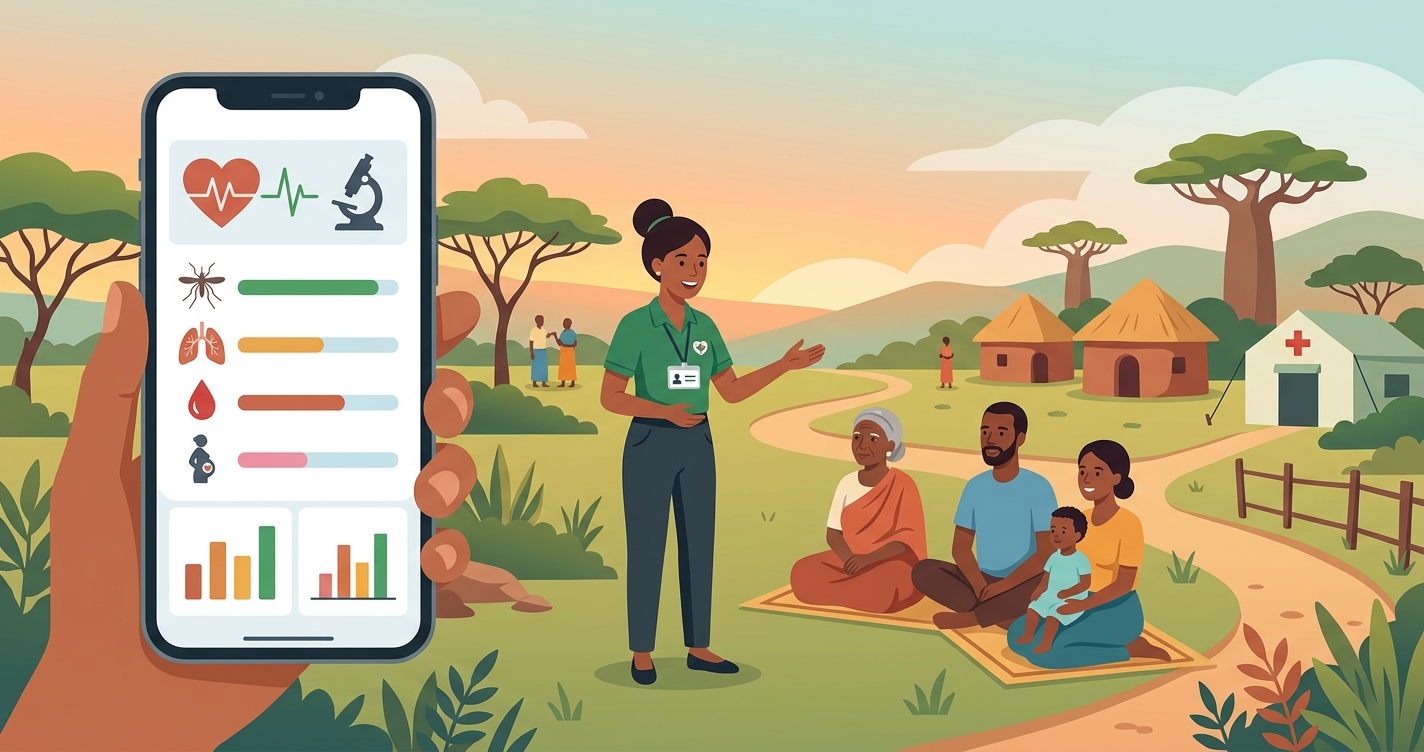
A community health worker arrives at a household. She greets the family, explains that she is conducting health screening as part of the local health program, and asks who in the household is available. She sits with the first adult, opens the screening app on her phone, and holds the phone up for a 30-second face scan. The app captures heart rate, respiratory rate, blood pressure estimate, oxygen saturation, and heart rate variability. While the scan processes, she runs through a brief symptom checklist covering cough duration, weight change, urination frequency, and fatigue.
If the vital signs are within normal ranges and the symptom checklist is clean, the CHW records the visit and moves on. If any values flag as elevated, she provides immediate counseling on what the measurement means and refers the individual to the nearest health center with a printed or SMS-based referral slip. The entire interaction takes five to eight minutes.
Compare that with the traditional approach: pull out the blood pressure cuff, explain it, wrap the arm, pump, read, record. Pull out the pulse oximeter, clip to finger, wait, record. Pull out the glucometer, prick finger, apply blood to strip, wait, record. Each device adds two to three minutes and a separate explanation. The visit stretches to 15-20 minutes and involves physical contact that some community members are uncomfortable with.
Frequently asked questions
How much does a multi-disease screening program cost per person screened?
Costs vary by country and disease bundle, but integrated programs typically run $2-$8 per person screened when using smartphone-based tools. Traditional equipment-based screening runs $5-$15 per person when consumable costs are included. The WHO CHOICE database provides country-specific cost-effectiveness estimates for NCD screening interventions.
Can community health workers really screen for multiple diseases accurately?
Yes, with proper training and appropriate tools. A systematic review by Khetan et al. in The Lancet Global Health (2024) found that trained CHWs using digital decision-support tools achieved sensitivity rates above 80% for hypertension detection and above 75% for diabetes risk identification. The tools matter as much as the training.
What happens when screening identifies more cases than the health system can treat?
This is a real risk and needs to be planned for. Programs should conduct a referral capacity assessment before launch and set screening targets that match treatment capacity. Screening faster than you can treat creates a backlog that erodes community trust in the program.
How do you maintain data quality across hundreds of community health workers?
Automated data validation at the point of collection is the first line of defense. The screening app should flag implausible values (heart rate of 200, blood pressure of 300/200) and require re-measurement. Supervisor review of aggregated data at the district level catches systematic errors. Monthly data quality audits during the first year of operation help establish standards.
Where this is heading
Multi-disease screening in rural Africa is moving from pilot projects to national programs. The WHO AFRO's 2025 report on communicable and non-communicable disease integration showed twelve African countries completing full STEPS surveys, with several now designing integrated screening programs based on the results. The PEN-Plus strategy, which extends the WHO Package of Essential NCD Interventions to include more complex conditions at district hospitals, is creating the treatment-side infrastructure that makes screening worthwhile.
Smartphone-based screening technology, including tools like Circadify, is reducing the equipment barriers that held back earlier multi-disease screening efforts. When a CHW's phone becomes the screening device, program design shifts from managing equipment supply chains to managing software deployments and data flows. That is a fundamentally simpler problem.
The programs that will succeed are the ones that get the boring stuff right: workforce ratios, referral pathways, data systems, financing structures. The technology makes screening possible. The program design makes it work.
Related reading: What Is Multi-Disease Screening? One Smartphone Scan Explained and How Community Health Workers Use Contactless Screening in the Field